How to Assess Hair Elasticity Before Chemical Services: Professional Stylist Guide
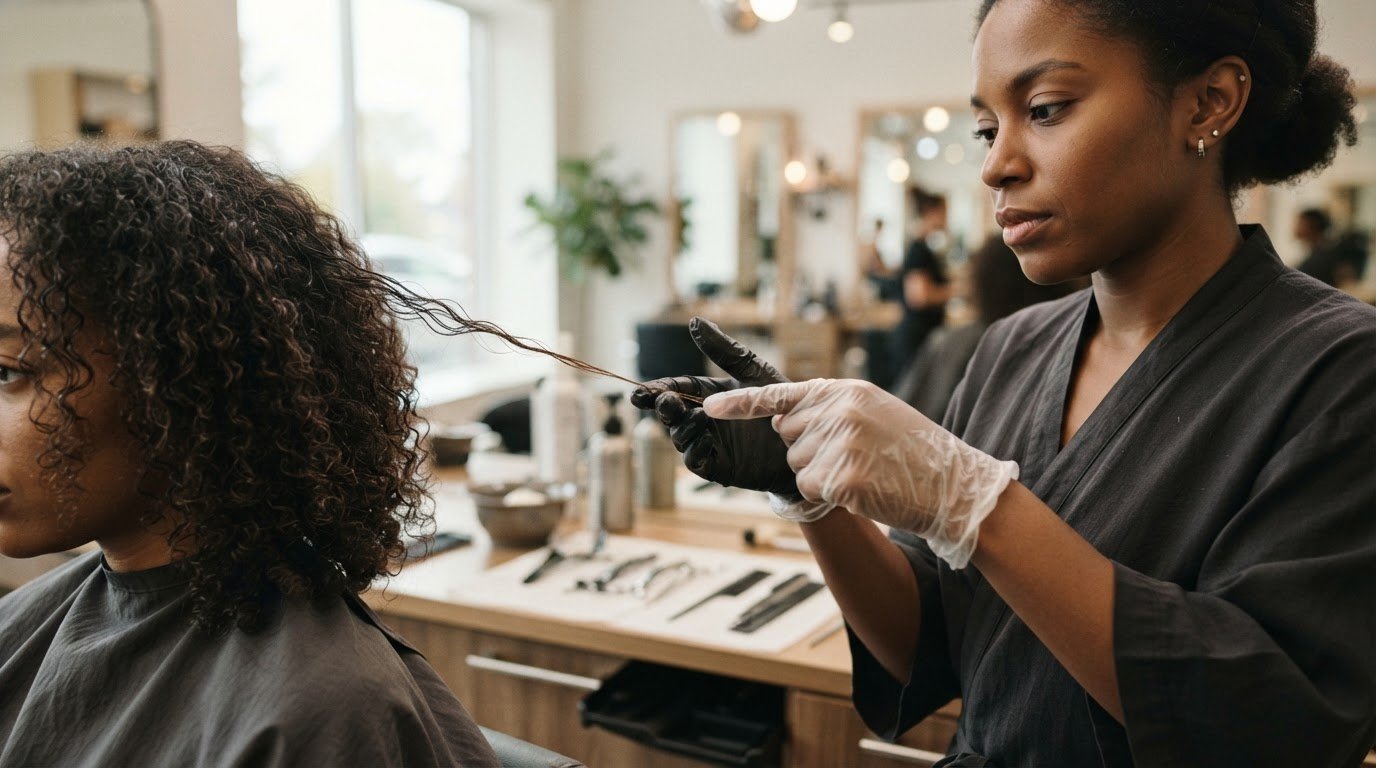
A client’s chemical history is rarely completely transparent, but the internal cortex never lies. Every professional stylist knows the quiet tension of applying lightener or relaxer over strands with an ambiguous past. Learning how to assess hair elasticity before chemical services is your strongest chairside defense against sudden strand melting, catastrophic breakage, and unexpected service liabilities.
You already know that relying solely on visual inspection or client memory leaves your artistry vulnerable at the shampoo bowl. In this guide, you’ll master an objective protocol for evaluating hair tensile strength so you can formulate safely and protect structural integrity every single time. We’ll establish an efficient 60-second diagnostic routine, detail how to read wet versus dry stretch responses with clinical accuracy, and show you how to confidently prescribe restorative backbar therapies when hair fiber is severely compromised.
Key Takeaways
- Mastering how to assess hair elasticity before chemical services protects clients from irreversible structural breakage and helps you formulate with precision.
- A standardized 60-second diagnostic protocol evaluates internal disulfide integrity by isolating small, damp ribbons from high-risk processing zones.
- Reading snap-back rates versus gummy over-extension allows you to immediately classify hair into actionable formulation tiers.
- Failing strands require an immediate triage protocol focusing on lipid and ceramide rebalancing rather than blind protein loading.
- Implementing consistent pre-service tensile evaluations across your salon team establishes transparent client boundaries and safeguards salon reputation.
Understanding Hair Elasticity and Its Role in Chemical Services
Hair elasticity is the physical ability of the cortex to stretch under mechanical tension and return to its original resting length without snapping. Knowing how to assess hair elasticity before chemical services gives colorists an objective measure of structural strength. While heavy glosses and silicone conditioners can mimic healthy texture, surface smoothness does not equal internal protein integrity. Applying alkaline lighteners or straighteners to a strand with compromised elasticity directly invites catastrophic chemical breakage at the shampoo bowl.
The Molecular Architecture: Keratin, Disulfide Bonds, and the Cortex
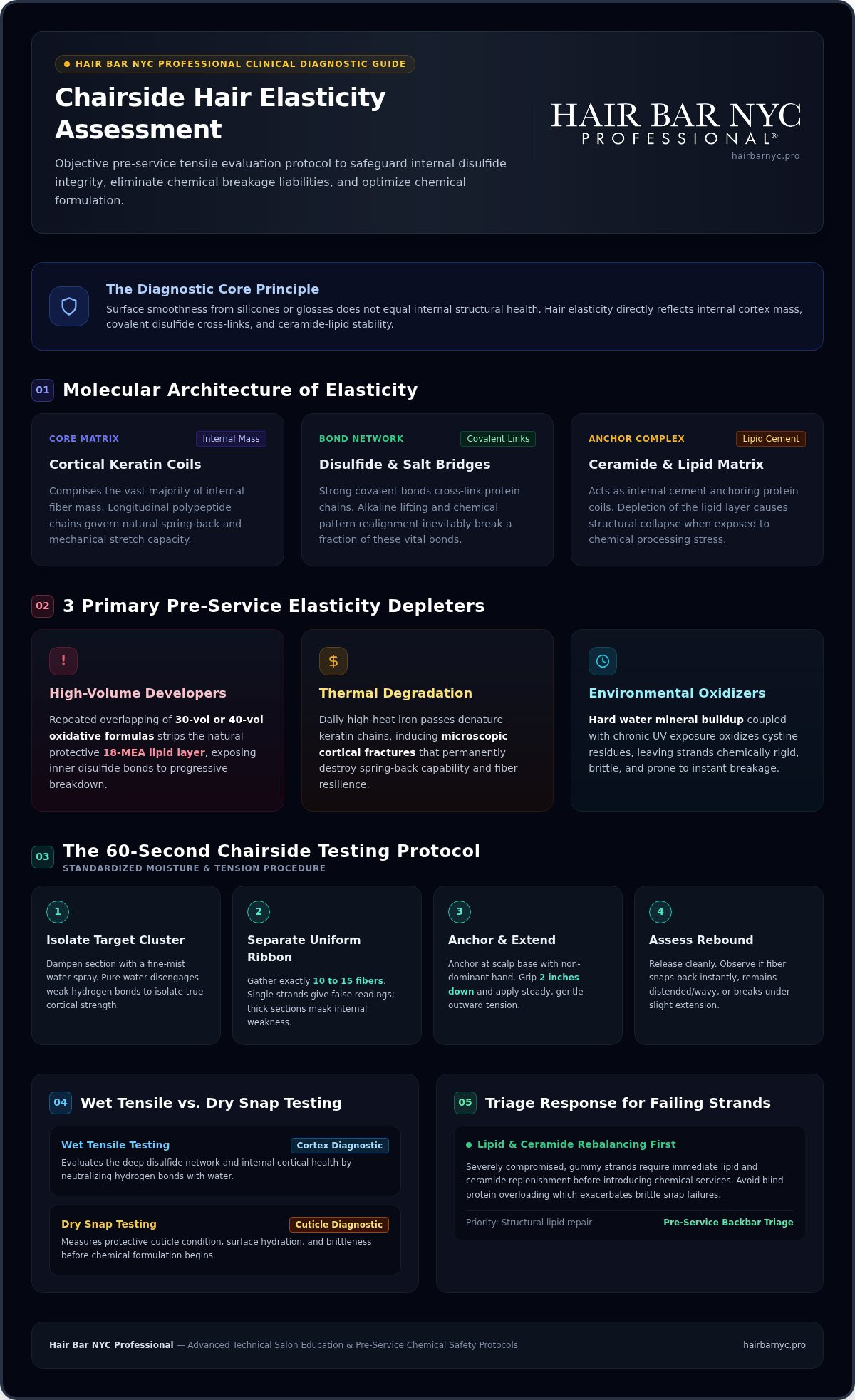
The cortex comprises the vast majority of the hair shaft’s interior mass, housing longitudinal polypeptide chains bound together by strong covalent disulfide bonds, ionic salt linkages, and hydrogen bridges. In natural hair structure, these cross-linked keratin coils govern spring-back response and tensile strength. When alkaline chemicals penetrate the outer cuticle layer, they inevitably break a percentage of these disulfide bonds to lift natural pigment or rearrange fiber pattern. If the cortex lacks the essential lipid complex and ceramide cement required to anchor these chains, the entire protein matrix degrades under processing stress.
Primary Factors That Deplete Elasticity Before Clients Reach Your Chair
Most salon guests arrive with underlying protein fatigue caused by daily lifestyle habits and past salon appointments. Three primary culprits routinely strip tensile strength before you ever begin an application:
- Cumulative High-Volume Developers: Repeated overlapping of 30-volume or 40-volume oxidative formulas strips the protective 18-MEA lipid layer, leaving internal bonds vulnerable to environmental degradation.
- Thermal Degradation: Daily mechanical styling and high-heat iron passes denature keratin proteins, causing microscopic cortical fractures that destroy natural spring-back.
- Environmental Oxidizers: Mineral buildup from hard water, combined with chronic ultraviolet radiation, oxidizes cystine residues and leaves strands rigid and brittle.
Because these hidden stressors deplete internal resilience, learning how to assess hair elasticity before chemical services is your essential checkpoint before formulating any color, lightener, or texture system.
Step-by-Step Chairside Protocol: How to Test Hair Elasticity Accurately
Executing a reliable diagnostic check requires more than grabbing random dry hairs and tugging until something breaks. When you evaluate tensile response, you need a controlled physical routine at the chair. Mastering how to assess hair elasticity before chemical services hinges on standardizing your strand count, moisture balance, and finger tension.
- Isolate a target strand cluster: Dampen a small subsection using a fine-mist spray bottle. Pure water temporarily opens weak hydrogen bonds, allowing you to gauge the true condition of the underlying protein matrix.
- Separate a uniform ribbon: Gather a precise ribbon of roughly 10 to 15 individual hair fibers. Testing a single isolated strand creates false readings due to individual fiber variation, while taking too thick of a section conceals internal fragility.
- Anchor and extend: Hold the base firmly against the scalp with your non-dominant thumb and index finger to avoid pulling the follicle. With your working hand, grip the strand roughly two inches down and gently stretch the fiber outward with steady, even pressure.
- Assess the rebound: Release the tension cleanly. Observe whether the hair returns to its starting point immediately, remains distended and wavy, or snaps under light extension.
Wet Tensile Testing vs. Dry Snap Testing
A wet stretch test isolates the internal cortex. Because water disengages temporary hydrogen connections, the hair must rely solely on its disulfide networks and cortical proteins. Dry snap testing serves a different purpose; it evaluates the condition of the protective cuticle layer and reveals surface brittleness. Performing both assessments gives you a complete structural profile, preventing formulation errors before you mix your bowl.
Diagnostic Zonal Mapping Across the Scalp
Damage rarely distributes evenly over a client’s head. Thermal tools, sun exposure, and prior application overlap create distinct zones of vulnerability that require individual testing:
- The Hairline and Temples: These delicate perimeter hairs have a smaller diameter, lower tensile resistance, and show processing fatigue first.
- The Crown and Apex: This zone absorbs intense friction, daily mechanical brushing, and concentrated heat from blow dryers and flat irons.
- The Porous Ends: Hair ends carry the historical record of every color change and oxidative service. Reviewing verified technical workflows highlights how consistent mechanical testing prevents cross-chemical damage on over-processed lengths.
When you encounter compromised fiber during your consultation, exploring salon-grade restorative solutions from Hair Bar NYC Professional provides reliable pathways to rebuild structural strength before proceeding with chemical processing.
Interpreting Elasticity Test Results: The Professional Diagnostic Matrix
Executing the mechanical stretch test is only half the consultation battle; interpreting the fiber’s feedback determines your entire chemical roadmap. When mastering how to assess hair elasticity before chemical services, you need clear parameters to translate physical tensile resistance into safe mixing ratios. Categorizing hair into three performance tiers removes guesswork at the dispensary scale.
High Elasticity (Normal): Formulating for Resilient Fiber
Healthy, intact hair stretches roughly 30% of its resting length when wet and contracts immediately to its natural formation without residual waviness. This spring-back confirms dense disulfide linkages and an intact lipid barrier. Hair exhibiting this profile clears all standard processing services, including high-lift blonding, permanent tinting, and keratin applications. For elevated technical formulation standards across modern color lines, reference the elite guide to professional hair color brands to pair resilient canvas states with premium pigments.
Medium Elasticity (Compromised): Restricting Alkalinity and Heat
Strands that stretch sluggishly, show slight distortion, or return only partially to baseline signal compromised structural integrity. The internal polypeptide coils have experienced minor cleavage, meaning aggressive alkaline swelling will induce breakage. When you encounter medium elasticity, adjust your chemical strategy immediately:
- Lower Developer Volumes: Drop from 30-volume to 10-volume or 20-volume to slow down oxidation and preserve existing cortex mass.
- Incorporate Bond Reinforcement: Integrate protective bond builders directly into lightener bowls to cross-link remaining protein chains during processing.
- Moderate Thermal Passes: Reduce iron heat below high thresholds during post-color styling or smoothing treatments to prevent denaturing fragile fibers.
Low or Zero Elasticity (Critical): Navigating the Service Refusal
Zero elasticity presents as either instantaneous snapping under slight tension or a gummy, sponge-like extension that fails to retract entirely. The structural disulfide bonds are severely depleted, leaving the fiber unable to tolerate alkaline shifts. When learning how to assess hair elasticity before chemical services, identifying this state requires an immediate halt to lightening, thio relaxers, and oxidative tinting.
Frame the conversation around fiber protection rather than failure. Tell the client: “Your hair cortex cannot support chemical lifting today without significant breakage. We’re going to pause processing and focus on rebuilding your fiber integrity first.” Setting clear boundaries protects your professional reputation while guiding the client toward targeted restorative care.
Triage Protocols: Restoring Elasticity Before Introducing Chemical Services
A failed stretch test should never end with a dead-end cancellation. Instead, it marks the beginning of a targeted recovery protocol. Understanding how to assess hair elasticity before chemical services allows you to pivot smoothly from chemical processing to structural rehabilitation. When hair snaps or over-extends without spring-back, introducing oxidative lighteners or high-pH systems is completely off the table. A mandatory restoration cycle must take place first.
Restoring Tensile Strength with Professional Ceramide Therapy
When cortex elasticity is severely compromised, the fiber requires lipid replenishment alongside structural reinforcement. Diamond Botox Hair Repair Treatment provides this exact backbar intervention, specifically formulated to restore elasticity in weakened or damaged hair. The formula utilizes Ceramide III combined with Meadowfoam seed oil to reconstruct the protective lipid barrier and improve tensile flexibility. Turnip Oilseed conditions and detangles fragile strands, while Vitamins E, B3, and B5 reinforce the fiber matrix to add natural shine and a smoother texture. Because one 20 ml ampule yields 3 to 4 applications and results last up to 5 weeks, it delivers a predictable, salon-controlled repair phase.
Balancing Moisture and Protein to Avoid Structural Brittleness
A common error when addressing low elasticity is overwhelming compromised hair with concentrated, unbuffered keratin proteins. Excessive hard protein without adequate lipid hydration causes catastrophic brittleness. The strands become rigid, snapping even faster under tension than they did before. Recovery demands an intentional balance:
- Lipid-first reconstruction: Focus on ceramides and emollient fatty acids to restore natural fiber elongation before applying dense protein complexes.
- Prescribed home maintenance: Pair backbar recovery with gentle hair care products for natural hair to protect recovering cuticles from friction and environmental moisture loss between salon visits.
- Disciplined follow-up schedules: Book diagnostic re-evaluations at strict two-week intervals, re-testing wet tensile response at each visit before clearing any chemical processing.
To upgrade your backbar with high-performance restorative systems that rebuild elasticity before chemical transformations, shop Hair Bar NYC Professional today.
Establishing a Standardized Pre-Service Diagnostic Workflow in Your Salon
Individual technical skill matters, but salon-wide consistency defines your brand’s reputation. When every stylist knows how to assess hair elasticity before chemical services, you eliminate costly chemical accidents and protect client trust. Institutionalizing a pre-service diagnostic check transforms consultation uncertainty into an elevated, professional guest experience.
Integrating Tensile Diagnostics into the Client Intake Process
Perform the stretch assessment directly in front of the mirror during the initial consultation. Let the client watch as you isolate a damp strand and demonstrate its tensile response. Visual proof bridges the gap between what a guest claims about their processing history and what the hair fiber actually tolerates. Showing poor snap-back or excessive elongation instantly justifies why an aggressive service must shift toward a gentler approach, such as those detailed in the ultimate guide to formaldehyde-free keratin treatments.
Log these diagnostic results directly into your salon’s digital booking system before mixing a single bowl. Include three essential metrics:
- Elasticity Score: Rate tensile rebound as High, Medium, or Zero based on the diagnostic matrix.
- Tested Vulnerability Zones: Record whether weakness appeared specifically at the hairline, apex, or ends.
- Service Action Plan: Document whether the hair was cleared for oxidative color, modified with lower developer volumes, or reassigned to structural backbar rehabilitation.
Equipping the Backbar for Elasticity Protection and Maintenance
A standardized protocol requires accessible tools at the backbar and styling stations. Keep fine-mist spray bottles and diagnostic reference cards near your dispensary so evaluating fiber condition becomes second nature for every team member. Train salon apprentices and assistants to flag compromised strands during initial shampooing, especially around vulnerable temples and perimeters.
When strands display depleted tensile response, pivot the guest smoothly into a structured in-salon recovery package. Pairing backbar restorative treatments with homecare regimens maintains the newly rebuilt lipid layer between appointments. Stylists who master how to assess hair elasticity before chemical services protect their salon from unforced errors while creating dependable pathways for long-term client loyalty.
Mastering Chairside Diagnostics for Superior Chemical Results
Protecting hair integrity starts long before you mix your first bowl of lightener or color. Consistent tensile testing replaces consultation guesswork with measurable science. When you make knowing how to assess hair elasticity before chemical services standard operating procedure, you safeguard your salon’s reputation and eliminate catastrophic strand failure at the basin.
Every failed elasticity check creates an opportunity to showcase your expertise. Instead of turning clients away, you can guide them through clinical recovery protocols that restore core lipid barriers and structural protein networks. With professional interventions like Diamond Botox Hair Repair Therapy, you can actively restore elasticity in weakened or damaged hair, delivering up to 5 weeks of resilience per treatment.
Empower your artistry with high-performance backbar solutions formulated specifically for licensed salon professionals and color specialists. Clean-beauty technology free from formaldehyde, sulfates, and harsh additives gives you complete confidence across every service tier. Ready to upgrade your backbar and protect your clients’ hair integrity? Explore professional restorative systems at Hair Bar NYC Professional and elevate your salon’s technical standard today.
Frequently Asked Questions
Why is assessing hair elasticity essential before applying chemical lightener or hair color?
Testing elasticity reveals the internal strength of the cortex and its ability to withstand alkaline swelling. High-lift lighteners and oxidative hair colors intentionally break disulfide bonds to lift natural melanin. If a client’s internal protein chains are already degraded, introducing chemical tension causes severe cortex collapse and strand breakage. Knowing how to assess hair elasticity before chemical services ensures you only process hair capable of maintaining its structural integrity.
What is the main difference between testing hair elasticity wet versus dry?
Wet testing evaluates internal cortex integrity, while dry testing evaluates surface cuticle condition. Water temporarily disrupts weak hydrogen bonds, forcing the strand to rely completely on its internal disulfide networks and polypeptide chains during a stretch. Dry testing primarily exposes surface brittleness, split cuticle scales, and environmental dehydration. Combining both diagnostics gives a complete picture of overall fiber health before you formulate chemical treatments.
Can severely damaged hair with zero elasticity be repaired enough for future chemical services?
Hair with zero elasticity cannot instantly regain its original biological state, but professional backbar rehabilitation can restore functional tensile strength over time. Applying targeted lipid and ceramide therapies rebuilds the protective intercellular cement, restoring spring-back and moisture retention. Stylists should postpone alkaline services, prescribe a structured four-week recovery regimen, and re-evaluate wet tensile resistance at bi-weekly intervals before reconsidering gentle chemical applications.
How much should healthy hair stretch during an elasticity test before returning to shape?
Healthy wet hair stretches roughly 30% to 50% of its resting length and snaps back completely without lingering distortion or wave formation. This snappy rebound indicates fully functional disulfide linkages and a dense internal keratin matrix. Strands that only stretch 10% before snapping are brittle and dry, while hair that stretches past 50% without retracting has lost critical structural proteins.
What happens if a stylist performs a chemical service on hair that fails an elasticity test?
Applying high-pH chemistry to compromised strands causes progressive cuticle melting, extreme porosity, and chemical breakage at the line of demarcation. Stressed disulfide bonds cannot survive further oxidation, causing the fiber to disintegrate during lightener processing or turn mushy and gummy at the shampoo bowl. Mastering how to assess hair elasticity before chemical services prevents these catastrophic chemical failures and protects salon reputation.
How does Diamond Botox Hair Repair Therapy help restore compromised hair elasticity?
Diamond Botox Hair Repair Therapy restores elasticity in weakened or damaged hair by replenishing vital lipids rather than overloading strands with unbuffered proteins. Formulated with Ceramide III, Meadowfoam, and Turnip Oilseed, it reconstructs the lipid barrier while Vitamins E, B3, and B5 reinforce tensile resilience. The treatment smooths texture, enhances shine, and lasts up to 5 weeks across 3 to 4 applications per 20 ml ampule.
Does hair porosity directly affect the results of an elasticity test?
Hair porosity significantly influences elasticity testing because highly porous hair absorbs water rapidly, softening hydrogen bonds instantly. A blown-out cuticle allows rapid water uptake, often making hair appear far more elastic and stretchy than it truly is under chemical exposure. Stylists must account for porosity by gently removing excess surface moisture before stretching, ensuring they measure genuine cortex strength rather than water-logged fiber distortion.