Styling Techniques for Frizz-Prone Hair: Pro Guide
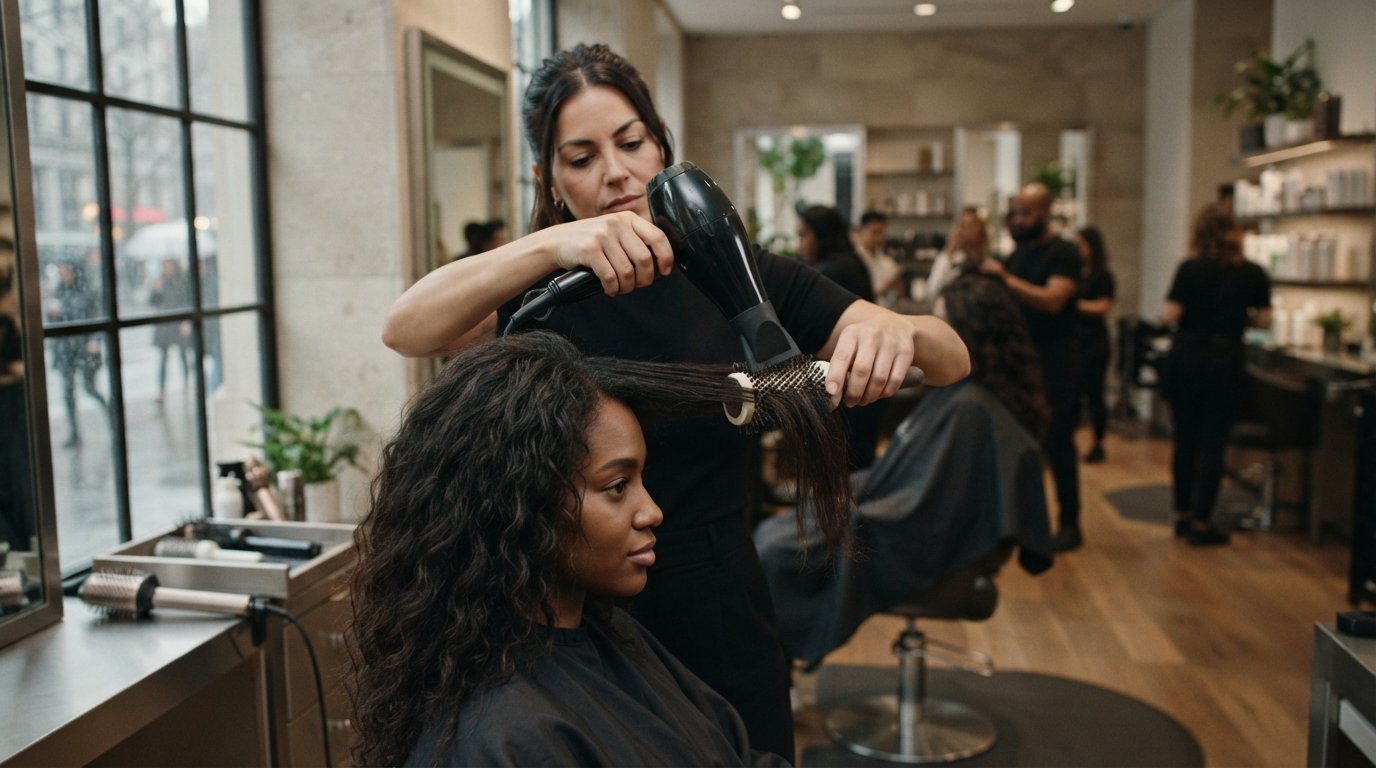
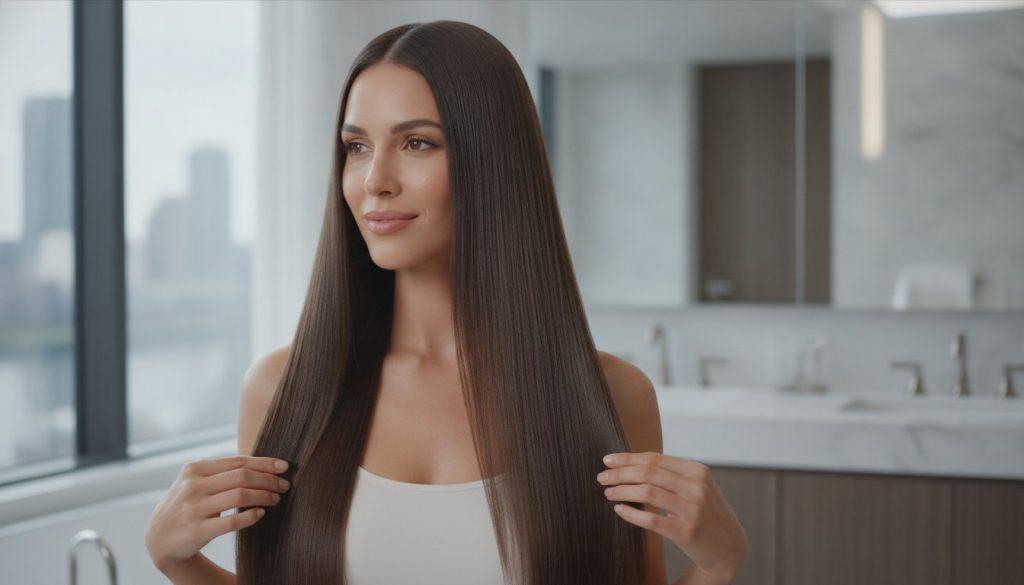
Piling on heavy serums won’t stop moisture swell; true frizz control is a discipline of mechanical cuticle sealing, not product overload. Mastering precise styling techniques for frizz-prone hair is what separates a fleeting blowout from an enduring, glass-like finish. Every stylist and client knows the frustration of spending forty-five minutes perfecting a smooth shape, only to watch the hair expand and dull the moment ambient humidity hits.
When the hair’s protective cuticle layer remains raised, atmospheric moisture quickly penetrates the hydrophilic cortex and breaks its temporary hydrogen bonds. By mastering directional airflow, ergonomic brush tension, and clean thermal protocols, you can lock out humidity without flattening natural body. In this professional guide, you’ll discover salon-grade blowout mechanics and porosity-calibrated heat strategies that shut down frizz and cut daily styling time by up to 80%. Here is the exact roadmap to creating sleek, touchably soft hair that holds its polish in any climate.
Key Takeaways
- Understand the science of cuticle porosity and why cleansing with sulfate-free, sodium chloride-free formulas is critical to prevent moisture absorption.
- Master precise styling techniques for frizz-prone hair, relying on directional nozzle concentrators and mechanical brush tension rather than heavy product overload to seal the cuticle flat.
- Calibrate thermal tool temperatures to specific hair porosity and texture, eliminating the risk of steam micro-fractures while securing an enduring polish.
- Learn when daily thermal styling should yield to professional salon smoothing systems, creating a clean foundation that resists atmospheric humidity for months.
Understanding Cuticle Porosity: The Science Behind Frizz-Prone Hair
Frizz is not merely an aesthetic nuisance; it is a physical reaction between moisture-deprived keratin fibers and atmospheric water vapor. At its core, frizz represents the irregular swelling of the hair shaft when ambient moisture bypasses the protective outer envelope. Healthy hair relies on an intact, hydrophobic lipid layer on the exterior surface. When that barrier degrades, water molecules migrate directly into the inner cortex, forcing individual filaments to twist and buckle out of alignment. Implementing effective styling techniques for frizz-prone hair requires understanding this structural mechanism rather than simply piling on cosmetic oils.
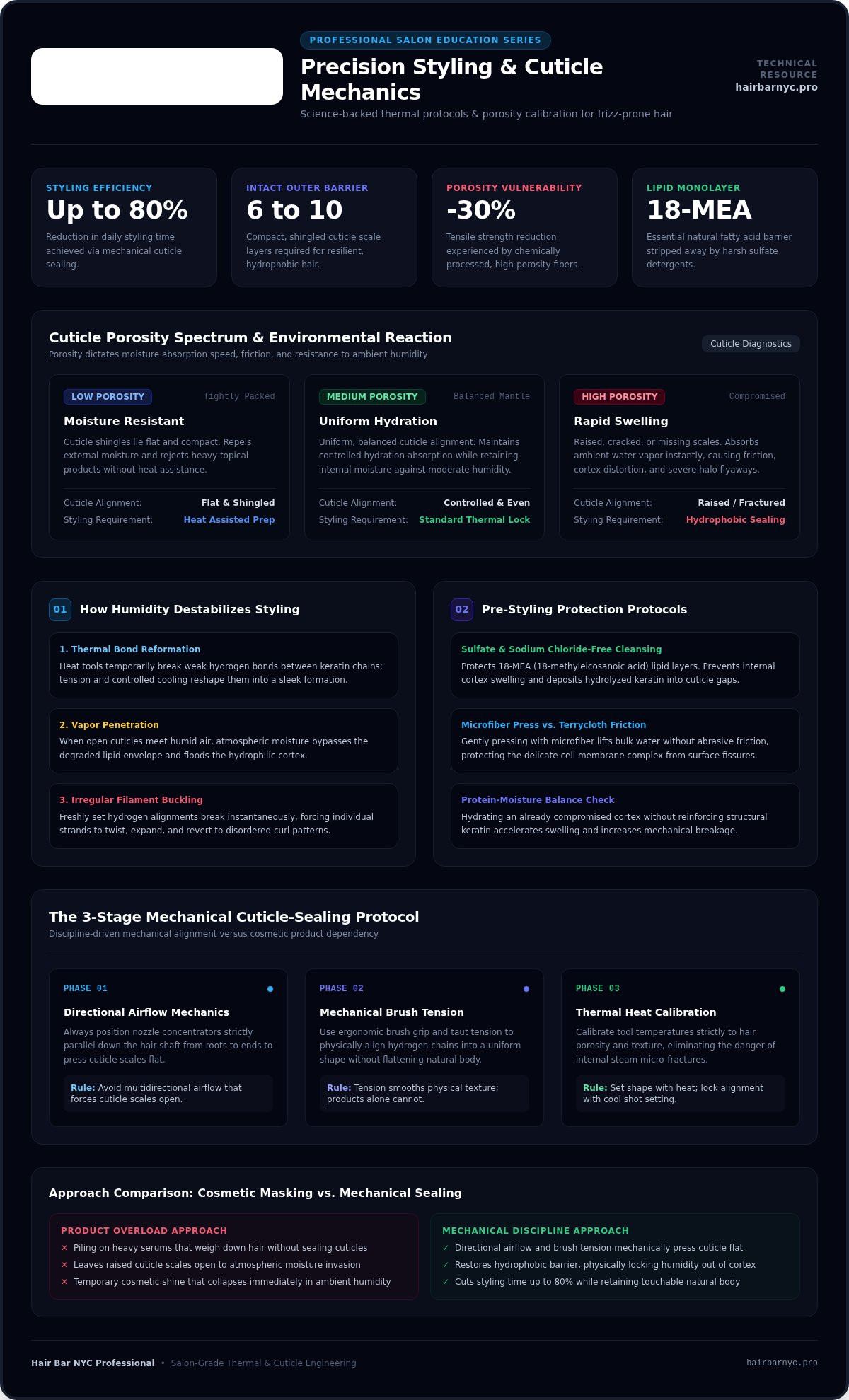
Understanding the biological hair cuticle structure clarifies why generic smoothing serums often fail. A resilient fiber features six to ten compact, shingled cuticle scales lying flat against the cortex. If those scales are lifted, chipped, or missing, external moisture floods the fiber. Surface hydration must always balance internal protein integrity; hydrating an already compromised cortex without reinforcing structural keratin simply accelerates swelling and mechanical breakage.
How Humidity Disrupts Temporary Hydrogen Bonds
Thermal styling relies on altering temporary hydrogen bonds within the cortex. High heat breaks these weak bonds between adjacent keratin chains, while tension and controlled cooling reshape them into a sleek configuration. Unlike permanent disulfide bonds, hydrogen bonds are exceptionally vulnerable to water. When humid air penetrates an open cuticle layer, atmospheric vapor breaks those freshly set alignments instantly. The hair fiber immediately reverts to its natural, often disordered pattern, leading to unexpected volume expansion and halo flyaways.
Evaluating Cuticle Health and Porosity Levels
Porosity measures the hair fiber’s ability to absorb and retain moisture, dictated entirely by cuticle condition:
- Low Porosity: Tightly packed, flat cuticle shingles resist moisture absorption and reject heavy styling products, requiring heat assistance to accept conditioning agents.
- Medium Porosity: Uniform, balanced cuticle alignment allows controlled hydration absorption while retaining internal moisture and resisting moderate humidity.
- High Porosity: Raised, cracked, or missing scales rapidly absorb moisture and lose it just as fast, creating intense friction, surface tangling, and dull light dispersion.
Chemical processing, bleach lightening, and uncalibrated heat tools aggressively elevate porosity. Studies indicate chemically processed, high-porosity hair experiences up to a 30% reduction in tensile strength compared to virgin fibers. Curly and wavy profiles naturally display higher porosity due to irregular cuticle overlapping along the bends of the strand. Tailoring styling techniques for frizz-prone hair to specific porosity levels ensures you seal the cuticle mechanically before atmospheric humidity can distort the hair’s shape.
The Pre-Styling Foundation: Cleansing, Hydrating, and Towel-Drying Protocols
Executing flawless styling techniques for frizz-prone hair begins long before turning on a blow-dryer. The wash basin sets the baseline for cuticle smoothness and determines how the fiber responds to heat. Cleansing with harsh surfactants like sodium lauryl sulfate strips essential 18-methyleicosanoic acid (18-MEA), the vital lipid monolayer that keeps cuticles flat and naturally hydrophobic. Using sodium chloride-free and sulfate-free formulas protects this protective mantle, preventing the cortex from swelling during washing.
Mechanical drying technique matters just as much as formulation. Standard terrycloth towels act like abrasive sandpaper against wet, fragile cuticle shingles. Instead, gently press the hair using a microfiber towel to lift bulk water without disrupting cuticle alignment. Independent clinical research on blow-drying damage demonstrates that protecting the delicate cell membrane complex during pre-styling significantly minimizes structural surface fissures later under heat.
Sulfate-Free Cleansing and Cuticle Alignment
Aggressive detergents disrupt the natural lipid barrier, leaving cuticle scales wide open and vulnerable to atmospheric intrusion. To counteract this, professionals choose targeted cleansing systems that deposit hydrolyzed keratin into high-porosity gaps along the strand. For clients with textured patterns, choosing calibrated hair care products for natural hair ensures balanced hydration that does not weigh down natural movement.
Moisture-Sealing Leave-Ins and Heat Primers
Product layering requires strict chemical discipline to build an effective hydrophobic barrier:
- Liquid Keratin Serums: Apply these first while strands are damp. Low-molecular-weight ingredients penetrate micro-fissures along the cuticle to reinforce structural elasticity.
- Thermal Smoothing Creams: Layer these second over mid-lengths and ends. High-molecular lipid polymers create a defensive barrier that shields the cortex against humidity.
This sequential approach prevents styling products from sliding off wet strands or sitting heavily on the surface. When you combine clean formulas with disciplined mechanical prep, you establish the ideal foundation for predictable styling techniques for frizz-prone hair. Stylists looking to upgrade backbar regimens can explore professional hair-care solutions engineered specifically for clean cuticle alignment.
Step-by-Step Blowout Techniques to Lock Out Atmospheric Humidity
Executing a long-lasting blowout requires precise mechanical discipline rather than high air volume alone. When managing high-porosity strands, blowing air randomly across the head lifts cuticle edges, inviting instant frizz. Proper styling techniques for frizz-prone hair demand a structured workflow that physically compresses the cuticle layer while evaporating residual water. Clean preparation with the Silk Touch System establishes the ideal foundation for this process, reducing daily styling time by up to 80% through targeted botanical smoothing.
To lock out external humidity completely, execute these five mechanical blowout phases:
- Phase 1: Controlled Pre-Drying. Remove dampness until hair reaches roughly 70% dryness using hand tension only, never letting the dryer nozzle touch naked strands without an attached concentrator.
- Phase 2: Clean Quadrant Sectioning. Divide hair into four balanced quadrants to keep wet sections from re-introducing moisture vapor to finished areas.
- Phase 3: Sub-Section Isolation. Work strictly in one-inch horizontal partings from the nape upward, ensuring the brush captures every single fiber under uniform tension.
- Phase 4: Downward Directional Heat Passes. Guide the concentrator nozzle down the hair shaft at a parallel angle, sealing cuticle scales flat against the cortex.
- Phase 5: Cool-Shot Setting. Disengage the heating element to flash-cool the section for five seconds before releasing the brush, locking the newly reshaped hydrogen bonds firmly in place.
Sectioning and Mechanical Tension Control
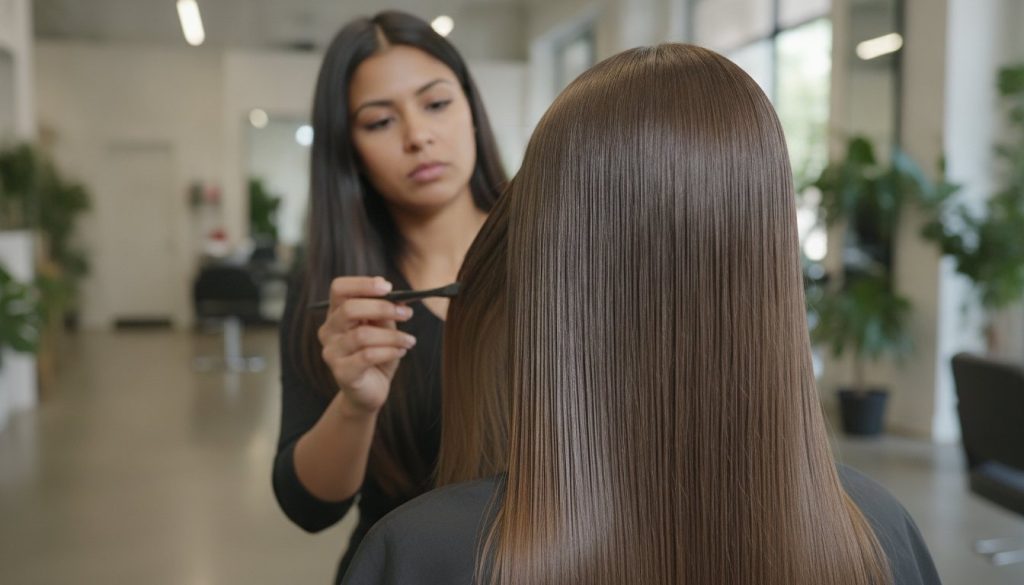
Tension is the primary smoothing mechanism during any professional blowout. Dividing hair into clean, one-inch horizontal partings gives the stylist complete mechanical control over the root-to-end grain. For unruly textures, boar bristle round brushes create superior grip, polishing the cuticle surface without overstretching fragile cortex bonds. In contrast, ceramic barrels conduct heat rapidly, making them ideal for accelerating dry time on medium-density hair.
Directional Airflow Mechanics with Ionic Dryers
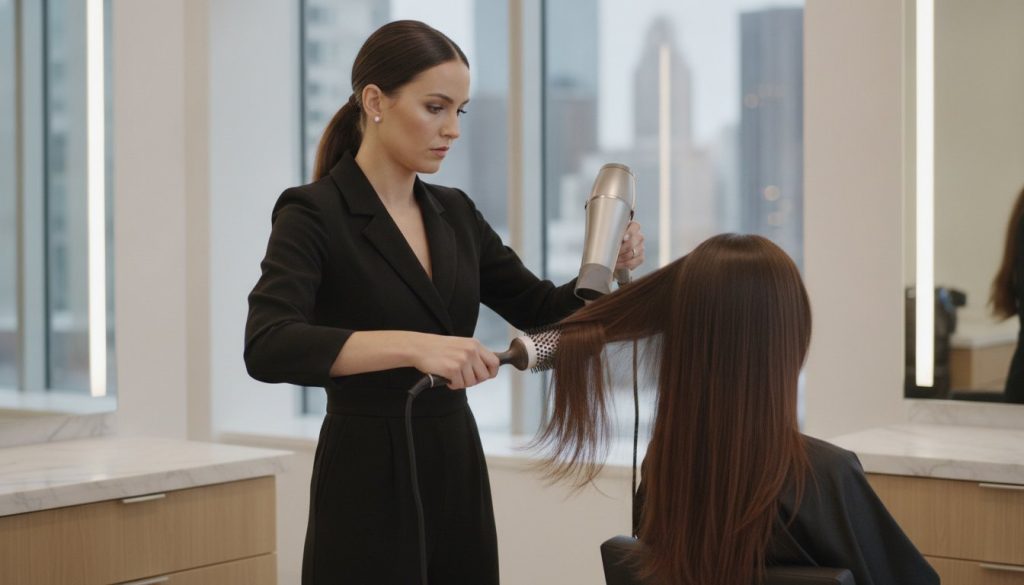
Concentrator nozzles are mandatory for controlling frizz. Using a tool like the ORYA Professional Ionic Hair Dryer delivers 2000-2200W of controlled negative-ion airflow, breaking water clusters into micro-droplets that evaporate quickly without stripping moisture. Always hold the nozzle at a 45-degree angle pointing downward toward the ends. Rough-drying without a directional nozzle blows open cuticle shingles, causing the exact flyaways and dull texture you want to avoid.
Setting the Shape with the Cool-Shot Function
Heat alters hydrogen bonds into a smooth orientation, but cool air locks that new alignment into place. Blasting each dried sub-section with the cool-shot function for five seconds drops the cuticle temperature instantly. This rapid cooling closes the outer envelope, creating an impermeable barrier against atmospheric vapor. While traditional salons historically used harsh chemical fumes to achieve lasting results, current FDA guidance on hair smoothing products underscores the value of clean chemistry and disciplined mechanical styling techniques for frizz-prone hair.
Thermal Tool Discipline: Precision Flat-Ironing and Heat Management
Precision ironing requires absolute thermal discipline, not excessive clamping pressure or repeated swipes. Clamping damp hair between heated plates causes trapped moisture within the cortex vacuoles to flash-boil into steam. Between 175°C and 215°C (345°F-419°F), this vaporizes internal moisture instantly, producing irreversible microscopic deformities known as “bubble hair.” Strands must be 100% bone-dry before plates ever make contact. Advanced styling techniques for frizz-prone hair rely on consistent plate metallurgy, controlled glide speed, and calibrated heat thresholds to seal the cuticle without degrading cortical α-keratin.
Plate composition heavily dictates how evenly heat transfers across the strand:
- Ceramic Plates: Deliver gentle, uniform far-infrared heat that penetrates slowly from the inside out, making them ideal for fine, color-treated, or fragile hair.
- Tourmaline-Infused Plates: Emit continuous negative ions that neutralize positive static charges, compressing raised cuticle scales to reflect brilliant surface shine.
- Titanium Plates: Offer rapid, high-temperature heat transfer best suited for coarse, resistant, or virgin textures that require immediate thermal response.
Calibrating Iron Temperatures by Texture and Chemical History
Unprotected hair experiences cuticle micro-fracturing starting between 150°C and 180°C (302°F-356°F). Cranking an iron straight to its maximum setting strips vital lipids and leaves hair brittle. Bleached, double-processed, or fine hair should never exceed 350°F to 360°F. Color-treated and medium textures maintain structural integrity between 360°F and 410°F. Reserve high temperatures up to 450°F exclusively for thick, resistant, coarse hair. Calibrating the iron to the hair’s specific porosity and processing background prevents protein denaturation while delivering lasting frizz control.
The Comb-Chase Technique for Flawless Alignment
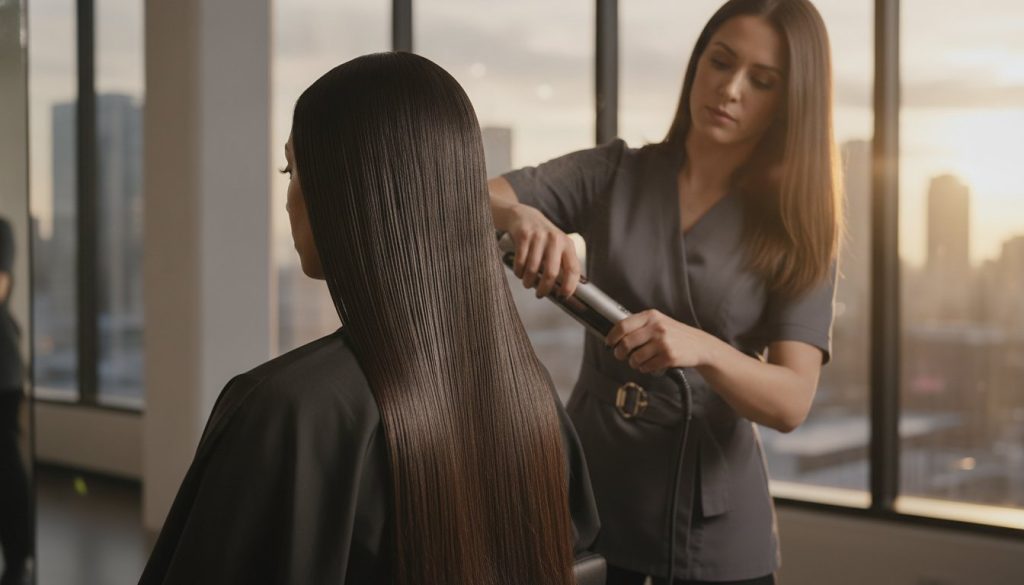
Rapid, frantic iron passes scorch the outer cuticle without smoothing the core. Instead, master the slow, single-pass comb-chase technique. Position a fine-tooth, heat-resistant carbon tail comb directly in front of your flat iron. Glide both down the sub-section in unison at a steady, uninterrupted pace. Pre-aligning every fiber with comb teeth ensures the iron plates distribute heat evenly across every single strand. Never pause or clamp down on the fragile ends. Stylists looking to upgrade their station tools with professional salon equipment can shop Hair Bar NYC Professional for high-performance irons engineered for precise heat retention.
Long-Term Smoothing Systems: When Daily Styling Requires Professional Intervention
Daily mechanical manipulation has its limits. For clients with naturally dense textures, elevated porosity, or active lifestyles in high-humidity climates, even the most disciplined brushwork can falter against sudden atmospheric shifts. When daily thermal work becomes a constant battle against reversion, in-salon smoothing provides a structural reset. Establishing a long-lasting hydrophobic foundation transforms styling techniques for frizz-prone hair from an exhausting daily chore into a predictable, effortless routine.
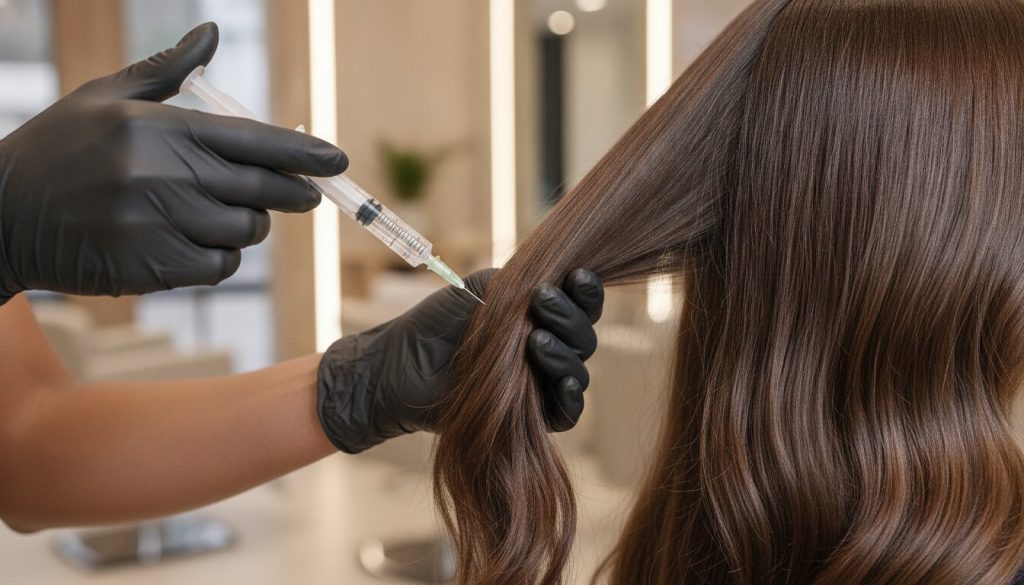
The Silk Touch Plus Formaldehyde-free Keratin Treatment exemplifies this clean-performance evolution. Engineered strictly for licensed stylists and salon use, this 100% vegan system uses OrgaLoc™ technology and ArmorPlex to align cuticle shingles without toxic aldehyde off-gassing. Instead of coating strands in heavy synthetic residues, it infuses botanical proteins directly into porous cuticles, providing clean frizz control for up to 6 months while slashing daily styling and drying time by up to 90%.
The Rise of Clean, Formaldehyde-Free Smoothing Systems
Legacy salon smoothing often relied on harsh methylene glycol formulas that released irritating fumes when exposed to flat irons. Modern salon chemistry replaces those compromises with restorative botanical complexes. Infusions of organic Aloe Vera and plant-derived proteins soothe the hair fiber, filling structural gaps and leaving cuticles resilient against water vapor. Stylists looking to upgrade their service menu can consult our comprehensive guide to formaldehyde free keratin treatment formulations to see how clean science outperforms traditional aldehyde-based products.
Post-Treatment Maintenance to Sustain Frizz-Free Results
Preserving the benefits of an in-salon smoothing service requires proper home care protocols:
- Observe Setting Windows: Instruct clients to wait 24 to 72 hours before shampooing, pinning, or tying back hair to allow the conditioning matrix to stabilize completely.
- Eliminate Stripping Salts: Prescribe sodium chloride-free and sulfate-free maintenance duos; salt dissolves the external keratin barrier and causes premature reversion.
- Moderate Thermal Exposure: Because the cuticle remains compact, subsequent blowouts require significantly less heat, protecting long-term hair health.
Salons that pair clean smoothing treatments with client education elevate their service standard and retain client trust. Licensed beauty professionals can explore high-performance formulas, tools, and salon packages directly at HAIRBARNYC.PRO.
Master Flawless Smoothness at the Styling Station
Executing modern styling techniques for frizz-prone hair doesn’t rely on heavy product layering; it requires treating cuticle biology with mechanical discipline. When you combine firm brush tension, downward ionic airflow, and porosity-matched heat settings, humidity-proof smoothness won’t be an accident. You compress the cuticle scales flat, safeguard internal moisture, and build an enduring barrier against atmospheric swell.
When hair demands deeper structural discipline, support your craft with clean backbar chemistry. Hair Bar NYC Professional equips stylists with OSHA-tested, formaldehyde-free smoothing formulas delivering up to 6 months of frizz control, alongside the Silk Touch System designed to cut daily styling time by up to 80%. Supported by exclusive professional-grade ionic styling tools engineered for master stylists, you’ll transform challenging textures into touchably soft, radiant hair that effortlessly holds its shape. Elevate your salon’s smoothing services at HAIRBARNYC.PRO and give every client enduring humidity defense.
Frequently Asked Questions
Why does my hair still frizz after blow-drying it straight?
Hair frizzles post-blowout when internal moisture hasn’t fully evaporated or when the cuticle remains rough and unsealed. If sections are too thick or released while still warm without a cool shot, reshaped hydrogen bonds fail to lock. Ambient humidity then seeps directly into the cortex, expanding individual fibers. Using precise mechanical styling techniques for frizz-prone hair, like small partings and constant brush tension, prevents this reversion.
Is it better to air-dry or blow-dry frizz-prone hair?
Blow-drying with controlled directional airflow is actually healthier and far more effective for frizz defense than air-drying. Allowing hair to air-dry keeps the cortex swollen with water for an extended period, placing prolonged mechanical stress on the cell membrane complex. A disciplined blowout using a nozzle concentrator compresses cuticle shingles flat, sealing out environmental humidity far better than passive drying ever can.
What is the best flat iron temperature for frizzy, color-treated hair?
For color-treated or sensitized hair, keep flat iron temperatures strictly between 360°F and 410°F. Exceeding 410°F on tinted or highlighted strands strips cosmetic color pigments and causes cuticle micro-fissuring, which accelerates porous moisture absorption. If the hair is bleached, double-processed, or fine, reduce the thermal setting even further to 350°F to 360°F and glide slowly with a comb chase.
How do ionic hair dryers help reduce frizz and flyaways?
Ionic dryers emit millions of negatively charged ions that break surface water clusters into micro-droplets for faster evaporation. Tools like the ORYA Professional Ionic Hair Dryer neutralize the positive static electrical charges that cause cuticles to flare. By accelerating moisture removal at lower heat thresholds, ionic airflow preserves natural lipid layers and seals cuticle scales tightly around the cortex, yielding a noticeably glossier finish.
Can a professional keratin smoothing treatment eliminate frizz completely?
Professional smoothing treatments dramatically reduce frizz and humidity swell by up to 90%, though natural movement remains. Formulations like Silk Touch Plus create an impenetrable hydrophobic barrier across porous cuticles for up to 6 months without toxic aldehydes. While cosmetic treatments don’t permanently alter biological hair structure, they align damaged cuticle shingles so thoroughly that daily styling techniques for frizz-prone hair become virtually effortless.
What ingredients should I avoid in anti-frizz styling products?
Avoid products containing sodium chloride, harsh sulfates like sodium lauryl sulfate, and drying short-chain alcohols. Sodium chloride actively dissolves protective keratin coatings, accelerating cuticle roughing and moisture intrusion. Harsh sulfates strip the essential 18-MEA lipid layer from the fiber surface, while drying alcohols dehydrate internal cortex structures, creating brittle strands that immediately swell when exposed to humid outdoor air.
How often should I use a deep conditioning mask on frizz-prone hair?
Incorporate a concentrated keratin-infused hair mask once weekly, or every third wash for high-porosity hair. Frizz-prone strands lose structural moisture rapidly through lifted scales. A rich treatment, such as the Silk Touch System Mask or Ultimate Repair System Mask, replenishes cortical proteins and essential lipids without weighing down the style. Distribute evenly through mid-lengths and ends to restore elasticity and natural light reflection.