The Professional Hair Color Formulation Chart: A Stylist’s Guide to Precision Results
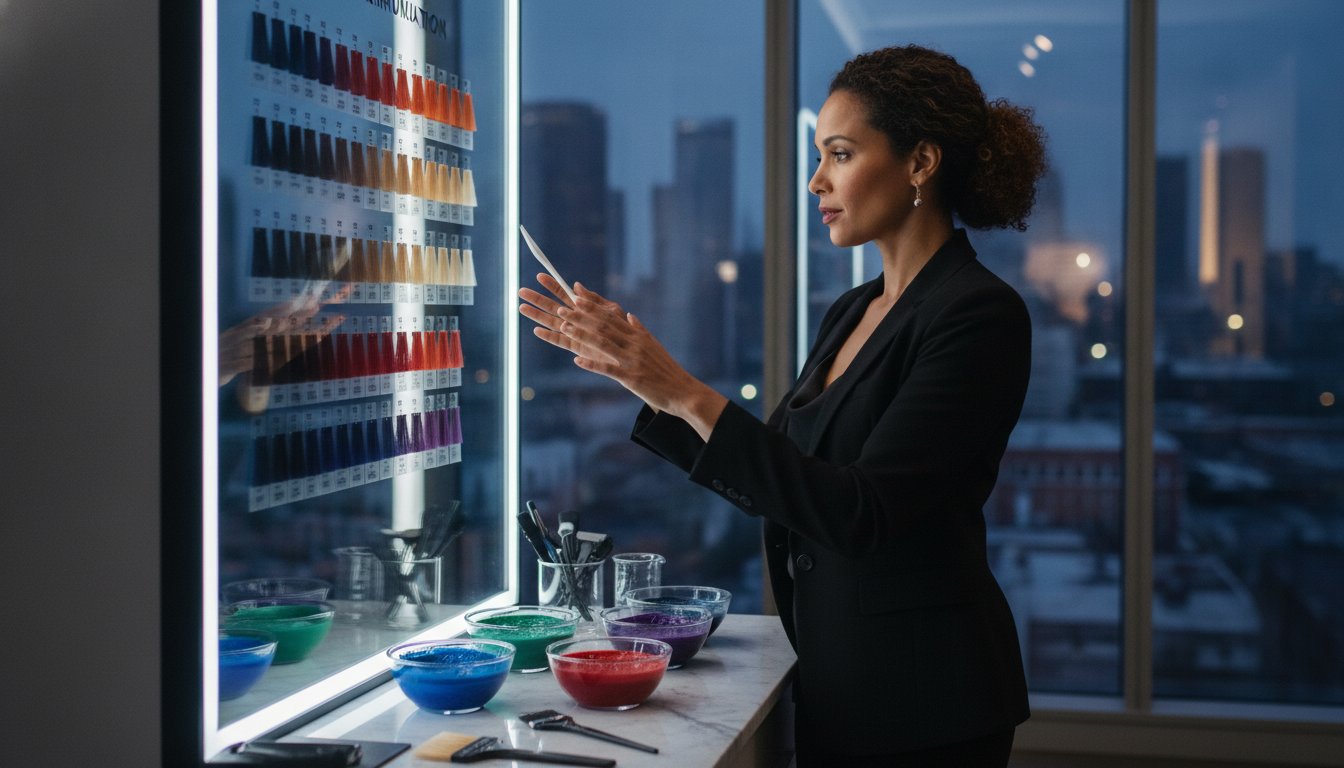
The difference between a standard service and a metropolitan-standard transformation lies in the chemistry you master before the brush ever touches the hair. While many stylists rely on intuition, the true masters of the craft understand that a professional hair color formulation chart is their most powerful strategic asset. It represents the vital bridge between a client’s aspirational vision and the reality of their unique underlying pigments. If you’ve ever faced the anxiety of a toner pulling too ash or a base lifting too warm, you know that guesswork has no place in a high-end salon environment.
You likely agree that the most frustrating part of a busy day is an unpredictable outcome that requires an unplanned color correction. It’s exhausting to navigate confusing numbering systems that seem to shift with every product line. We’re going to change that. This guide promises to decode the science of color theory, empowering you to utilize your formulation chart with total precision. We’ll explore the critical relationship between levels and tones, master the art of neutralization, and ensure every bowl you mix delivers the sophisticated, high-performance results your discerning clientele expects.
Key Takeaways
- Master the professional hair color formulation chart to eliminate guesswork and transition from intuitive mixing to scientific precision.
- Decipher the International Numbering System to accurately navigate levels and tones for consistent, high-end results across every service.
- Understand the relationship between the Law of Color and the lightening curve to effectively neutralize unwanted pigments and achieve elite color corrections.
- Learn to perform a comprehensive hair analysis that accounts for porosity and elasticity, ensuring your custom formulas remain vibrant and predictable.
- Discover how to pair high-performance color with treatments like Silk Touch Keratin to deliver unparalleled shine and long-lasting vibrancy for your metropolitan clients.
Demystifying the Professional Hair Color Formulation Chart
For the elite stylist operating in a high-stakes metropolitan environment, color isn’t a game of chance. It’s a calculated chemical reaction. The professional hair color formulation chart serves as your strategic roadmap, transforming a client’s aspirational mood board into a predictable, high-end reality. While retail “box” guides offer a simplistic and often misleading glimpse at potential results, professional-tier charts provide the granular detail necessary to account for underlying pigments, hair history, and structural integrity.
Think of the chart as the bridge between the artistry of your vision and the chemistry of the bottle. It demands a shift in perspective. You aren’t just applying paint; you’re manipulating light and pigment at a molecular level. This level of precision is what separates a standard salon visit from an elite care experience that keeps sophisticated clients returning to your chair. Mastering this tool is the first step toward achieving the uncompromising quality that defines a top-tier urban professional.
To see how these technical standards are applied in a high-end salon setting like The Collective ATX to achieve flawless, personalized results, find out more.
The Purpose of a Standardized System
In a bustling salon, efficiency and consistency are non-negotiable. A standardized system ensures that your entire team operates with a unified technical vocabulary. This eliminates the guesswork that often leads to costly, time-consuming color corrections. When every stylist masters the chart, the salon’s reputation for excellence remains untarnished, regardless of who performs the service. A professional hair color formulation chart is the universal language for chemical hair transformation, ensuring that “cool beige” means the exact same thing across every mixing station.
- Predictability: Removes the “hope for the best” mindset from complex lift-and-tone services.
- Scalability: Allows senior stylists to mentor juniors using a concrete, data-driven framework.
- Professionalism: Establishes a technical standard that mirrors the sophistication of high-end fashion and design.
Universal vs. Brand-Specific Charts
While most elite systems utilize the International Numbering System (INS) as a foundation, the true magic happens in the proprietary nuances of high-performance lines. Transitioning to a system like Color Bar Professional requires an understanding of how clean-beauty pigments behave differently than traditional formulas. These vegan, cruelty-free options are engineered for maximum precision, but they rely on the stylist’s ability to interpret the specific tonal shifts indicated on the brand’s unique chart. By mastering these brand-specific details, you unlock the ability to deliver vibrant, long-lasting results that maintain the hair’s health, especially when paired with advanced maintenance like Silk Touch Shampoo. Understanding these subtle differences is what allows a stylist to pivot between brands without sacrificing the integrity of the final look.
The Anatomy of a Color Chart: Levels, Tones, and Numbering
To master the professional hair color formulation chart, you must first speak its technical language. The International Numbering System (INS) isn’t just a set of digits; it’s a precise coordinate system for hair chemistry. It removes the ambiguity of marketing names like “Sun-Kissed Honey” and replaces them with mathematical certainty. By understanding how these numbers interact, you gain the power to predict exactly how a pigment will behave when it meets the hair fiber.
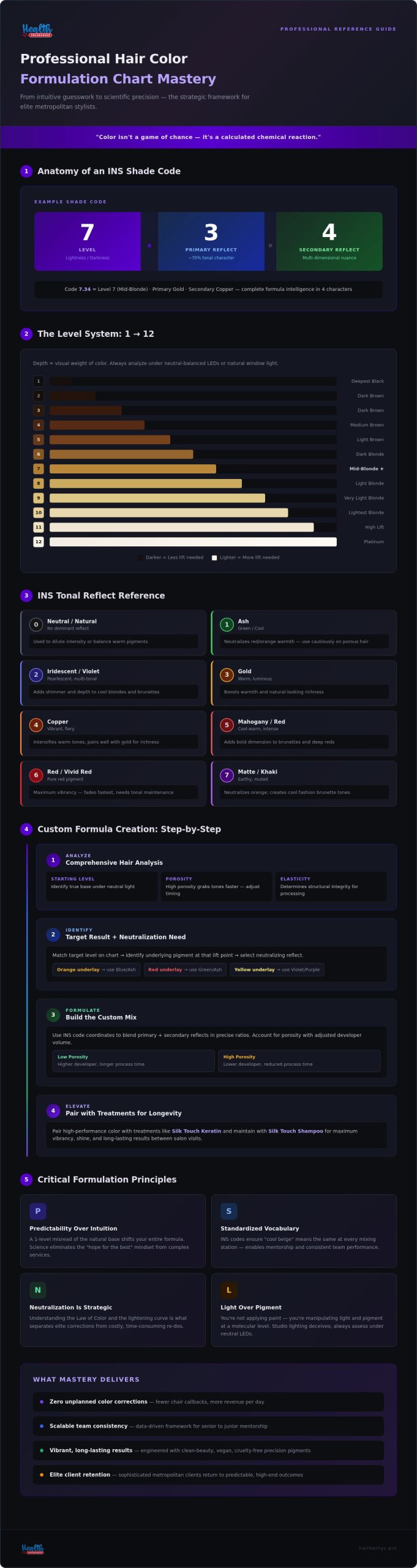
A shade code like 7.34 reveals a complete story. The number before the decimal represents the level, indicating the degree of lightness or darkness. The first digit after the decimal is the primary reflect, contributing approximately 70% of the tonal character. The second digit is the secondary reflect, which provides that subtle, multi-dimensional nuance that defines a high-end finish. Mastering this code allows you to formulate with the confidence of a chemist and the eye of an artist.
Mastering the Level System
Accurately identifying the natural starting level is the most critical step in any service. If you misjudge the base by even one level, your entire formula will shift. It’s vital to distinguish between depth and intensity. Depth is the visual weight of the color on a scale from 1 (deepest black) to 10 or 12 (lightest platinum). Intensity refers to how vivid that level appears. In chic metropolitan salons, studio lighting can be deceptive. Always analyze the hair under neutral-balanced LEDs or near a window to ensure your starting point is correctly identified before reaching for your Color Bar Professional tools.
Decoding Tones and Reflections
Tones are the soul of the color, dictating whether the result feels warm, cool, or neutral. The professional hair color formulation chart categorizes these as reflects. Ash (.1) and Violet (.2) are the architects of cool, sophisticated blondes, while Gold (.3), Copper (.4), and Mahogany (.5) build richness and warmth. Secondary reflects are what create an “insider” look, adding complexity that prevents the color from appearing flat. Use these reflects to balance skin undertones: cool tones neutralize redness in the skin, while warm reflects can brighten a sallow or golden complexion. Understanding this relationship ensures your custom formulas always look intentional and expensive.
- Primary Reflect: The dominant character that defines the overall hue.
- Secondary Reflect: The supporting tone that adds depth and dimension.
- Natural/Neutral: Often represented by .0, these are essential for gray coverage and tonal balance.
Mastering Color Theory: The Science Behind the Chart
The Law of Color is the engine behind every successful application. It dictates how primary, secondary, and tertiary pigments interact on the hair fiber to create the final visual result. When you consult a professional hair color formulation chart, you’re looking at a simplified map of these complex chemical relationships. Understanding this science allows you to move beyond simple color matching and into the space of true custom alchemy, where you control the outcome of every chemical reaction.
The Color Wheel in Professional Practice
In a high-end salon environment, precision is paramount. The color wheel is the stylist’s primary tool for color correction. By identifying the dominant tone on the wheel, you can select its direct opposite to achieve perfect neutralization. For instance, you’ll use violet to cancel yellow at a level 9, while blue is essential for canceling orange at a level 6 or 7. However, the expert professional knows the risk of over-neutralizing. Adding too much opposite pigment can lead to muddy, flat results that lack the luminosity your metropolitan clients demand. The goal is balance, not just cancellation.
Understanding Contributing Pigment
Every level of lift reveals a specific underlying pigment that must be factored into your final formula. This is known as the lightening curve. You can’t ignore the warmth that emerges during the chemical process; you must either neutralize it or work with it to enhance the final result. If you’re aiming for a vibrant copper, the orange revealed at level 6 is your ally. If you’re aiming for a cool brunette, it’s your biggest obstacle.
- Level 6: Reveals deep orange. Requires blue-based tones for a neutral finish or copper tones to enhance richness.
- Level 8: Reveals yellow-orange. Needs a violet-blue balance to reach a sophisticated beige.
- Level 10: Reveals pale yellow. Only a touch of violet is needed to reach a clean, platinum result.
High-performance, clean-beauty formulas like Color Bar Professional require an even deeper understanding of these pigments. Because these vegan formulas feature high concentrations of pure pigment without harsh additives, your formulation must be exact. Hair porosity also plays a major role; highly porous hair will grab cool tones more aggressively, potentially resulting in an unintended over-neutralization. By aligning your knowledge of the lightening curve with the data on your professional hair color formulation chart, you ensure every client leaves with a vibrant, sophisticated finish that maintains the hair’s structural integrity.
Step-by-Step: How to Create Custom Formulas Using the Chart
Precision is the hallmark of the metropolitan stylist. Moving from the theoretical Law of Color to the practical application at the mixing station requires a disciplined, step-by-step approach. Your professional hair color formulation chart isn’t just a static reference; it’s a dynamic tool that guides your decision-making through every phase of the chemical transformation. By following a standardized protocol, you ensure that high-end, predictable results become the rule rather than the exception.
The Consultation: Setting the Stage for Success
Every elite service begins with a rigorous diagnostic phase. You must perform a comprehensive hair analysis, evaluating porosity, elasticity, and texture before formulating. Identifying previous chemical history, including formaldehyde-free keratin treatments, is non-negotiable. These smoothing services can affect how the hair accepts pigment, and failing to account for them can lead to uneven results. Manage your client’s expectations for complex color journeys, especially when moving across multiple levels of lift. In an uncompromising professional environment, a strand test is your best insurance policy against the unknown.
The Math of Custom Formulation
Once you’ve identified the natural starting level and the client’s aspirational target, it’s time to calculate the “math” of the formula. This involves determining exactly how many levels of lift are required and selecting the appropriate developer strength. Your professional hair color formulation chart acts as the final arbiter in this decision, showing you the expected result of specific level shifts. Finalize the formula by balancing your target shade with a neutralizing or enhancing “kicker” to address the underlying pigments revealed during the process.
- Step 1: Identify the natural starting level and percentage of gray.
- Step 2: Define the target level and desired tonal character.
- Step 3: Select the developer volume based on the required lift or deposit.
- Step 4: Add corrective tones to neutralize or enhance the lightening curve.
Mixing and Application Precision
Consistency is the enemy of guesswork. Measuring your components by weight using a digital scale is far superior to measuring by volume; it ensures that your ratios are exact every time. This level of accuracy is essential when working with high-performance professional hair color brands that rely on specific pigment concentrations. Use your chart to decide if the service requires the longevity of a permanent formula or the gentle reflection of a semi-permanent solution. To achieve the elite standard your clients demand, equip your station with the Color Bar Professional collection for uncompromising results.
Elevating Your Salon Services with Color Bar Professional
Mastering the technicalities of a professional hair color formulation chart is the foundation of your craft. However, the true elevation of your salon’s reputation comes from the products you choose to bring those formulas to life. Color Bar Professional Hair Color represents the intersection of scientific precision and high-performance artistry. It’s engineered for the stylist who demands uncompromising quality in every bowl. When you integrate these advanced pigments with the Silk Touch Keratin Treatment, you offer more than just a color change. You provide a transformative experience that infuses the hair with a luminous, mirror-like shine that lasts long after the client leaves your chair.
Why Color Bar Professional is the Elite Choice
Conscious beauty is no longer a niche preference; it’s the expectation of the modern, sophisticated client. By utilizing vegan and cruelty-free pigments, you align your salon with the values of a discerning urban demographic. Color Bar Professional respects the hair’s natural structure, ensuring that the cuticle remains smooth and light-reflective. This commitment to integrity allows you to achieve the “New York standard” of vibrancy. Whether you’re creating a deep, moody brunette or a high-fashion platinum, the concentration of pigment ensures that the results are as bold as they are durable. Your chair becomes a destination for high-end care where health and style are never mutually exclusive.
Post-Color Care for Metropolitan Lifestyles
A metropolitan lifestyle is demanding on hair. Environmental pollutants and the minerals found in urban water systems can compromise the longevity of your work. The expert professional understands that the service doesn’t end at the salon door. You must prescribe a maintenance routine that protects the investment your client has made. Recommend Silk Touch Shampoo and Silk Touch Conditioner as the primary defense against fading. These products are formulated to work in synergy with our color line, sealing the hair fiber and locking in tonal brilliance. For those requiring deeper restoration after complex color corrections or high-lift services, the Keratin Intensive Treatment acts as a vital repair tool. It replenishes lost proteins and ensures the hair remains resilient enough for future transformations. Explore the Color Bar Professional range for your salon today.
Master the Science of Sophisticated Color
Transitioning from an intuitive stylist to a technical master requires a deep commitment to the chemistry of hair. You’ve seen how mastering the professional hair color formulation chart is more than a technical skill; it’s the strategic blueprint for delivering the high-end, predictable results that define a metropolitan salon. By accurately identifying levels, decoding complex tones, and respecting the lightening curve, you eliminate the uncertainty that leads to costly color corrections. This disciplined approach ensures every client leaves your chair with a vibrant, multi-dimensional finish that commands attention and reinforces your professional authority.
Now is the time to align your expertise with tools designed for the elite professional. Utilized in prestigious salons nationwide, these vegan and cruelty-free professional formulas deliver sophisticated results for discerning stylists who refuse to compromise on quality. Upgrade your salon with Color Bar Professional Hair Color and experience the synergy of precision pigments and elite hair health. You’re not just applying color; you’re setting a new standard of excellence in your craft. Trust your training, embrace the science, and watch your artistry reach new heights of luxury.
Frequently Asked Questions
How do you read a professional hair color numbering system?
The number before the decimal indicates the level of depth, while the digits following represent the primary and secondary tones. A professional hair color numbering system uses this standardized scale to define character and intensity. The first digit after the decimal identifies the primary reflect, providing the dominant tonal direction. The second digit represents the secondary reflect, adding the subtle nuance and multi-dimensional finish expected in elite salon results.
What is the difference between level and tone on a hair color chart?
Level measures the degree of lightness or darkness, whereas tone describes the specific hue or reflect of the color. Level is a quantitative measurement of depth, ranging from deep black to light platinum. Tone is a qualitative descriptor that defines whether the color is warm, cool, or neutral. Understanding this distinction is vital when utilizing a professional hair color formulation chart to achieve sophisticated, balanced results for every client.
How do I use a color chart for color correction?
Use the chart to identify the existing underlying pigment and select the direct opposite tone on the color wheel to neutralize it. Successful color correction relies on the Law of Color to cancel unwanted warmth or muddy tones. By consulting the chart, you can determine which reflect will best counteract the current shade. This scientific approach ensures the correction is intentional rather than reactive, maintaining the hair’s structural integrity.
Can I use a color chart from one brand for another brand’s dye?
No, you should always use the specific chart designed for the product line you are applying. While many brands follow the International Numbering System, pigment concentrations and base tones vary significantly between manufacturers. A “level 7 ash” in one line may have a blue base, while another uses a green base. Relying on a different brand’s professional hair color formulation chart can lead to unpredictable results. For maximum precision, always pair Color Bar Professional pigments with their dedicated brand resources.
What are the underlying pigments at each level of hair color?
Underlying pigments, or contributing pigments, are the warm tones revealed as hair is lifted during a chemical service. At levels 1 through 4, the underlying pigment is predominantly red. As you lift to level 5, it transitions to red-orange, followed by orange at level 6 and gold at level 8. Recognizing these specific stages of the lightening curve allows you to formulate custom tones that either neutralize these pigments or enhance them for warmth.
How does hair porosity affect the results on a color formulation chart?
Porosity determines how quickly and deeply hair absorbs pigment, which can cause results to appear darker or more ash than the chart predicts. Highly porous hair has an open cuticle that grabs cool tones aggressively, often resulting in an over-neutralized or muddy appearance. Stylists must adjust their formulation or processing time based on the hair’s condition. A professional chart requires this diagnostic step to ensure the final deposit matches the target accurately.
Why is a professional hair color chart better than a retail shade guide?
Professional charts offer technical data on levels and reflects, whereas retail guides provide a simplistic visual of the end result. Retail guides assume a “one size fits all” application on virgin hair, ignoring the complexities of underlying pigment and history. Professional charts empower the stylist to act as a chemist, providing the granular detail needed to mix custom formulas. This precision is what allows metropolitan salons to deliver high-end, consistent results.
How do I neutralize orange hair using a professional chart?
To neutralize orange, you must select a blue-based ash reflect at the corresponding level of the hair. Orange tones typically emerge at levels 5, 6, and 7 during the lifting process. By consulting your chart, identify the ash shades that contain a blue primary reflect. Applying this opposite pigment cancels the warmth, resulting in a sophisticated brunette or dark blonde. For lasting results, ensure the hair is maintained with Silk Touch Shampoo after the service.
Related Posts
Demi vs. Semi-Permanent Color for Toning: Stylist Guide
The cleanest lift can unravel in minutes if you miscalculate how your toner interacts with the hair cuticle. When deciding between demi-permanent vs…
Professional Auburn Hair Dye: The Stylist’s Guide to Multidimensional Red
With search interest in warm metallic tones like “Liquid Copper” surging by 45% this year, the demand for sophisticated, multi-tonal reds has reached…
Professional Hair Color: Expert Guide to Gray Coverage
Translucent, highlight-like gray coverage is a failure of chemistry, not an inevitable fact of aging. It’s frustrating to invest time in your…
Mastering Copper Hair Color: 2026 Stylist’s Guide
The most captivating copper hair isn’t found in a single tube of dye; it’s engineered through a precise calculation of underlying pigment and light…
Professional Hair Color Correction: The Elite Guide to Restoring Hair Integrity and Tone
What if your most devastating hair disaster wasn’t a dead end, but the foundation for your most sophisticated look yet? Most clients believe that…
Master the Melt: A Professional Color Melting Tutorial for 2026
True color melting isn’t just a physical blending of dyes; it’s a mathematical orchestration of saturation zones that separates the elite colorist…
What to Do When a Client’s Color Turns Brassy: The Professional Stylist’s Guide for 2026
That expensive bottle of retail-grade purple shampoo is often the very thing sabotaging your client’s sophisticated cool-toned balayage. It’s…
Hair Color Remover: The Professional Guide to Safe Pigment Extraction in 2026
Reaching for a tub of bleach to fix a botched dye job is the most expensive mistake you can make for your hair’s structural health in 2026. You…