How to Properly Mix Professional Hair Color and Developer: The Stylist’s Guide 2026
The difference between a flat, brassy finish and a luminous, multi-dimensional masterpiece isn’t just the pigment you choose; it’s the invisible chemistry happening in your mixing bowl. You’ve likely felt that surge of anxiety when staring at a scale, wondering if a slight deviation in your 1:1 or 1:2 ratio will result in the dreaded ‘hot roots’ or compromised hair integrity. Learning how to properly mix professional hair color and developer is the defining line between a standard service and an elite transformation that defines the 2026 professional standard.
We understand that as a discerning professional, you demand more than just a change in shade; you seek perfection in every strand. This guide will help you master the precise chemistry and ratios required to achieve salon-standard results with elite techniques. We’ll explore the science of developer volumes, the nuances of molecular pigment stability, and the professional protocols that guarantee 100% gray coverage and vibrant longevity while protecting the hair’s natural lipid barrier for a healthy, high-performance finish.
Key Takeaways
- Understand the chemical synergy of hydrogen peroxide and oxidation to ensure pigment molecules expand perfectly within the hair shaft for lasting vibrance.
- Identify the ideal developer strength for every client goal, from the subtle deposit of 10 volume to the industry-standard gray coverage of 20 volume.
- Master how to properly mix professional hair color and developer by calculating precise 1:1 and 1:1.5 ratios to achieve deep saturation and elite lift.
- Adopt professional-grade protocols using a digital scale and a high-quality mixing bowl and brush set to eliminate clumps and ensure a smooth, consistent application.
- Preserve your high-performance results by mastering the critical 48-hour post-color window and implementing sulfate-free maintenance routines.
The Science of Color Activation: Why Precision Mixing Matters
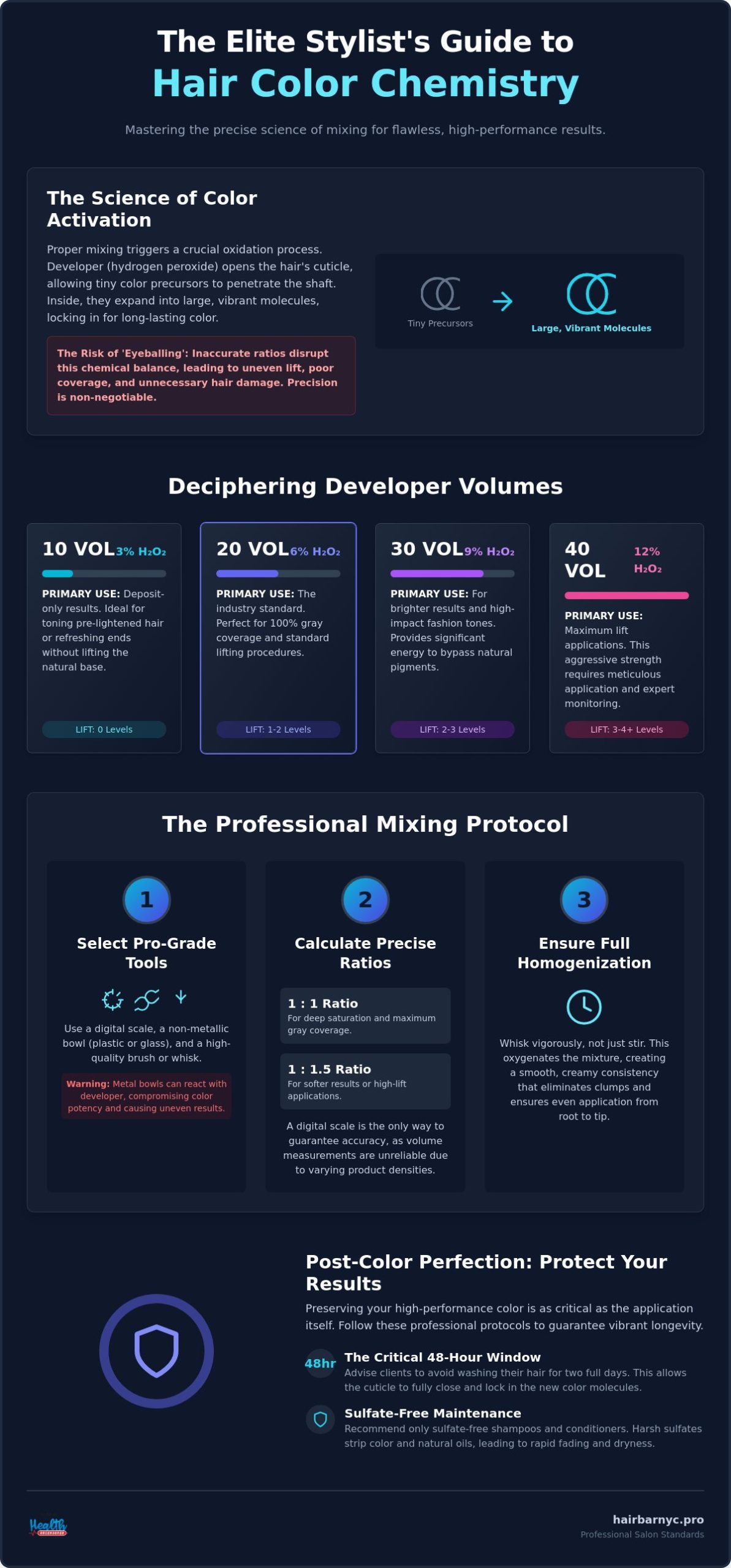
Achieving a flawless, high-end finish begins long before the brush touches the hair. It starts with a fundamental understanding of hair coloring chemistry. Professional hair color isn’t just paint; it’s a sophisticated chemical reaction. Hydrogen peroxide, the active agent in your developer, serves as the key that unlocks the hair’s outer cuticle. Without this precise activation, pigments simply sit on the surface, leading to lackluster results and rapid fading. This is why mastering how to properly mix professional hair color and developer is the first step in any elite service.
When you mix our Color Bar Professional Hair Color with the appropriate developer, you trigger an oxidation process. This reaction causes tiny, colorless pigment precursors to enter the hair shaft and expand into large, vibrant color molecules. These molecules become trapped within the cortex, ensuring the longevity and depth your clients expect. ‘Eyeballing’ your measurements disrupts this delicate balance. Inaccurate ratios lead to inconsistent pH levels, which can cause uneven lifting or, worse, unnecessary chemical stress on the hair fiber. Learning how to properly mix professional hair color and developer ensures every application is predictable, safe, and stunning.
The Role of Developer in Pigment Deposit
The developer acts as the oxidizing agent that provides the oxygen gas needed to develop color molecules. This process works in tandem with the alkalinity of the color cream, typically provided by ammonia or an alkanolamine. This alkaline component swells the hair, allowing the peroxide to penetrate and disperse natural melanin. Whether you’re lifting natural levels or depositing rich, new tones, the strength of the developer determines the intensity of this action. A professional-grade system ensures these two components synchronize perfectly to maintain the hair’s structural integrity.
Why Professional Tools Outperform Improvised Gear
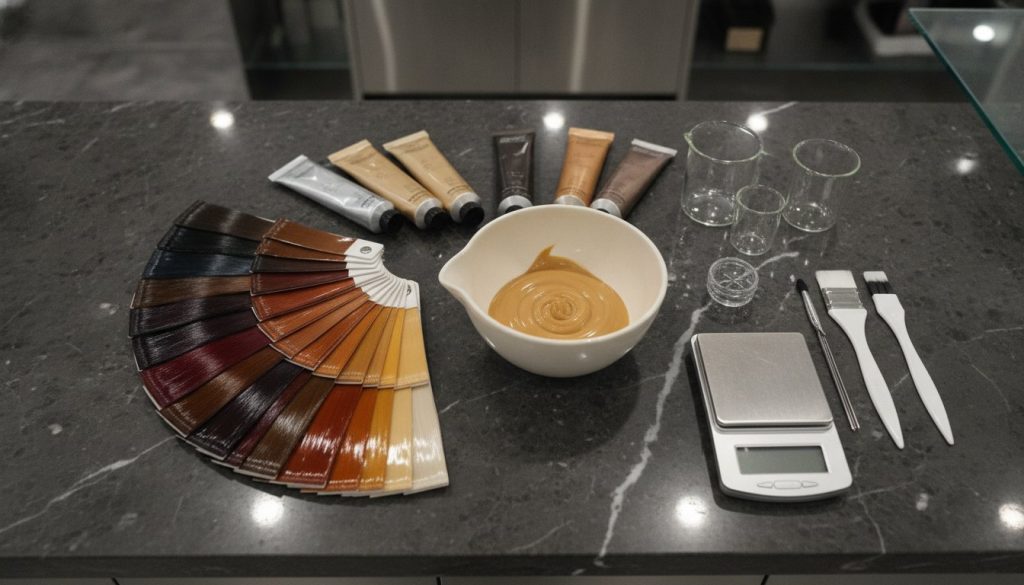
Precision requires the right equipment. You should always use a plastic or glass bowl from a Mixing Bowl and Brush Set. Metallic bowls can trigger a premature chemical reaction with the developer, compromising the color’s potency and potentially causing scalp irritation. This chemical interference can shift the tonal direction of your formula, resulting in unexpected brassiness or muddy results.
A digital scale is non-negotiable for the modern stylist. It’s the only way to guarantee a true 1:1 or 1:2 ratio, as different color creams have varying densities that volume-based measuring cups can’t accurately capture. Finally, pay attention to your technique. Whisking the mixture rather than just stirring it ensures proper oxygenation. This creates a creamy, homogenized consistency that glides onto the hair, ensuring every strand receives the exact same concentration of pigment and lift.
Deciphering Developer Volumes: Selecting the Right Strength
Your choice of developer volume acts as the throttle for your entire color service. It controls the speed and intensity of the lift while determining the ultimate permanence of the pigment. To master how to properly mix professional hair color and developer, you must treat the developer as a precision tool rather than a generic additive. Each volume serves a specific chemical purpose in the high-end salon environment, and selecting the wrong one can jeopardize your entire color map.
- 10 Volume (3% Peroxide): This is the ultimate choice for deposit-only results. Use it when toning pre-lightened hair or refreshing mid-lengths and ends to avoid shifting the natural base.
- 20 Volume (6% Peroxide): Recognized as the industry standard, this strength provides the necessary power to open the cuticle for 100% gray coverage and 1 to 2 levels of lift.
- 30 Volume (9% Peroxide): When you need 2 to 3 levels of lift or high-impact fashion tones, this volume provides the required energy to bypass natural pigments.
- 40 Volume (12% Peroxide): Reserved for maximum high-lift applications, this strength is the most aggressive. It requires a meticulous application and constant professional monitoring to protect the hair’s integrity.
Matching Volume to Hair Integrity
Before you commit to a formula, evaluate the hair’s porosity and chemical history. Sensitized or previously lightened hair often lacks the structural resilience to handle high-volume peroxide. In these cases, we advocate for a “low and slow” approach. Dropping down a volume level and extending the processing time often results in a more even, healthier finish. Scientific data regarding hair dye ingredient safety underscores the importance of respecting the hair’s lipid barrier during these oxidative processes. Don’t sacrifice the hair’s fabric for a faster result.
Gray Coverage vs. High-Lift Blonde
Stubborn gray hair requires the specific alkaline punch of a 20 volume developer to ensure pigments fully saturate the cortex. While it’s tempting to reach for 30 volume for faster results, higher strengths can often expose unwanted underlying warmth, leading to brassy undertones. For high-lift blonde goals, the higher volumes are necessary but must be balanced with the correct tonal pigments to neutralize warmth. Our Color Bar Professional Hair Color is formulated to work synergistically with these specific volumes, ensuring predictable, elite results every time you mix. Choosing the right strength isn’t just about the finish; it’s about the health of the hair post-process.
Master the Math: Calculating Ratios for Every Color Service
Precision is the hallmark of the expert stylist. While entry-level tutorials might suggest a “one size fits all” approach, the reality of high-end color is far more nuanced. Understanding how to properly mix professional hair color and developer requires a mastery of ratios, as these numbers dictate the chemical strength and pigment density of your formula. Every professional tube, including our Color Bar Professional Hair Color, is engineered for a specific mathematical synergy that ensures predictable, elite results.
- The 1:1 Ratio: This equal-parts formula is the standard for permanent color. It provides the highest pigment concentration, making it essential for maximum gray coverage and deep, opaque saturation.
- The 1:1.5 Ratio: Often favored by high-end metropolitan brands, this “middle ground” offers a slightly thinner consistency. It perfectly balances lifting power with pigment deposit for a sophisticated, multi-dimensional finish.
- The 1:2 Ratio: Reserved for high-lift blondes and sheer toners. The double dose of developer provides the extra oxygenation needed to clear natural melanin while ensuring the translucency required for bright, clean blonding.
Calculating Ounces and Milliliters with Precision
Most professional color tubes are 2oz (60ml), but elite stylists don’t rely on the markings on a plastic cup. Weighing your formula in grams on a digital scale is the only way to achieve a true chemical balance. For a 1:1.5 ratio using a standard 60ml tube, you would need exactly 90ml of developer. If you’re working with thick or long hair, you must increase both components proportionally. Never “stretch” a formula by adding extra developer; this violates hair dye safety precautions and compromises the hair’s integrity by altering the intended pH level.
Common Mixing Ratio Mistakes to Avoid
The “Runny Mix” trap is a frequent error. When you add too much developer, you dilute the pigment precursors, leading to translucent coverage and the risk of the product dripping into the client’s eyes. On the other hand, a “Pasty Mix” caused by insufficient developer fails to fully activate the color molecules. This results in “pinking” or muddy ends where the color hasn’t processed correctly. Using a dedicated Mixing Bowl and Brush Set allows you to see the consistency clearly, ensuring a smooth, homogenized cream that guarantees a professional standard of excellence.
The Professional Mixing Protocol: Step-by-Step Execution
Precision execution is what separates a master stylist from an amateur. Once you’ve determined your ratios and selected your developer volume, the physical act of blending requires a meticulous approach. Mastering how to properly mix professional hair color and developer is as much about the order of operations as it is about the math. A haphazard mix results in uneven oxidation, which directly translates to patchy saturation and unpredictable tonal shifts. To maintain an elite standard, you must follow a disciplined protocol at the color bar.
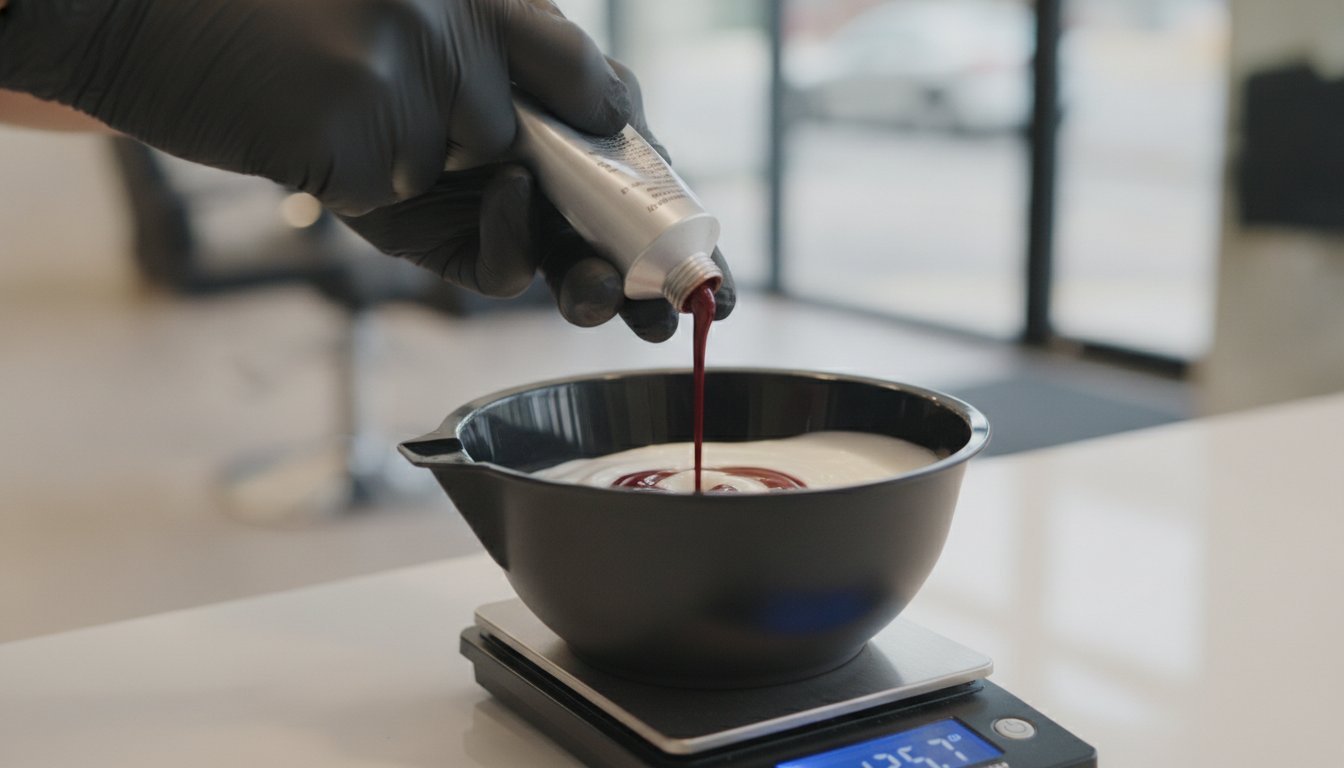
Start by placing your bowl from the Mixing Bowl and Brush Set onto a digital scale and zeroing it out. Always squeeze the required amount of Color Bar Professional Hair Color into the bowl first. This “cream-first” method is a professional secret that many tutorials overlook. By breaking up the dense color cream with your brush before adding liquid, you eliminate the stubborn clumps that often hide pockets of unoxidized pigment. Slowly pour your developer into the center of the cream. Whisk the mixture with a steady, rhythmic motion until it reaches a smooth, custard-like consistency. You’re looking for a homogenized blend with absolutely no visible streaks of developer or pigment.
Achieving the Perfect Consistency
A well-mixed formula should have a luxurious viscosity that clings to the brush without dripping. If your mix feels too thin, you’ve likely over-poured the developer, which will lead to translucent coverage. If it’s too thick, it won’t spread easily, causing you to use more product than necessary. Remember that the chemical potency is highest in the first 30 minutes. The oxidation process begins the millisecond the components touch, so you must transition from the mixing bowl to the hair immediately to capture the peak of the reaction.
Safety and Cleanliness in the Color Bar
Professionalism extends to your environment and personal protection. Ensure your client is protected with a high-quality Salon Cape and that you’re wearing professional-grade gloves to prevent skin irritation. Proper ventilation is essential during the oxidation process to manage the release of vapors. Once your service is complete, dispose of any unused mixed color. Never attempt to save leftovers; the chemical reaction is finite, and the mixture will lose its efficacy and stability within an hour. For the best results, ensure you have a dedicated Mixing Bowl and Brush Set that is cleaned and dried between every client to avoid cross-contamination of tones.
Post-Color Perfection: Protecting Your Investment
The artistry of a perfect application relies heavily on the chemistry you established at the mixing scale. While knowing how to properly mix professional hair color and developer creates the initial brilliance, the first 48 hours post-service determine the color’s ultimate lifespan. This period is a critical window where the hair’s pH balance must stabilize. We advise clients to avoid shampooing or excessive moisture during this time. The cuticle, which was opened by the developer’s alkalinity, requires this duration to fully contract and trap the new pigment molecules deep within the cortex.
Standard retail shampoos often use harsh surfactants that strip the lipid barrier we worked so hard to preserve during the oxidation process. Professional-grade, sulfate-free systems are non-negotiable for anyone serious about color longevity. These high-performance formulas cleanse without disturbing the molecular bonds of the pigment. This ensures that sophisticated shades remain vibrant and true to tone rather than shifting into dull or brassy territory within a few weeks.
The Synergy of Color and Keratin
A sophisticated approach to hair health often involves layering treatments to achieve a mirror-like shine. Integrating a Silk Touch Keratin Treatment can dramatically enhance the depth of your professional color. For the best results, you should perform your color service first. The keratin treatment then acts as a vacuum-sealed protective shield, smoothing the cuticle and locking in the pigment. Maintain this elite finish at home by using Silk Touch Shampoo and Conditioner. These products are specifically engineered to support the hair’s natural pH and prolong the life of both the color and the keratin structure.
Weekly Maintenance for Salon-Grade Results
Chemical processes, no matter how precise, require ongoing structural support to remain healthy. We recommend incorporating a Keratin Intensive Treatment once a week. This deep-conditioning protocol repairs chemical bonds and replenishes the vital proteins lost during the lifting process. Additionally, always apply a Keratin Infused Serum before using a Professional Hair Dryer or Professional Flat Iron. High heat is a primary driver of color oxidation and fading; a heat-protective barrier is essential to maintain the integrity of the hair fiber.
Excellence is a habit, not a one-time event. When you master how to properly mix professional hair color and developer and follow through with elite maintenance, you achieve a standard of beauty that is uncompromising. Elevate your daily routine and secure your artistic investment with our Color Bar Professional collection.
Elevate Your Artistry with Professional Precision
Mastering the science of activation transforms a routine service into an elite experience. You’ve learned that precision isn’t optional; it’s the foundation of high-performance color. By understanding how to properly mix professional hair color and developer, you ensure that every formula delivers the exact pH balance and pigment density required for a flawless finish. From selecting the perfect developer strength to executing a meticulous mixing protocol, these techniques separate the standard stylist from the metropolitan expert.
Your choice of product is just as critical as your technique. Our formulas are trusted in elite New York salons for their professional-grade pigment density and reliable 100% gray coverage. We believe in beauty without compromise. That’s why our range features cruelty-free and vegan-friendly ingredients that respect both the hair and the environment. Take the next step in your professional journey and experience the difference that high-end chemistry makes. Shop the Color Bar Professional Collection today to bring salon-standard excellence to every bowl you mix. You have the tools and the knowledge; now it’s time to create something extraordinary.
Frequently Asked Questions
Can I mix hair color and developer from different brands?
We strongly advise against intermixing brands. Professional color lines are engineered with specific pH levels and molecular weights that correspond exactly to their own developers. Using a different brand can disrupt chemical stability, leading to unpredictable tonal shifts or uneven saturation. For the high-performance results expected in an elite salon environment, always stick to a unified professional system to ensure the hair’s lipid barrier remains protected.
What happens if I use too much developer in my hair color mix?
Excess developer dilutes the pigment precursors, leading to translucent coverage and a runny consistency that is difficult to control. This imbalance also increases the alkalinity of the formula, which can lead to unnecessary chemical stress on the hair cuticle. To learn how to properly mix professional hair color and developer with precision, always use a digital scale to ensure your ratios maintain the intended chemical integrity.
How do I know if I need 20 or 30 volume developer for gray coverage?
20 volume developer is the gold standard for achieving 100% gray coverage. It provides just enough lift to open the cuticle while allowing maximum pigment deposit. 30 volume is typically reserved for clients with exceptionally coarse or resistant hair, or when you need to lift the natural base by two to three levels while simultaneously covering grays. Be mindful that higher volumes can sometimes expose unwanted underlying warmth.
Do I mix the hair color or the developer in the bowl first?
You should always place the color cream in the bowl first. This professional “cream-first” protocol allows you to use your brush to break down the dense color paste before introducing the liquid developer. By smoothing the cream first, you ensure a homogenized, custard-like consistency. This prevents the stubborn clumps that often lead to patchy application and inconsistent oxidation once the mixture is applied to the hair.
Can I save leftover mixed hair color for my next touch-up?
Mixed hair color cannot be saved for future use. The oxidation process begins the moment the developer and color touch, and the chemical reaction is usually exhausted within 60 minutes. Once this window closes, the mixture loses its ability to penetrate the hair and deposit pigment. Additionally, storing mixed color in a sealed container is a safety hazard, as the chemical gases produced during oxidation can cause the container to burst.
Is a 1:1 ratio always best for permanent professional color?
While a 1:1 ratio is standard for permanent color and gray coverage, it isn’t universal. Many high-lift blonde series or sheer toners require a 1:2 ratio to achieve the necessary translucency and brightness. Mastering how to properly mix professional hair color and developer involves reading the specific instructions on each tube. Using the wrong ratio can result in “hot roots” or a finish that lacks the desired depth and dimension.
What should I do if my hair color mix is too thick to apply?
If your mixture feels too thick, don’t simply add more developer. Adding extra liquid after the initial mix alters the pH and dilutes the pigment, compromising your results. Instead, ensure you’re whisking the mixture vigorously with a professional brush to emulsify the components. If you’ve followed the correct ratio and it still feels unworkable, it’s better to start fresh than to risk an uneven, low-performance application.