How to Promote Keratin Treatments in Your Salon: A 2026 Guide
A keratin treatment can attract attention and still leave clients unsure what they’re booking. To understand how to promote keratin treatments in your salon, start with a clear distinction: smoothing services can help manage frizz and improve hair’s feel, but they aren’t automatically permanent straightening. Precise expectations build more trust than dramatic promises.
Clients want to know whether a treatment suits their hair, what results to expect, and how to care for it afterward. Salon owners and stylists need a practical way to answer those questions while making the service easier to discover and consult about. Promotion works best when education, visibility, and the consultation process reinforce one another.
This guide lays out a repeatable approach: explain the service in plain language, create useful content for your website and social channels, make key information easy to find, and shape inquiries into informed consultations. You’ll also see how to set expectations around suitability and aftercare, and how to keep promotion aligned with your salon’s workflow. The aim isn’t louder marketing; it’s clearer communication that helps the right clients take the next step.
Key Takeaways
- Describe smoothing and straightening accurately, and avoid suggesting every keratin service delivers the same outcome.
- Build service messaging around client goals, suitability, and what a stylist-led consultation can clarify.
- Make your service easier to find by keeping its description and salon details consistent across profiles you control.
- Use a considered inquiry process to learn about hair history and expectations before discussing whether the service may be suitable.
- Turn how to promote keratin treatments in your salon into a repeatable workflow: audit, clarify, publish, respond, review, and refine.
Start with a keratin service clients can understand and trust
Effective service promotion matches accurate education with the client’s next step, from first question to stylist consultation. Before choosing photos or writing a booking prompt, make sure your description explains what the service is intended to address, what will be discussed during consultation, and why the result depends on the selected treatment and the individual’s hair.
That distinction matters because “smoothing” and “straightening” aren’t interchangeable promises. The term keratin treatment is used broadly, and clients may arrive expecting a specific finish. For background on the terminology and process commonly associated with Brazilian hair straightening, salons can review this overview, then describe their own service according to its product documentation and professional assessment.
Define the treatment without overpromising
Use plain language and specific, supportable details. Explain the concern your service is designed to address, such as frizz or manageability, then clarify that the consultation helps determine whether the service aligns with the client’s hair history and expectations. Don’t imply permanent repair, guaranteed results, or that every client will get the same finish.
Keep claims tied to the exact product used. For example, Hair Bar NYC Professional describes Silk Touch Formaldehyde-free Keratin Treatment as formaldehyde- and aldehyde-free. That detail belongs to this specific treatment; it shouldn’t be generalized to other products or to keratin services as a category. Check the relevant product documentation before including formula, application, result, or aftercare details in salon materials.
A clear service description might say: “A stylist-led smoothing service for clients looking to address frizz or manageability. We’ll discuss your hair history, desired finish, and treatment suitability during consultation.” Adjust the wording to match the treatment you actually use.
Choose the client and concern your message addresses
Decide who the service is intended for and what questions your salon can answer responsibly. One client may ask whether smoothing will preserve their natural texture; another may want to understand how a treatment fits with their hair’s chemical history. Use those questions to shape useful website copy, consultation prompts, or social content, not to make unsupported promises.
Suitability depends on professional assessment and the selected service. A concise message can invite clients to share their goals and relevant hair history before an appointment is discussed. This gives the stylist a chance to explain realistic options and limits, while helping the client arrive with clearer expectations.
That clarity is central to how to promote keratin treatments in your salon: help clients understand the service before asking them to book. A well-informed inquiry is a stronger starting point for a considered consultation and a service experience built around the person, not a one-size-fits-all claim.
Build keratin treatment messaging around education and salon value
A service page should do more than name a treatment. Strong messaging helps prospective clients recognize whether the service may match their goals, understand what the salon will discuss, and know what to do next. Keep the language consistent across your service menu, booking description, and staff responses so clients don’t encounter conflicting claims as they move from research to inquiry.
Write service-menu copy that answers practical questions
Start with the treatment’s clear name, followed by a short, factual description. State the concern it addresses, who may want to ask about it, and that consultation helps the stylist review hair history, desired results, and suitability. Avoid adding claims about treatment time, ingredients, results, or maintenance unless those details are confirmed for the exact product and service.
For example: “A professional smoothing treatment for clients looking to address frizz or manageability. Consultation helps us discuss your hair history, goals, and whether this service is a suitable option.” Adapt the wording to your salon’s treatment and its verified documentation. A booking description should clarify the purpose of the appointment, not imply that every client will achieve the same finish.
Train the team to use the same client-friendly language. If a client asks whether a treatment will straighten their hair, staff can explain that outcomes depend on the specific service and professional assessment, then invite them to discuss their desired finish. This keeps the conversation helpful without turning a general question into an unsupported guarantee.
Create useful education for social and email channels
Let recurring questions guide your content. A short post or newsletter can address one topic at a time, such as the difference between smoothing and straightening, what information to bring to a consultation, or why hair history matters when considering a service. Keep the explanation direct, and use a simple next step: invite readers to ask the salon about suitability rather than promise a particular result.
Before-and-after material can help illustrate a service, but represent it carefully. Use authentic, appropriate images and avoid implying that one client’s outcome predicts another’s. Captions should identify the content as an individual example and include context where needed, rather than treating a visual as proof of a universal result.
For deeper client education, link to Hair Bar NYC Professional’s professional guide to formaldehyde-free keratin treatments. The guide can support a broader conversation, but keep any product-specific claims in your salon copy tied to the documentation for the exact treatment you use. This kind of considered communication is central to how to promote keratin treatments in your salon with credibility.
Improve local SEO for hair stylists promoting keratin services
Local visibility works best when a potential client can move from a search to a useful service page, then understand how to inquire. Build that path around information your salon controls: a clear keratin treatment page, accurate business details, and consistent service descriptions across your profiles. Search platforms change, so check their current guidance before relying on a particular feature or claiming it influences rankings.
Create a dedicated keratin service page
Give the service a page of its own rather than burying it in a broad list of offerings. Use the treatment name naturally in the page title, main heading, and body copy. Explain the concern the service is intended to address, what a consultation covers, and how a client can take the next step. Keep claims specific to the exact treatment and supported by its documentation.
Organize the page so both readers and search engines can scan it. Brief sections can address questions such as:
- What does the salon mean by a keratin or smoothing service?
- What hair history or goals should a client discuss?
- How does the salon assess suitability and set expectations?
- How can someone ask a question or request an appointment?
Answer only what your salon can verify. If a detail depends on the selected product or individual assessment, say so rather than filling the gap with a general promise. Link to relevant salon education where it adds context, instead of copying a broad treatment guide word for word.
Strengthen local discovery without keyword stuffing
Review the salon’s website and profiles that it manages. Check that the salon name, contact details, and keratin service description are accurate and consistent. If the treatment name or description changes, update those controlled listings so prospective clients don’t encounter outdated information. Use location terms only where they read naturally and accurately; repeating them throughout the page can make copy feel forced and does not guarantee search placement.
Invite clients to share honest feedback about their experience, but don’t script what they should say or offer an incentive for specific claims. Reviews can help prospective clients understand the service through real experiences, while the salon’s own copy should continue to set realistic expectations.
Finally, connect discovery to a measurable client journey. Use salon records to note which inquiries mention the service page or a profile, then track consultation requests and bookings. These observations can show where clients are finding the service and where the path needs clarification. That’s a practical foundation for how to promote keratin treatments in your salon without relying on ranking promises or inflated claims.
Turn keratin inquiries into confident consultations and bookings
A clear response can turn curiosity into a productive next step without rushing a client into an appointment. When someone asks about a keratin service, use the exchange to understand their goals, hair history, and questions. Then explain what can be assessed in consultation and what cannot be confirmed from a message alone.
Prepare consultation content that reduces uncertainty
Give stylists a consistent set of prompts, while leaving room for a personal conversation. Ask what the client hopes to change, how they’d like their hair to look and feel, and what treatments or chemical services are part of their hair history. Clarify what they mean by “smoother” or “straighter,” since those goals may not be the same.
Use their answers to guide the discussion, not to pre-approve the service. A stylist can explain that suitability and expected outcomes depend on professional assessment and the specific treatment selected. If the client asks about ingredients, application, or aftercare, refer only to information confirmed for that product. Don’t use a general marketing statement as a substitute for an individualized conversation.
Make the next step easy to understand. Depending on the salon’s process, invite the client to request a consultation or book an available appointment. If more information is needed first, tell them what details to share or how to continue the conversation. Clear options make the inquiry feel supported, not pressured.
Use reviews and client stories responsibly
After a service, invite clients to leave honest feedback if they wish. Follow the current policies of the platform where a review is requested, and don’t script a client’s wording or ask them to make claims they can’t personally support. Thoughtful feedback can help future clients understand the experience, while your own service information remains the place to explain the process and its limits.
Client stories and images also need appropriate permission and context. Describe what the individual wanted and what they experienced without implying that another person should expect the same outcome. A single story can illustrate a service, but it can’t establish universal suitability or guarantee results.
This measured approach is central to how to promote keratin treatments in your salon: respond with care, guide each inquiry toward an informed decision, and make booking the next step only when the client is ready. For professional salon products and education that support stylist-led service decisions, explore Hair Bar NYC Professional.
Create a repeatable keratin treatment promotion plan for your salon
Promotion becomes easier to manage when it follows a simple cycle instead of depending on occasional posts. Use this sequence to keep the service accurate, visible, and connected to a clear client journey:
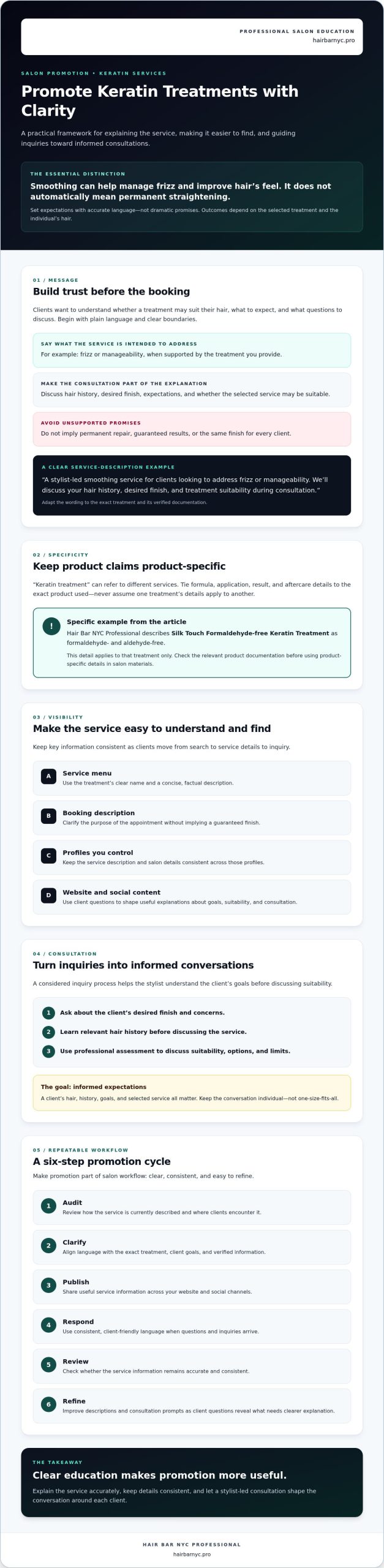
- Audit: Review your service page, booking descriptions, salon-controlled profiles, and staff responses. Note outdated details, unclear wording, or gaps in the inquiry process.
- Clarify: Confirm how the service is described, which client concerns it addresses, and what the consultation covers. Check claims against the documentation for the exact treatment used.
- Publish: Update the relevant service information, then create useful content based on questions clients actually ask. Keep each post, email, or page consistent with the same verified description.
- Respond: Give staff a shared set of talking points and a clear process for handling inquiries. Team members should know what they can answer directly and when a stylist needs to assess suitability.
- Review: Use salon records to note where inquiries came from and whether they led to consultation requests or bookings.
- Refine: Improve the weakest part of the journey, whether that’s an unclear service description, a missing answer, or an inquiry that doesn’t receive a clear next step.
Choose practical signals to review
Track keratin-related questions, consultation requests, and bookings in the salon’s existing records. Where possible, note whether an inquiry came through the website, a salon profile, social media, email, or another channel. The goal isn’t to assume one source performs better; it’s to understand what your own activity shows over time.
Pay attention to repeated objections or points of confusion. If clients often ask whether smoothing means straightening, for example, that may signal a need for clearer language on the service page or in staff responses. Use the pattern to guide a specific update, then review your records again later. Don’t set a benchmark without a reliable basis or treat a change in bookings as proof of a single cause.
Keep promotion consistent with professional standards
Train the team to explain the service consistently across inquiries, consultations, and booking conversations. Revisit that guidance when service details or product documentation changes. Keep each treatment’s claims separate, and remove outdated copy rather than carrying it forward into new posts.
For licensed salon professionals, Hair Bar NYC Professional offers distinct professional keratin treatment options alongside online education and stylist support. Explore its professional products and education as you refine a service approach grounded in accurate information and stylist-led consultation.
Make Clear Promotion Part of Your Salon Workflow
Strong keratin treatment promotion starts with clarity. Explain the service in accurate, client-friendly language, distinguish smoothing from straightening, and keep product-specific claims grounded in the right documentation. Then make the service easy to find and guide inquiries toward a stylist-led consultation where goals, hair history, and suitability can be discussed.
To put how to promote keratin treatments in your salon into practice, build a simple cycle: review your service information, publish useful education, respond thoughtfully, and use your salon’s own records to see where clients are engaging. Consistency across your team helps each interaction feel informed and considered, without relying on exaggerated promises.
For licensed professionals and salon owners, Hair Bar NYC Professional offers professional salon products, online education, and stylist support. Explore professional salon products and education as you refine your approach. Clear communication is a practical foundation for attracting better-matched inquiries and building client trust, one consultation at a time.
Frequently Asked Questions
How can I promote keratin treatments in my salon?
Promote keratin treatments by pairing clear service information with a straightforward path to consultation. Describe the concern the service addresses, clarify that smoothing and straightening aren’t interchangeable, and explain what a stylist will discuss before recommending a treatment. Make the service easy to find on your website and salon profiles, then prepare staff to respond consistently. Review inquiries, consultation requests, and bookings in salon records to see what may need refining.
How do I get more clients interested in keratin treatments?
Help potential clients recognize whether the service may fit their goals. Share useful answers to common questions through your website, social channels, or email, and invite interested clients to discuss their hair history and expectations with a stylist. Authentic client feedback may also offer perspective, but don’t present one person’s experience as a typical result. Focus on informing and attracting better-matched inquiries rather than relying on dramatic claims or pressure.
What should a salon include on a keratin treatment service page?
A keratin service page should name the treatment, explain its intended purpose in plain language, and outline what a consultation covers. Include a clear way to inquire or book, plus concise answers to practical questions about suitability and expectations. Keep product-specific details tied to the documentation for the treatment used. If a point depends on an individual assessment, say so rather than making a broad promise about results, timing, ingredients, or maintenance.
Does local SEO help hair stylists promote keratin treatments?
Local SEO can help make a salon’s service information easier to discover online, but it can’t guarantee rankings or bookings. Start with a dedicated service page and check that your salon’s business details and keratin service description are accurate across profiles you control. Use treatment language naturally in page titles, headings, and copy. Review current platform guidance before relying on specific features or claiming that a particular factor determines search placement.
How can a salon explain keratin treatment results without overpromising?
Describe the service’s intended purpose and explain that the finish depends on the selected treatment and professional assessment. Avoid suggesting that smoothing always means straightening, or that every client will get the same result. Keep statements about ingredients, process, and performance connected to the exact product’s confirmed documentation. A consultation gives the stylist a chance to consider hair history and client goals before discussing suitability and setting realistic expectations.
What content should a stylist post to promote keratin services?
Post concise educational content based on questions clients actually ask. Useful topics include the difference between smoothing and straightening, what to discuss during a consultation, and why hair history matters when considering a service. If you share before-and-after material or client stories, use authentic content with appropriate permission and context. Make captions informative, avoid implying that one example predicts another client’s outcome, and direct interested readers toward a consultation.
How should salon staff respond to keratin treatment inquiries?
Staff should acknowledge the client’s goal, ask about relevant hair history, and clarify what they mean by a smoother or straighter finish. They can explain what the consultation will cover, but shouldn’t confirm suitability or promise a result based only on a brief message. If product-specific questions arise, use verified information for that treatment. Offer a clear next step, such as requesting a consultation or using the salon’s online booking route.