Best Professional Flat Irons: A Salon Buying Guide

What makes the best professional flat iron for stylists: the highest heat setting, or the tool that fits the client and service in your chair? Product specifications can look impressive, but plate material, width, and temperature information are most useful when you can connect them to your workflow.
Choosing a salon tool means weighing practical details rather than chasing one standout feature. Plate material and width are separate considerations, and neither guarantees a particular result. The right combination depends on the services you offer, the clients you work with, and the way you prefer to handle the tool.
This guide provides a framework for comparing professional flat irons, interpreting common specifications, and identifying questions to ask before buying. It also reviews the ORYA Ionic Flat Iron from Hair Bar NYC Professional using its documented details: 1.5-inch nano-titanium plates and a listed maximum temperature of 480°F. Those are useful specifications to evaluate, not a universal recommendation. Use the comparison to decide whether the documented features suit your salon workflow and professional needs.
Key Takeaways
- Choose the best professional flat iron for stylists by matching documented features to your services and workflow, not by popularity alone.
- Compare plate material and width separately. Neither specification proves that a tool will produce a particular result.
- Use a side-by-side checklist to compare temperature information, controls, and product documentation. Mark unlisted details as unavailable.
- Before buying, define your service needs, identify required features, check manufacturer specifications, and ask the supplier about missing information.
- Consider Hair Bar NYC Professional’s ORYA Ionic Flat Iron as one documented option, then decide whether its listed specifications fit your professional needs.
What Makes a Professional Flat Iron Right for Stylists?
A professional flat iron is a heat-styling tool selected for repeated salon use and the services a stylist performs, not simply for its professional label or maximum temperature. The best professional flat iron for stylists depends on what the tool needs to support, the clients in the chair, and how clearly the manufacturer documents its specifications.
A flat iron uses heated plates to temporarily shape hair. For a foundational overview of the tool and how heat styling works, see Hair iron. Choosing a salon tool, however, involves more than understanding its basic function. A popular consumer pick or strong online rating won’t necessarily tell you whether its plate width, material, or controls suit your services.
A high listed maximum temperature doesn’t establish that an iron is suitable for every service or client, either. The maximum is a product specification, not a recommended setting for every head of hair. Compare the full set of available details, then use professional judgment to assess how the tool fits a particular service.
Which salon tasks should shape your flat iron choice?
Start with the services and techniques the iron will support most often. Consider whether you mainly use it for straightening, finishing, or creating varied styles. Then think about the clients you regularly serve and the handling characteristics you value at your station. Hair length, texture, condition, and styling preferences can all inform which features matter to your work.
Keep specifications separate from outcomes. Plate measurements and temperature listings describe the tool. The result also depends on technique and the client’s hair condition, so don’t assume a specific feature guarantees a particular finish.
What does “professional” mean in a buying guide?
Treat “professional” as a starting point for evaluation, not proof that a tool is right for your salon. Look for clear, comparable manufacturer information and assess how each documented feature supports your services and daily workflow. If an important detail isn’t listed, mark it unavailable and ask the supplier rather than filling the gap with assumptions.
Reviews and popularity rankings can offer perspective, but they rarely establish fit for a specific professional routine. For licensed stylists and salon owners, a more useful comparison weighs verified specifications against actual service needs, client variety, and how the tool will be used. This keeps the decision grounded in evidence instead of promotional claims.
Which Flat Iron Specifications Matter Most in a Salon?
Compare plate material, width, temperature information, and controls as separate factors. A specification is useful when the product listing explains what it refers to and gives you enough detail to compare options. Don’t treat a particular material, a wider plate, or a high heat limit as proof of a specific result.
Plate width is worth comparing with your usual techniques and service mix. Check the manufacturer’s stated measurement rather than estimating from product photos, then consider how the width fits your preferred handling style. No single measurement establishes a good fit for every stylist or client.
Titanium or ceramic plates: what can stylists compare?
Titanium and ceramic are different plate-material categories. The label alone doesn’t establish how an iron will perform across hair types or services, so check whether the product listing clearly identifies the material. If it mentions a blend or coating, look for precise details instead of assuming its composition or benefits.
Compare material alongside width and controls. Treat each as documented product information, not a guarantee of a particular finish.
How should you interpret a flat iron’s temperature range?
Check the manufacturer’s documentation for listed temperature settings, adjustment options, and maximum temperature. A maximum describes the tool’s stated upper limit; it isn’t a recommended setting for every service or client. A listed maximum temperature is a product specification, while a recommended setting depends on applicable manufacturer guidance and professional judgment.
Controls matter, too. Review how the settings are selected and whether the manufacturer provides relevant instructions. Don’t fill gaps in a listing with assumptions. For general background on heat and hair, read this overview of the science of heat damage, then use current product documentation for tool-specific guidance.
Before purchasing, confirm that the specifications are current and complete. Record what’s stated and note missing details, including:
- Plate material and width
- Temperature information and adjustment options
- How the controls work, if documented
- Available manufacturer instructions or service guidance
If a missing detail matters to your workflow, ask the supplier to clarify it before deciding. Clear documentation makes it easier to compare practical fit instead of relying on assumptions.
How to Compare Professional Flat Irons for Different Salon Workflows
A useful comparison connects each tool’s verified specifications to the services you perform, your handling preferences, and how often the tool will be used. The goal isn’t to find the longest feature list. It’s to identify which documented features matter at your station and where the product listing leaves questions unanswered.
Use a simple matrix to compare options side by side. Enter information from current manufacturer documentation or the product listing. If a detail isn’t provided, mark it “unavailable” rather than guessing.
| Comparison factor | What to record | Workflow question |
|---|---|---|
| Plate material | Manufacturer’s stated material | Does the listing provide enough detail for your evaluation? |
| Plate width | Documented measurement | Does the width suit your usual techniques and service mix? |
| Temperature information | Listed range or maximum, if provided | Are the temperature details clear and relevant to your needs? |
| Controls | Documented adjustment and control features | Can you confirm how the tool’s settings are selected? |
| Documentation | Product instructions and source checked | Are essential specifications or guidance missing? |
How can stylists assess plate width and handling?
Compare the listed width with the techniques you use and the services you offer. Check product descriptions for actual dimensions, since product photos aren’t a reliable way to estimate plate size. If possible, assess handling directly before purchase. Don’t assume a particular width is ideal for a technique unless the manufacturer or another reliable source supports that guidance.
Which checklist helps separate useful features from marketing language?
Keep the comparison grounded in evidence. For each tool, record the specification, where you found it, and anything the listing omits. If a claim about speed, durability, or results lacks supporting details, ask the seller for clarification. Then weigh verified information against your actual workflow before promotional language influences the decision.
- List your common services and preferred styling techniques.
- Note how frequently the tool will be used in your salon.
- Compare verified features and mark missing details as unavailable.
- Ask the supplier to clarify claims that could affect your purchase.
The best professional flat iron for stylists is the one whose documented features align with a stylist’s workflow, not a universal choice for every salon. A clear comparison helps licensed professionals and salon owners make that decision using the information available.
How Should Stylists Evaluate a Flat Iron Before Buying?
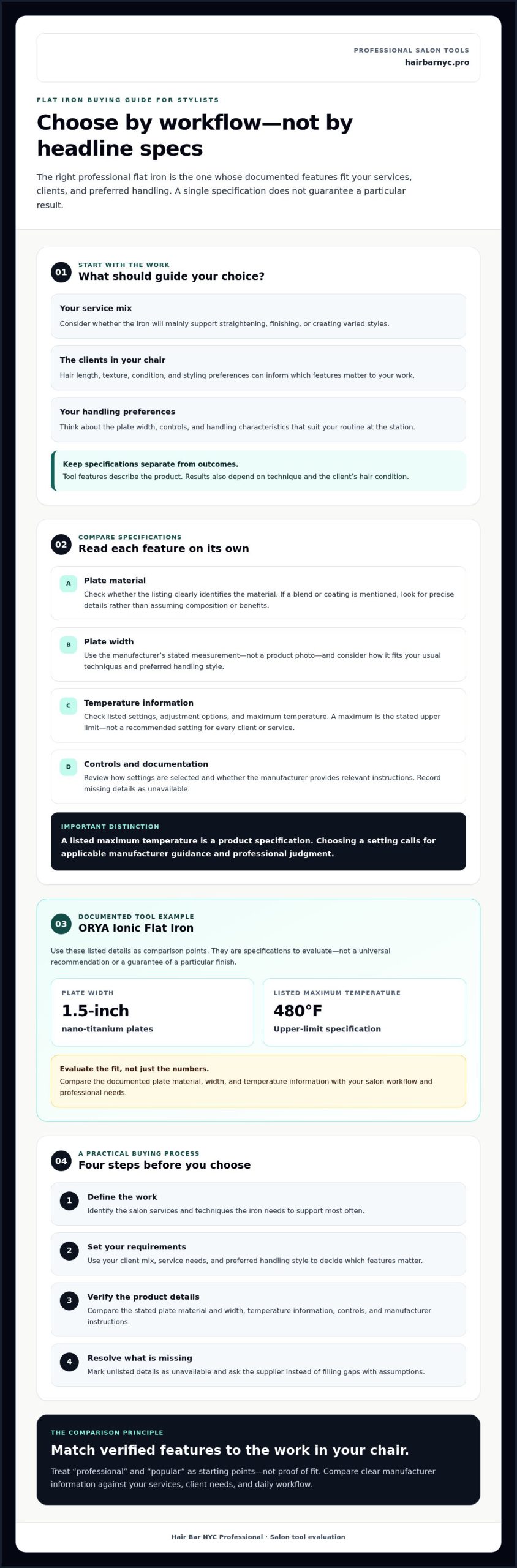
A disciplined buying process helps licensed professionals and salon owners separate salon fit from polished marketing language. Before deciding which option could be the best professional flat iron for stylists in your setting, work through these four checks:
- Define the services. Note which styling tasks the iron needs to support, how frequently it will be used, and which client needs are common in your salon. This gives you a practical basis for comparison.
- List required features. Identify the specifications that matter to your routine, such as plate material, width, temperature information, and controls. Separate essential requirements from preferences.
- Verify the specifications. Check the exact product name and details against current manufacturer documentation or the product listing. Don’t infer dimensions from photos or treat broad performance language as a confirmed specification.
- Compare options against your workflow. Weigh confirmed features against your services, handling preferences, and expected frequency of use. Record gaps that could affect your decision instead of filling them with assumptions.
What should you confirm in the product listing?
Review the exact product name, stated plate width and material, and listed temperature information. Look for clear documentation that explains the specifications; a third-party summary or general promotional claim may leave out important details. If warranty, service, or availability terms matter to your purchase, confirm them directly with the supplier before relying on them. Don’t assume terms that aren’t stated.
When information is missing, ask the supplier a focused question and keep the answer with your comparison notes. If a detail important to your salon’s requirements can’t be confirmed, treat it as unresolved rather than a point in the tool’s favor.
How can a stylist judge fit without a universal winner?
Match verified features to the services you perform and the way you prefer to work. A specification may suit one salon’s priorities without being essential to another’s. Separate personal handling preferences from broad performance claims, and avoid presenting an individual choice as right for all stylists. The stronger decision is supported by documented information and a clear fit with your workflow.
Use this checklist to evaluate Hair Bar NYC Professional’s documented flat iron specifications alongside other options. Explore the professional flat iron specifications as part of your research.
The ORYA Ionic Flat Iron: A Verified Professional Tool Example
Hair Bar NYC Professional’s ORYA Ionic Flat Iron has a specific set of documented details for licensed professionals and salon owners to assess. It’s an example to compare against your buying criteria, not a universal winner or a recommendation for every stylist.
What specifications are confirmed for the ORYA Ionic Flat Iron?
The available product information lists three specifications:
- Plate width: 1.5 inches
- Plate material: Nano-titanium
- Listed maximum temperature: 480°F
These details describe the product, but they don’t establish how it will perform for a particular service or on every client. The listed maximum is an upper temperature specification, not a recommended setting. Use it as one point of comparison, and rely on appropriate product guidance and professional judgment when considering heat use.
How can professionals decide whether this tool fits?
Return to the criteria you set for your salon. Does the documented 1.5-inch width align with the tools and techniques you prefer? Is nano-titanium the plate material you’re looking for? Does the listed maximum temperature answer your purchasing question, or do you need more detail about temperature controls and other features? Those additional specifications aren’t confirmed here, so check current product documentation rather than making assumptions.
For a fair comparison, enter the ORYA specifications in the same checklist as other options, then note any unavailable information. Consider how the confirmed details relate to your service mix, handling preferences, and expected frequency of use. Specifications can help narrow the choice, but only you can judge whether that combination suits your workflow.
Product details can change, so confirm that the name and listed specifications are current before purchase. If you have questions or need clarification about the ORYA Ionic Flat Iron, contact Hair Bar NYC Professional directly. The best professional flat iron for stylists is ultimately the one that meets the individual salon’s documented requirements, not a single tool declared right for everyone.
Explore professional styling tools from Hair Bar NYC Professional.
Choose a Tool That Fits Your Salon
The best professional flat iron for stylists isn’t determined by a popular ranking or one standout specification. Start with the services you perform, then compare documented plate material, width, temperature information, and controls against your salon’s needs. A listed maximum temperature describes the tool’s limit, not a recommended setting for every client or service.
Hair Bar NYC Professional’s ORYA Ionic Flat Iron is one option to assess. Its documented specifications include 1.5-inch nano-titanium plates and a listed maximum temperature of 480°F. Use those details as a starting point, verify current product information, and decide whether they align with your workflow. They don’t make it a universal choice for every professional.
Build your comparison around clear information and the way you work. Explore professional styling tools from Hair Bar NYC Professional as you evaluate options for your salon. A thoughtful checklist can help you make a confident, well-informed choice for your professional practice.
Frequently Asked Questions
What is the best professional flat iron for stylists?
There’s no verified universal winner for every stylist. To find the best professional flat iron for stylists in your salon, compare plate material and width, documented temperature information, controls, and fit with your services. Hair Bar NYC Professional lists the ORYA Ionic Flat Iron with a 1.5-inch width, nano-titanium plates, and a 480°F maximum. Treat these as specifications to evaluate, not proof that the tool suits every workflow.
Is a titanium flat iron better for professional salon use?
The available product information doesn’t establish that titanium is better than other plate materials for every salon or service. Assess material alongside plate width, controls, and manufacturer documentation rather than relying on material alone to judge suitability. Hair Bar NYC Professional lists nano-titanium plates for the ORYA Ionic Flat Iron. Compare that confirmed detail with your services and workflow, and verify any additional specifications you need before purchasing.
What flat iron width should a stylist choose?
Choose a width by comparing the manufacturer’s stated dimensions with your usual services, techniques, and handling preferences. No single width is established as best for every client or styling need. Hair Bar NYC Professional lists the ORYA Ionic Flat Iron at 1.5 inches wide, giving you a concrete measurement to compare with other tools. Check product documentation for exact dimensions instead of estimating from photos or relying on broad marketing language.
Is 480°F a recommended temperature for every client?
No. A listed maximum temperature is a product specification, not a recommended setting for every client, service, or hair condition. The ORYA Ionic Flat Iron is documented with a 480°F maximum, but the available information doesn’t provide client-specific temperature guidance. Check the tool’s current manufacturer instructions and use your professional judgment. Don’t infer a universal setting from the maximum specification alone.
How can stylists compare flat irons before buying?
Start by identifying the services and workflow the tool needs to support. Then compare verified plate material, width, temperature information, controls, and available documentation in a simple table. Mark missing specifications as unconfirmed and ask the supplier for clarification before relying on them. This evidence-based approach helps you assess real differences without treating promotional language or one standout feature as proof that a tool fits every salon.
Are professional flat irons only for licensed stylists?
Hair Bar NYC Professional positions its products for licensed professionals and salon owners, and this guide is written primarily for those salon-industry buyers. If you’re not a licensed professional, don’t assume these products are marketed to you. Before making a purchase decision, contact Hair Bar NYC Professional directly to confirm eligibility and review the product’s intended-use information. This keeps your decision aligned with the brand’s stated professional audience.