Continuing Education for Licensed Cosmetologists: The 2026 Professional Growth Guide
What if your mandatory license renewal wasn’t a regulatory burden, but the primary driver of your salon’s revenue growth? Most stylists view continuing education as a drain on their time and a distraction from the chair. It’s frustrating to pause your schedule for outdated courses that don’t reflect the sophisticated demands of today’s discerning clientele. We understand that every hour away from your station must deliver a return on investment. This guide offers actionable professional development tips for hair stylists using keratin treatments to help you master the 2026 landscape with confidence.
You’ll discover how to fulfill your specific professional requirements while elevating your artistry with elite solutions like our Hair Bar NYC Professional Silk Touch and Diamond Keratin Treatments. We’ll break down the latest renewal deadlines and show you how to leverage advanced smoothing techniques to command higher tickets. It’s time to stop checking boxes and start building an expert reputation that defines the standard of excellence in clean beauty. We are here to bridge the gap between regulatory compliance and professional mastery.
Key Takeaways
- Learn to navigate the 2026 shift toward high-definition, on-demand continuing education that respects your time and your craft.
- Transform mandatory hours into a strategic advantage by prioritizing high-revenue technical electives over basic compliance.
- Implement professional development tips for hair stylists using keratin treatments to command higher service tickets and establish expert status in clean beauty.
- Master the art of vetting CE providers to ensure their curriculum meets elite technical standards while maintaining your board-approved status.
- Bridge the gap between theoretical training and salon-floor excellence with professional-grade tools like the Silk Touch Keratin Treatment system.
Navigating Continuing Education Requirements for Licensed Cosmetologists in 2026
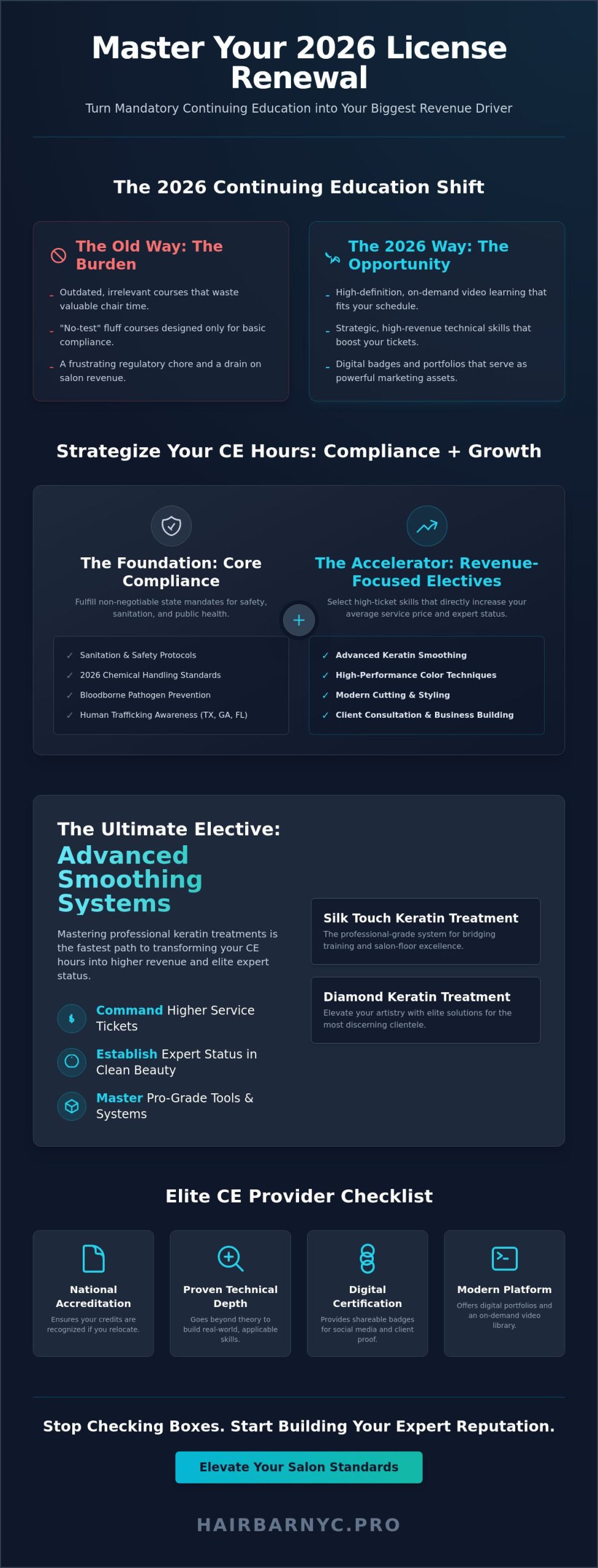
In the fast-paced environment of an upscale urban salon, time is your most valuable currency. Continuing Education (CE) often feels like a tax on that currency, but in 2026, it has evolved into a sophisticated tool for career advancement. These mandatory hours, dictated by state boards, ensure you maintain an active license while staying synchronized with industry shifts. The most significant change this year is the transition toward high-definition, on-demand video learning. This allows busy professionals to absorb complex techniques between appointments without sacrificing their chair time or salon revenue.
Choosing the right courses requires a discerning eye. You must verify national accreditation to ensure your credits carry weight if you relocate or seek cross-state recognition. For salon owners, staying current on evolving labor laws isn’t just a recommendation; it’s a foundational requirement for maintaining a professional standard of excellence. When seeking professional development tips for hair stylists using keratin treatments, prioritize providers who offer technical depth over simple compliance. Expert knowledge is the bridge between a standard service and a luxury experience.
Why State Boards Mandate Ongoing Learning
State mandates serve a dual purpose: protecting public health and elevating the industry’s professional tier. The 2026 disinfection protocols have become more rigorous, requiring specific knowledge of modern chemical interactions and specialized tool maintenance. Proper ventilation and chemical storage are paramount, especially when performing a Brazilian hair straightening or other intensive smoothing services. Additionally, states like Texas, Georgia, and Florida require mandatory hours dedicated to human trafficking awareness, ensuring stylists act as informed advocates within their metropolitan communities.
The 2026 National Trend: Quality Over Compliance
The era of “no-test” fluff is over. In 2026, the industry has pivoted toward meaningful technical assessments that actually prove mastery. Elite stylists are no longer satisfied with just a paper certificate. Instead, they seek digital certification badges to display on social media, turning their education into a powerful marketing asset. Digital portfolios are rapidly replacing traditional paper trails for license renewal, allowing you to showcase your evolving skills to both boards and high-end clients. Incorporating professional development tips for hair stylists using keratin treatments into your digital showcase proves you are an expert in high-performance care. This shift ensures that your education reflects the premium quality of the services you provide, such as the Silk Touch Keratin Treatment.
Mandatory Hours vs. Skill-Based Electives: Balancing Compliance and Career Growth
Most state boards mandate a specific split between core safety topics and elective professional development. For example, Illinois requires 14 hours every two years, while Florida stylists must complete 10 hours. While sanitation hours are non-negotiable, the elective portion is where you define your professional trajectory. Adopting a revenue-first mindset ensures that your time away from the chair pays dividends. Instead of choosing the easiest or cheapest course, select subjects that directly increase your average service ticket.
Integrating professional development tips for hair stylists using keratin treatments into your renewal cycle allows you to bridge the gap between basic licensure and elite expertise. This strategic approach transforms a regulatory chore into a competitive advantage. By focusing on high-ticket technical skills, you ensure that every hour of continuing education contributes to your long-term financial growth.
Fulfilling Core Requirements: Sanitation and Safety
Safety represents the foundation of a premium salon reputation. The 2026 chemical handling standards focus heavily on minimizing health risks through superior ventilation and precise application techniques. Understanding bloodborne pathogen prevention is essential in high-end urban environments where client safety is a hallmark of luxury. Fulfilling these requirements through streamlined digital modules allows you to maintain your standards without sacrificing valuable salon time. These core hours protect your license, your health, and your clients’ well-being.
Strategic Electives: Choosing Topics That Pay Off
Identify gaps in your current service menu to find the most profitable electives. If you aren’t offering a range of high-performance smoothing options, you are missing a significant revenue stream. Manufacturer-led training provides more depth than generic courses because it focuses on the specific chemistry of advanced formulations. For instance, mastering the application of the Diamond Keratin Treatment requires specialized knowledge that generic CE providers often overlook. These strategic electives also facilitate the transition from stylist to owner by incorporating business management and retail growth strategies.
- Manufacturer-led product knowledge and technical application.
- Advanced chemical safety, storage, and ventilation protocols.
- High-ticket technical certifications in smoothing and repair.
- Salon business management, marketing, and client retention.
Mastering these areas does more than keep your license valid. It positions you as an Expert Professional in a crowded metropolitan market. When you choose your next set of hours, prioritize professional development tips for hair stylists using keratin treatments to ensure your skills remain as sharp as your shears.
Mastering Advanced Smoothing Systems: Why Keratin Training is the Ultimate Elective
Technical mastery is the only way to separate yourself from the average stylist in a crowded metropolitan market. While basic license renewal is a legal necessity, choosing keratin smoothing as your primary elective is a strategic business decision. In 2026, keratin treatments remain the most profitable technical service on the salon menu, often yielding the highest hourly return. Clients are no longer looking for generic “frizz control”; they’re searching for experts who understand the nuances of high-performance hair repair.
The global keratin market is projected to reach $3.16 billion by 2034, driven by a compound annual growth rate of 6.49%. This growth isn’t coming from legacy products, but from advanced, sophisticated systems that prioritize hair integrity. If you’re looking for professional development tips for hair stylists using keratin treatments, focus your energy on becoming a specialist in clean beauty. Mastering these systems allows you to command premium pricing while building a loyal, high-spending clientele that values both results and safety.
The Evolution of Keratin: From Harsh Chemicals to Clean Beauty
The industry has undergone a massive shift away from legacy straightening methods toward modern, health-conscious formaldehyde free keratin treatment protocols. Modern systems like the Silk Touch Keratin Treatment utilize advanced protein delivery methods that work with the hair’s natural structure rather than against it. Understanding the science of molecular protein bonding gives you a significant competitive advantage. You’re not just applying product; you’re performing a sophisticated chemical transformation that requires precision.
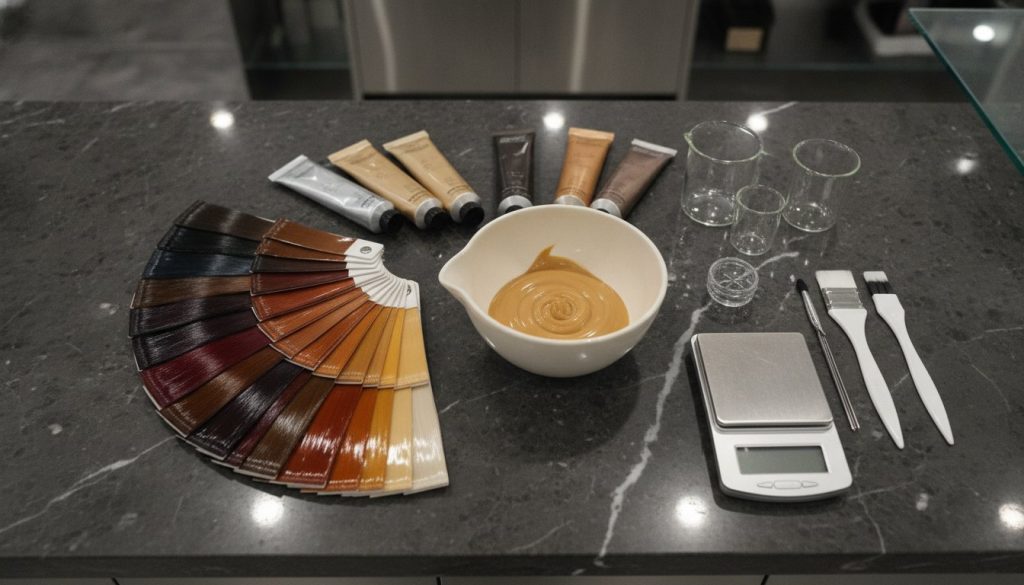
Precision application is the secret to maximizing your margins. When you learn exactly how much product is required for different hair densities, you drastically reduce waste. Using professional tools like our Mixing Bowl and Brush Set ensures you apply the perfect amount of Silk Touch or Diamond Keratin formulas every time. This level of detail protects your bottom line and ensures the client’s hair is never weighed down by excess product. It’s the difference between a standard service and a luxury experience.
Certification as a Marketing Tool
Discerning clients in 2026 are more educated than ever. They research a stylist’s social media and credentials before booking, specifically looking for vegan and eco-conscious options. Being a certified specialist allows you to justify premium pricing because you’re offering a level of expertise that generic stylists can’t match. When you can articulate the benefits of a vegan keratin system, you speak directly to the values of the modern, sophisticated consumer. Comprehensive certification eliminates the guesswork of application, reducing costly technical errors while ensuring the mirror-like shine and hair health your clients expect. This expertise, combined with professional development tips for hair stylists using keratin treatments, ensures your chair stays full and your revenue stays high.
How to Choose the Right CE Provider: Beyond the ‘No Test’ Promise
Settling for the cheapest continuing education provider is a mistake that costs you more than just the enrollment fee. It costs you growth. While discount providers promise a “no-fail” experience, they often deliver outdated content that doesn’t align with the standards of an elite salon. You should treat your CE selection with the same scrutiny you use when selecting your professional tools. High-quality education translates directly into higher service tickets and a more sophisticated client experience.
When you evaluate a potential curriculum, look for specialized technical training that offers real-world utility. The best professional development tips for hair stylists using keratin treatments come from providers who understand the chemistry of modern, high-performance formulas. You need to distinguish between “product agnostic” safety courses, which cover general sanitation, and “brand-specific” technical mastery that teaches you how to push the limits of what a treatment can achieve. Don’t waste your time on fluff; invest in knowledge that builds your expert reputation.
Verification Checklist for Professional Providers
Before you invest your time, run through this essential checklist to ensure the provider meets the standards of a modern expert:
- Immediate Certification: Does the platform offer downloadable certificates the moment you finish? This is crucial for seamless board submission.
- Current Regulations: Is the content updated for 2026 chemical handling and safety standards?
- Visual Quality: Do they provide high-definition video demonstrations? You can’t master a complex technical service through text alone.
Prioritize mobile-friendly platforms. This flexibility allows you to transform unexpected salon downtime into a productive session of technical refinement without needing to carry a laptop to your station.
Evaluating Course Content Depth
A comprehensive curriculum must go beyond the basics. It should bridge the gap between sanitation and artistry. Ensure your chosen path includes advanced insights into professional hair color brands and chemical safety. This holistic approach ensures you understand how smoothing treatments interact with various color chemistries, protecting the hair’s integrity during complex transformations.
Verify that the provider covers mandatory topics like human trafficking or domestic violence awareness, as these are now required in many states like Texas and Florida. Avoid text-heavy, static courses. Instead, seek out interactive modules that simulate real-world salon scenarios. This active learning style ensures you actually retain the knowledge rather than just clicking through slides to get a certificate. Your clients expect you to be the most knowledgeable professional in the room; your education should reflect that expectation.
Ready to elevate your technical standards? Explore the Hair Bar NYC Professional collection to see the tools and systems used by the industry’s elite.
Elevating Your Salon Standards with Hair Bar NYC Professional
Hair Bar NYC Professional serves as the essential bridge between your mandatory education and elite execution. While your license renewal confirms your legal right to practice, our pro-grade systems empower you to perform at the highest level of the industry. We’ve engineered our formulations for the stylist who views their craft through a lens of scientific precision and metropolitan sophistication. By choosing a partner that prioritizes technical support, you transform your salon into a destination for high-performance care. You aren’t just following professional development tips for hair stylists using keratin treatments; you’re setting a new standard for excellence in your city.
Joining our national network connects you with a community focused on clean beauty and uncompromising quality. We provide the resources necessary to keep your skills sharp long after your CE credits are filed. Our professional partners gain access to a specialized ecosystem of tools, from our Professional Flat Irons to our Mixing Bowl and Brush Sets, ensuring every application is flawless. This commitment to ongoing support ensures you remain an Expert Professional in a rapidly evolving market.
The Silk Touch and Diamond Advantage
Our proprietary smoothing systems, such as the Silk Touch and Diamond Keratin Treatments, reward your technical knowledge with superior, predictable results. These formulas allow you to address diverse hair textures with confidence, providing the mirror-like shine and internal repair that high-end clients demand. To maximize your service menu, consider integrating professional hair color into your post-CE offerings. This holistic approach ensures that your color work and smoothing services complement each other, maintaining the hair’s integrity while delivering sensory luxury. Results matter. Your clients expect a transformation that feels as good as it looks.
Your Next Steps: Beyond the License Renewal
True mastery requires a culture of continuous learning rather than periodic compliance. Don’t let your professional growth stall once your license is secure. Stay connected with the latest high-end trends and technical breakthroughs through our dedicated professional portal. By refining your technique with professional development tips for hair stylists using keratin treatments, you ensure your chair remains the most sought-after in the salon. It’s time to move beyond the basics and embrace a career defined by elite artistry and premium performance.
Explore our professional-grade smoothing systems and tools today.
Mastering the Future of Professional Artistry
License renewal in 2026 is no longer just about maintaining status; it’s about elevating your craft to meet the demands of a discerning urban clientele. By prioritizing high-revenue technical electives and choosing quality-driven education providers, you turn a mandatory requirement into a strategic business asset. Mastering these professional development tips for hair stylists using keratin treatments ensures you remain at the forefront of the clean beauty revolution. You’ve learned how to navigate state boards and vet curriculum; now it’s time to apply that knowledge at the chair.
Bridge the gap between compliance and elite execution with systems designed for the modern expert. Since 2013, we’ve established elite metropolitan standards by providing cruelty-free and formaldehyde-free professional formulas trusted by premium salons nationally. Our systems are engineered for those who refuse to compromise on quality or safety. Upgrade your salon service menu with Hair Bar NYC Professional tools and treatments. Embrace the expert standard and watch your artistry transform your salon’s bottom line. Your journey toward technical mastery starts with the right tools and a commitment to excellence.
Frequently Asked Questions
How many continuing education hours do I need to renew my cosmetology license in 2026?
Required hours vary significantly depending on your specific state board’s regulations. For instance, Texas requires 4 hours, while Florida mandates 10 hours and Illinois requires 14 hours every two years. Conversely, states like California and New York currently don’t require continuing education for standard renewals. Always verify your state’s current biennial or triennial requirements to ensure you remain compliant with local laws and maintain your professional standing.
Can I complete all of my cosmetology CE hours online?
Most states allow you to complete your entire continuing education requirement through approved online platforms. This digital shift provides the flexibility to transform salon downtime into a productive learning session without leaving your station. As of January 1, 2026, Georgia licensees must report their hours through CE Broker, a platform that often integrates with online course providers for seamless tracking. Ensure your chosen provider is board-approved before beginning any digital module.
What happens if I do not complete my continuing education before my license expires?
Failing to complete your hours before the deadline results in an expired license and the inability to work legally in a salon. You’ll likely face late renewal fees, which in Texas range from $75 to $100 depending on how long the license has been expired. If your license remains expired for an extended period, typically over three years, you may be required to retake the state board examination to regain your expert status.
Do elective hours have to be specifically about hair cutting or styling?
Elective hours offer the freedom to explore diverse topics including business management, retail growth, or advanced technical certifications. This is the perfect opportunity to implement professional development tips for hair stylists using keratin treatments to increase your salon’s average service ticket. You can choose subjects that align with your career goals, such as mastering the chemistry of the Silk Touch Keratin Treatment, rather than repeating basic styling techniques you use daily.
Is there a difference between CE requirements for estheticians and cosmetologists?
Yes, state boards frequently set different hourly requirements and mandatory topics for estheticians compared to cosmetologists. While both may need to cover core sanitation and safety, estheticians often focus on skin-specific health regulations and advanced facial protocols. Cosmetologists generally have a broader scope that includes chemical hair services and scalp health. Always check your specific license type on your state’s regulatory website to avoid completing a curriculum that doesn’t apply to your craft.
How do I report my completed CE hours to my State Board?
Reporting methods differ by state, with many moving toward automated digital tracking systems for increased efficiency. In some jurisdictions, approved providers report your hours directly to the board upon completion of the course. In others, you must manually upload your certificates of completion during the renewal process. Keeping a digital portfolio of your certificates is a hallmark of an Expert Professional, ensuring you’re prepared for any potential board audit or relocation.
Are there free continuing education courses for licensed stylists?
Free courses are often available through product manufacturers or industry events, but they may not always be board-approved for license renewal credit. While these sessions offer valuable professional development tips for hair stylists using keratin treatments, you must verify they provide a state-sanctioned certificate of completion. Investing in a high-quality, approved course ensures that your learning counts toward your legal requirements while providing the elite technical depth your sophisticated clientele expects.
Why is human trafficking awareness now a mandatory part of cosmetology CE?
State boards have implemented mandatory human trafficking training because stylists are uniquely positioned to recognize signs of exploitation through regular, close contact with the public. States like Texas and Florida require this specific hour to empower professionals to act as informed advocates for community safety. This training provides the tools needed to identify red flags and follow proper reporting protocols, reflecting the industry’s commitment to public welfare and uncompromising ethical standards.