How to Prevent Hot Roots When Coloring: The Professional Guide to Flawless Results
Your scalp is a biological radiator, and it’s likely sabotaging your hair color. That glowing, brassy halo at your crown isn’t a product failure; it’s a temperature miscalculation that even seasoned enthusiasts get wrong. If you’ve ever finished a session only to find unintentional orange tones staring back at you in the mirror, you know the sting of wasted time and money. Understanding how to prevent hot roots when coloring requires a shift from DIY guesswork to the meticulous discipline of professional Zone Coloring.
It’s frustrating when your vision of a chic “biscuit blonde” or a rich copper turns into an uneven mess. We’re going to change that. You’ll master the sophisticated techniques and formulation secrets used by elite stylists to eliminate unwanted warmth and achieve seamless color from root to tip. This guide explores the science of developer levels, the latest 2026 market shifts toward “quiet luxury” hair health, and how to choose professional-grade formulas like our Color Bar Professional Hair Color. By the end, you’ll have the confidence to execute a flawless, salon-quality transformation with total precision.
Key Takeaways
- Identify the unique thermal properties of Zone 1 and understand how the 98.6°F temperature of your scalp dictates your final color result.
- Discover exactly how to prevent hot roots when coloring by selecting the precise developer volume and shade intensity required for the first half-inch of hair.
- Master the professional Zone Coloring Method to ensure seamless blending between your roots, mid-shaft, and ends for an expensive, salon-grade finish.
- Explore the “backwards” application technique used by elite stylists to control processing times and eliminate over-lightening at the crown.
- Learn why clean beauty, professional-grade formulas are essential for maintaining hair integrity while achieving predictable, high-performance color.
What Are Hot Roots? Decoding the Science of Scalp Heat
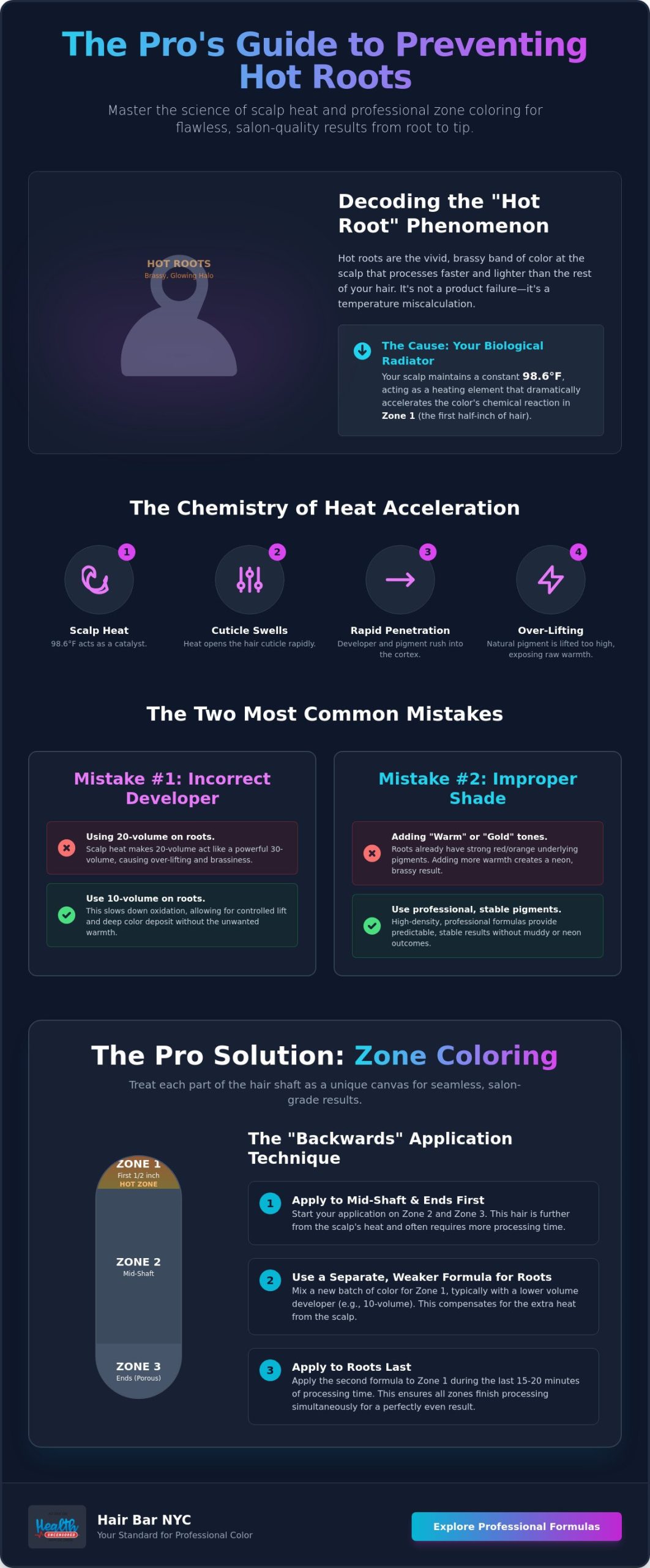
Hot roots are the ultimate salon faux pas, appearing as a vivid, often brassy halo of orange or red right at the scalp. This phenomenon occurs when the hair closest to the skin processes significantly faster and lightens more intensely than the mid-lengths and ends. Professionals refer to this first half-inch of growth as Zone 1. Because your scalp maintains a consistent temperature of 98.6°F, it acts as a built-in heating element. This thermal energy serves as a catalyst, accelerating the chemical reaction within the dye or lightener. When you’re learning how to prevent hot roots when coloring, you’re essentially learning how to manage the physics of heat.
The visual markers of this mistake are unmistakable. You might notice a “neon” glow at the base of the hair that looks disconnected from the rest of the head. This usually happens when the roots reach a higher level of lift than intended, exposing the raw, warm underlying pigments of the hair. While the ends of your hair are subjected to room temperature, Zone 1 is essentially being “cooked” by your own body heat, leading to an uneven, unprofessional finish.
The Chemistry of Oxidation and Temperature
To master the art of a seamless blend, you must understand the chemistry of hair coloring and how it reacts to external stimuli. Heat causes the hair cuticle to swell and open more rapidly. Once the cuticle is open, the developer and pigments penetrate the cortex with intense speed. This accelerated lift of natural melanin happens because the oxygen in the developer is released more aggressively in a warm environment. Thermal acceleration is the primary driver of hot roots, where scalp heat speeds up the chemical reaction before the rest of the hair can catch up.
Scenario Check: Virgin Hair vs. Color Regrowth
Virgin hair is particularly susceptible to over-lifting at the scalp. It hasn’t been compromised by previous chemicals, making it a reactive canvas that responds aggressively to any level of lift. A common trap occurs when someone tries to apply a lighter shade over previously colored mid-lengths. Since color cannot lift existing artificial color, the ends stay dark while the virgin roots lift to a bright, warm level.
Differences in porosity also play a major role. The hair at the scalp is new and healthy, while the ends are often more porous and “thirsty.” This creates a “hot” imbalance where the roots process too quickly and the ends absorb color differently. Knowing how to prevent hot roots when coloring requires a strategic approach to these two very different textures on a single head of hair. Applying the same formula with the same timing to both areas is a guaranteed recipe for disappointment.
The Primary Culprits: Developer Volume and Improper Shade Selection
Choosing the wrong developer is the fastest way to ruin a professional finish. While 20-volume developer is the industry standard for standard lift, applying it directly to the scalp is often a recipe for disaster. The inherent heat of Zone 1 accelerates the oxidation process, making a 20-volume formula behave with the intensity of a 30-volume. This results in “hot” roots that are several levels lighter than the rest of your hair. You must calculate the necessary level of lift for Zone 1 independently from the mid-shaft and ends to maintain control. When you’re determining how to prevent hot roots when coloring, the developer choice is your most powerful lever.
Improper shade selection is another major hurdle. If you reach for a “Warm” or “Gold” tone to achieve a sun-kissed look, you’re likely inviting a neon glow. The natural undercoat of hair at the root is already heavy with red and orange pigments. Adding more warmth on top of thermal acceleration creates an oversaturated, brassy result. Professional-grade pigments differ significantly from retail-grade fillers found in box dyes. Our Color Bar Professional Hair Color utilizes refined, high-density pigments that provide stable results, avoiding the muddy or neon outcomes common with lower-tier products.
Developer Math: Why Less is Often More
Professional stylists often reach for 10-volume developer when working on the roots. This lower strength slows down the oxidation, allowing the color to deposit deeply without over-lifting the natural melanin. It’s about control, not just speed. You’ll find that professional hair color brands offer more sophisticated, controlled oxidation than the unpredictable chemicals found in retail kits. For a deeper dive into these formulations, explore The Elite Guide to Professional Hair Color Brands: Science, Performance, and Luxury. Using a lower volume developer is a fundamental secret in how to prevent hot roots when coloring effectively.
The Power of Ash and Neutral Tones
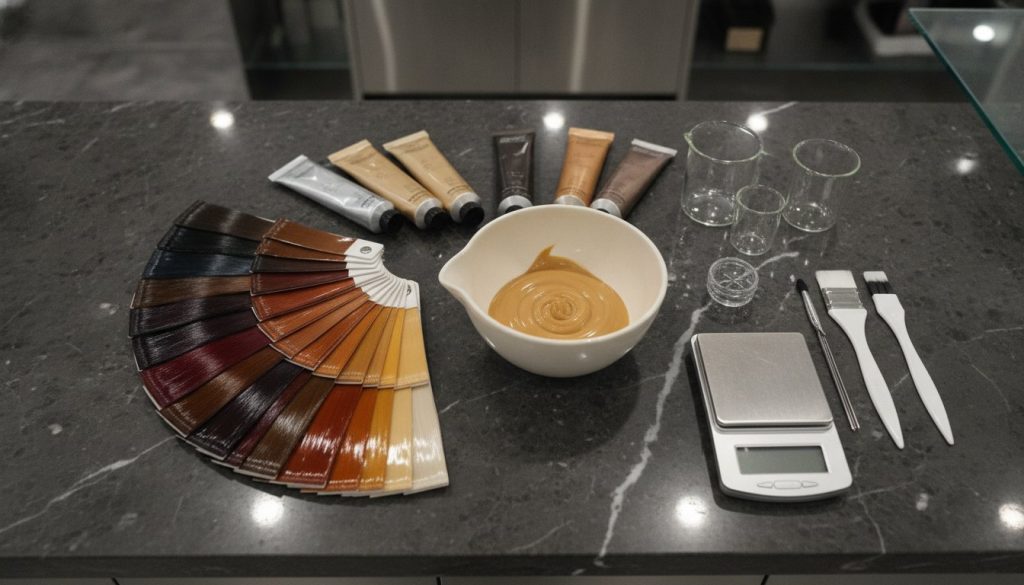
Counteracting the natural warm undercoats of your hair requires a strategic use of cool-toned additives. Ash (blue or green base) and Violet shades are your best defense against unwanted warmth. “Neutral” shades in professional lines are specifically formulated to balance scalp heat, providing a stable anchor for your color formula. Learning to read a color chart like an expert allows you to identify the base tones of your chosen shade. If the chart indicates a strong gold base, you know to adjust your formula with a neutral or ash mixer to maintain a sophisticated, balanced finish. This level of precision is what separates a home job from an elite, urban salon result.
Mastering the Professional Technique: The Zone Coloring Method
To achieve the seamless, expensive-looking color found in high-end urban salons, you must stop treating your hair as a single unit. Elite stylists view the hair shaft as three distinct territories, each with its own chemical needs and processing speeds. Zone 1 covers the first half-inch of hair closest to the scalp. Zone 2 encompasses the mid-shaft, while Zone 3 refers to the more porous ends. Mastering the Zone Coloring Method is the most effective way to manage these variables and is the industry secret for how to prevent hot roots when coloring.
Precision is your greatest ally during application. While retail kits often suggest using a squeeze bottle, professionals always reach for a Mixing Bowl and Brush Set. A brush allows for surgical accuracy, ensuring you don’t accidentally deposit high-lift color onto the heat-sensitive Zone 1 too early. You should also adhere to the 15-minute rule: if you cannot apply the color to the entire head within 15 minutes, your starting sections will be significantly over-processed compared to your finishing sections. This timing imbalance is a frequent culprit behind uneven, “hot” results.
Step-by-Step Zone Application for Lightening
When you’re lifting hair to a lighter shade, a “backwards” application is often necessary. Start your application in Zone 2, approximately one inch away from the scalp, and work through to the ends. Let this process for the first 20 minutes. While the mid-lengths are lifting, mix a separate, lower-volume formula specifically for the root area. Only apply this root-specific mixture during the final 15 to 20 minutes of your total processing time. This delayed start accounts for the thermal acceleration from your scalp, ensuring the roots reach the same level of lift as the rest of the hair without overshooting into brassy territory.
Cross-Checking for Saturation and Evenness
Consistent results require meticulous sectioning. Use fine, 1/8-inch sections to ensure every strand is fully saturated. If your sections are too thick, the color won’t penetrate evenly, leading to patchy results and a “hot” appearance where the color did manage to take. At the sink, emulsify the color by adding a small amount of warm water and massaging the transition point between Zone 1 and Zone 2. This creates a soft, blurred effect rather than a harsh line of demarcation. Remember, professional stylists never overlap permanent color onto previously lightened Zone 3 ends. Doing so causes “color grab,” making the ends look dull and dark while the roots appear too bright. This contrast is a fundamental lesson in how to prevent hot roots when coloring with professional precision.
Advanced Prevention: Timing, Porosity, and Post-Color Care
The cold water rinse is one of the most persistent myths in the hair industry. While it feels refreshing, it does little to chemically close the cuticle or stabilize the oxidation process. True stabilization comes from pH balancing. Mastering how to prevent hot roots when coloring requires more than just application technique; it demands a deep understanding of hair porosity and chemical stabilization. If the hair’s pH isn’t returned to its neutral state, the oxidation continues, often leading to a shift in tone long after you’ve left the sink. Professional products are engineered to halt this reaction instantly, preserving the cool, sophisticated tones you worked hard to achieve.
Timing is another critical variable. Many enthusiasts believe that leaving color on for an extra ten minutes will help the ends “catch up” to the roots. In reality, chemical reactions have a peak performance window. Once the developer has exhausted its lifting power, it won’t magically fix a bad formulation. Because of the 98.6°F scalp heat discussed earlier, the color in Zone 1 remains aggressive throughout the entire processing time. Leaving it on too long only increases the risk of over-sensitizing the scalp and creating a more pronounced “neon” glow. Elevate your results by choosing Color Bar Professional Hair Color for a formula designed to resist thermal instability and provide predictable, high-performance results.
Pre-Color Prep: The Secret to Even Porosity
Predictable color starts with a uniform canvas. Using a Keratin Infused Serum before your service helps fill the microscopic gaps in the hair cuticle, especially in the more porous mid-lengths and ends. This ensures that the hair absorbs pigment evenly rather than “grabbing” too much in some areas and resisting it in others. Your hair should be clean and dry. Avoid heavy silicone buildup from retail-grade styling products. These silicones create a plastic-like barrier that can cause patchy, inconsistent results, making your efforts to prevent hot roots much more difficult.
Stabilizing the Result: The Post-Color Routine
Once the color is rinsed, the maintenance phase begins. A sulfate-free, professional-grade shampoo is non-negotiable for locking in pigment and preventing early fading. Follow this with our Silk Touch Conditioner, which is specifically formulated to seal the cuticle and restore the hair’s natural pH level. This step is vital for maintaining the “cool” of the root and the vibrancy of the ends. For more expert advice on maintaining the integrity of your strands, see our Hair Care Products for Natural Hair: The Professional Stylist’s 2026 Guide. Consistent use of professional-tier quality products ensures your color stays as fresh and balanced as the day it was applied.
The Hair Bar NYC Standard: Elevating Your Color Experience
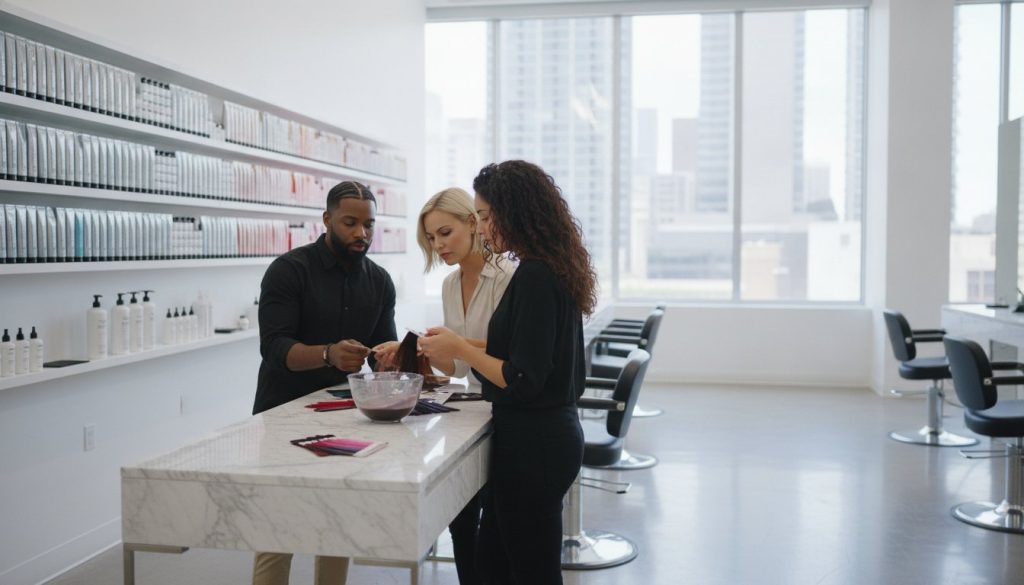
Achieving the elite results associated with Hair Bar NYC Professional involves more than just technical skill; it requires a commitment to a higher standard of care. Our salons across New York and Florida have pioneered a protocol that eliminates the guesswork from chemical services. By integrating the advanced science of thermal acceleration into every consultation, our stylists ensure your results are consistent and sophisticated. Mastering how to prevent hot roots when coloring is a core competency of our expert team, providing you with a finish that feels both premium and personalized.
The foundation of this excellence lies in the synergy between expert application and superior formulation. Hair Bar NYC Professional utilizes Color Bar Professional Hair Color to provide the predictability required in a high-volume, urban salon environment. This system allows our stylists to execute the Zone Coloring Method with surgical accuracy, ensuring the first half-inch of growth receives a formula specifically balanced for your scalp’s temperature. This meticulous attention to detail is what separates a standard retail result from a high-performance, salon-grade transformation.
Why Professionals Choose Color Bar Professional
Elite results require a high-pigment load that retail products simply cannot match. Color Bar Professional Hair Color is engineered to provide superior gray coverage and tonal depth without the dreaded neon glow at the scalp. These low-ammonia formulas respect the hair’s natural pH balance, reducing the risk of thermal instability during the oxidation process. As the industry moves toward a stricter regulatory environment under MoCRA, Hair Bar NYC Professional remains ahead of the curve by prioritizing clean, vegan beauty formulas that don’t sacrifice performance for safety. To see how these professional standards are shaping the future of the industry, explore The Ultimate Guide to Professional Hair Color: Trends, Science, and Inspiration for 2026.
The Ultimate Smoothing and Color Duo
Color is only half of the equation; the true hallmark of an elite finish is the health and shine of the fiber. This is why our stylists often recommend a Silk Touch Keratin Treatment as the perfect follow-up to a professional color service. While the color provides the hue, the keratin smoothing system seals the cuticle, locking those expensive pigments deep within the cortex. This synergy creates an incredible vibrancy that lasts significantly longer than color alone. The keratin fills in any remaining porosity gaps, ensuring that your light-reflective blonde or rich cinnamon red remains multidimensional from root to tip. Ready to transform your routine with the tools used by the experts? Explore our Professional Color Bar and Keratin Systems and experience the difference of professional-tier quality.
Secure Your Signature Glow
You now possess the specialized knowledge required to bypass common coloring pitfalls and achieve a seamless, metropolitan finish. By mastering the science of thermal acceleration and the strategic discipline of the Zone Coloring method, you’ve moved beyond amateur guesswork. You understand that developer calculation and precise timing are the true architects of a balanced, expensive-looking result. Mastering how to prevent hot roots when coloring is essentially about reclaiming total control over your aesthetic transformation.
Elite stylists in our high-end New York and Florida locations rely on these exact principles to deliver uncompromising quality for every guest. Our professional-grade formulas are engineered for this level of salon-grade precision, ensuring your hair remains healthy and vibrant from root to tip. It’s time to trade unpredictable outcomes for the sophisticated reliability of expert-tier care. You don’t have to settle for less than perfection.
Upgrade to Color Bar Professional Hair Color for Elite Results and experience the power of vegan, cruelty-free pigments designed for absolute excellence. You’ve earned the confidence that comes with a flawless, professional finish. Your journey to high-performance beauty starts today.
Frequently Asked Questions
Can I fix hot roots without redyeing my entire head?
You can effectively neutralize hot roots without a full color overhaul by performing a “root smudge” or applying a demi-permanent toner. This technique involves depositing a cooler, darker shade only on the over-processed Zone 1 area. It blurs the transition between the scalp and the mid-lengths, successfully masking the brassy glow without affecting the integrity of your ends. Precision is vital here; use a professional brush to ensure you don’t overlap onto the darker sections.
Does professional hair color prevent hot roots better than box dye?
Professional formulas offer significantly more control because they allow you to customize the developer strength for different zones. Retail box dyes typically include a high-volume developer designed to work on everyone, which is often too aggressive for the scalp’s natural heat. Using a refined product like Color Bar Professional Hair Color allows you to choose a lower volume for the roots, which is a fundamental step in how to prevent hot roots when coloring with salon-grade accuracy.
How do I choose the right developer volume for my roots?
Select a developer volume for your roots that is at least one level lower than the one used for your mid-lengths. If your ends require a 20-volume developer for lift, drop to a 10-volume for the first half-inch of hair. This lower concentration slows the oxidation process, compensating for the thermal acceleration caused by your body heat. This balanced approach ensures that the roots and ends reach the same level of lift simultaneously for a uniform result.
Will a purple shampoo fix orange roots?
Purple shampoo is specifically designed to neutralize yellow tones, so it won’t be effective against the orange or red pigments of hot roots. To counteract a brassy orange glow, you need a blue-based pigment according to color theory. While a blue toning shampoo can offer a temporary mask, a permanent fix requires a professional-grade toner or ash-based color deposit. These professional tools provide the depth and cool tones necessary to cancel out stubborn, warm undercoats.
Should I apply hair color to dirty or clean hair to avoid hot roots?
Apply your color to clean, dry hair that is free from heavy silicone or styling buildup. While traditional advice suggested “dirty hair” to protect the scalp, modern professional pigments penetrate more predictably on a clean canvas. Excessive oils or product residues can create a barrier that leads to patchy absorption and uneven lift. Ensuring your hair is clean allows the formula to work efficiently, which is a key component of how to prevent hot roots when coloring.
What is the “Zone 1” rule in professional hair coloring?
The Zone 1 rule defines the first half-inch of hair closest to the scalp as a unique territory influenced by body heat. In professional environments, this area is always treated differently than the mid-shaft or ends. Because Zone 1 processes faster, it requires either a cooler formula or a later application time. Treating the hair in these distinct segments is the industry standard for achieving an expensive, perfectly blended finish that looks natural and sophisticated.
Is it possible to get hot roots when dyeing hair darker?
You can still experience hot roots when going darker if your developer volume is unnecessarily high. If you use a 20-volume developer on virgin roots while applying a dark shade, the peroxide may lift your natural pigment before the new color deposits. This results in a root area that looks slightly lighter or warmer than the rest of the head. For darkening services, a 10-volume or deposit-only developer is usually the safest choice for a seamless, deep finish.
How long should I wait to fix hot roots after a failed color session?
If your hair feels healthy and strong, you can apply a demi-permanent toner to fix the tone immediately. Demi-permanent formulas don’t penetrate the cortex as deeply as permanent color, making them a safer choice for quick corrections. However, if you plan to use permanent color or lightener again, wait at least 48 hours. This brief window allows your scalp’s protective oils to replenish and gives you time to assess the hair’s integrity before another chemical process.