The Professional Stylist’s Guide to Salon Cape and Gown Materials
What if the only thing standing between your professional reputation and a ruined designer dress is a few micrometers of polyurethane? The most transformative color service loses its luster the moment a client feels a chemical seep through their cape. Many stylists settle for standard apparel, only to watch it crack, stain, or fail during a high-stakes Silk Touch Keratin Treatment. This salon capes and gowns material guide explores the intersection of textile science and elite hair care, ensuring your tools are as sophisticated as your technique.
It’s a common frustration to see expensive capes degrade after just a few uses or to have clients grow uncomfortably warm under heavy, non-breathable fabrics. You deserve apparel that withstands the rigors of a busy Color Bar while maintaining a chic, high-end aesthetic. This guide promises to help you master the science of salon fabrics, from understanding the technical difference between waterproof and water-resistant to selecting materials that repel Diamond Keratin Treatments. We will break down the specific performance of nylon, polyester, and specialized coatings to ensure your salon remains a sanctuary of uncompromising quality and metropolitan style.
Key Takeaways
- Learn how to select technical barriers that protect your client’s wardrobe without compromising the precision of your Color Bar professional hair color.
- Use this salon capes and gowns material guide to evaluate denier counts and fabric breathability for the perfect balance of durability and luxury.
- Discover why specialized chemical-proof capes are essential for maintaining the integrity of Silk Touch Keratin Treatments during high-heat applications.
- Identify the critical design features, from secure neck fits to closure types, that prevent service leaks and elevate the professional client experience.
- Master a professional care protocol to avoid the “silent killers” of salon apparel and preserve the waterproof integrity of your high-end gowns.
The Science of Protection: Why Salon Cape Materials Dictate Service Quality
A professional salon cape is far more than a simple garment; it’s a technical barrier engineered to separate high-performance chemistry from your client’s skin and clothing. While the history of protective capes dates back centuries as a basic shield against the elements, modern hair care requires a much more sophisticated approach. In an elite urban environment, every touchpoint must reflect a standard of excellence. This salon capes and gowns material guide explores why your choice of fabric is a critical component of the service itself. It’s the silent protector of your artistry.
When you utilize high-end professional hair color brands, the chemical precision of the formula depends on a controlled environment. If a cape material is too porous, it can absorb moisture or atmospheric humidity, potentially wicking away the necessary hydration from the hair shaft during processing. This interference can lead to uneven results or diminished vibrancy. Beyond technical performance, the 2026 standard for salon sanitation demands non-porous surfaces that can be disinfected instantly. This isn’t just about compliance; it’s about the psychological peace of mind that comes from knowing every tool in the room is hospital-grade. Stepping into a high-end salon should make a client feel like an insider in a world of elite care. A premium gown is the first physical touchpoint of that transformation.
Elevating the Client Experience through Fabric Selection
Luxury is felt before it’s seen. The weight and “drape” of a gown signal a premium experience the moment it settles on a client’s shoulders. A heavy, stiff material feels industrial and cold; a lightweight, supple fabric feels like an intentional choice for comfort. Breathability is equally vital. During long sessions for a Silk Touch Keratin Treatment, a client shouldn’t feel trapped in a heat-retaining plastic shell. High-end urban salons also prioritize “quiet” fabrics. Materials that crinkle or rustle with every movement disrupt the serene, metropolitan energy of a luxury space. Choose textiles that move silently to maintain a sophisticated atmosphere, and just as you curate your fabrics, you can explore Interior Painting to ensure your salon’s walls reflect that same level of elite care.
Protecting the Wardrobe from Professional Formulations
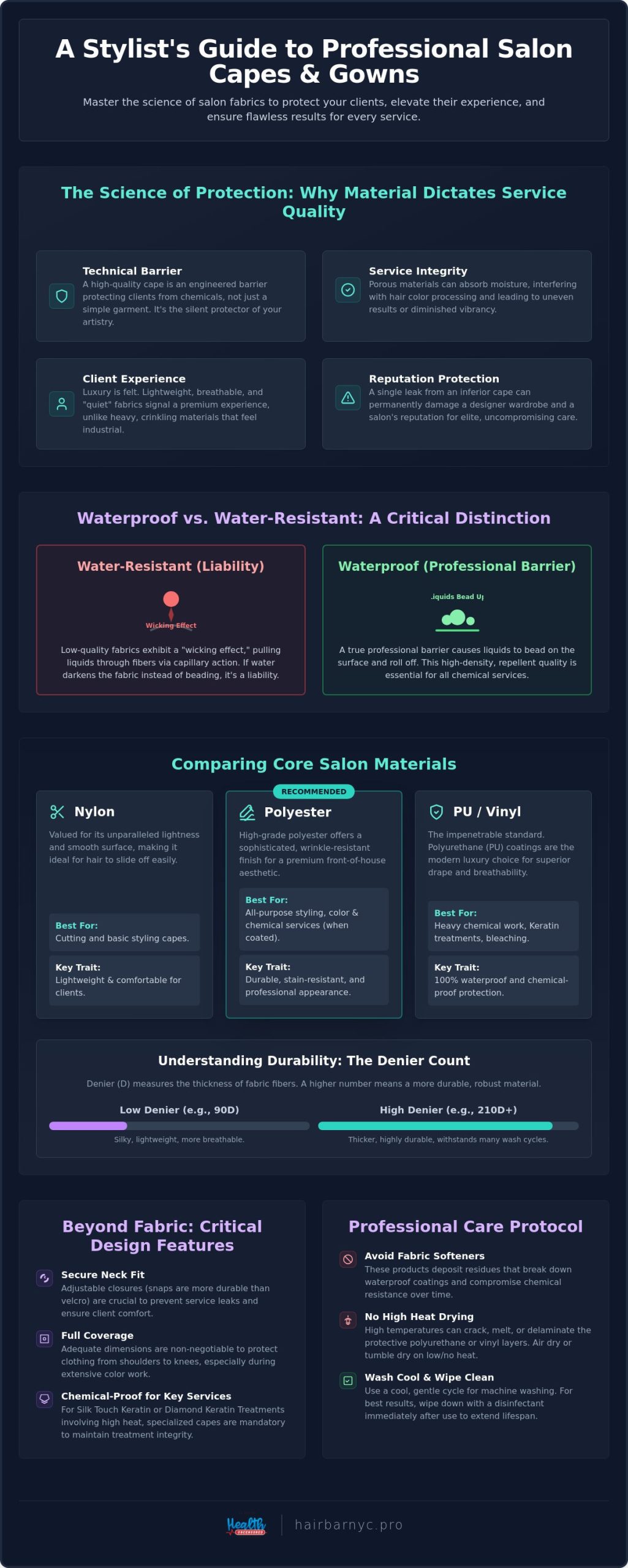
The cost of a material failure is measured in more than just a ruined blouse. A single leak during a Color Bar session can permanently damage a salon’s reputation for elite care. Material density is the primary defense against the “wicking” effect found in low-quality polyester blends. In these inferior fabrics, liquids don’t just sit on the surface. They are pulled through the fibers via capillary action, leading to hidden stains on the client’s clothing. Identify the wicking effect early: if water beads on the surface, you have a professional barrier. If it darkens the fabric, you have a liability. Choosing high-density, chemically-repellent synthetics ensures that even the most aggressive lighteners remain exactly where you placed them.
Comparing Core Materials: Nylon, Polyester, and Advanced Synthetics
Selecting the right textile is a strategic decision for any high-end studio. While a standard drape might suffice for a basic trim, a professional environment demands materials that perform under pressure. This salon capes and gowns material guide breaks down the three pillars of salon apparel: Nylon, Polyester, and Vinyl. Each serves a specific technical purpose within your workflow. Nylon offers unparalleled lightness for cutting, while high-grade Polyester provides the wrinkle-resistant, sophisticated finish required for a front-of-house aesthetic. For heavy chemical work, Vinyl remains the impenetrable standard, though modern Polyurethane (PU) coatings are quickly becoming the preferred luxury alternative for their superior drape and breathability.
To understand longevity, you must look at the “denier” count. In the textile world, denier measures the linear mass density of fibers. A higher denier, such as 210D, indicates a thicker, more durable thread that withstands hundreds of industrial wash cycles. Conversely, a lower denier like 90D offers a silkier, more breathable feel. To bridge the gap between comfort and protection, elite manufacturers often apply technical coatings. Teflon treatments provide a stain-repelling shield, while PU coatings transform a breathable fabric into a waterproof barrier. It’s vital to distinguish between “water-resistant” fabrics, which repel moisture temporarily, and “waterproof” materials that provide a total chemical block. For services involving intensive saturation, only a waterproof barrier ensures your client’s wardrobe remains pristine. Investing in a high-quality Salon Cape ensures you never have to choose between technical safety and a luxury feel.
Nylon: The Lightweight Standard for Precision Cutting
Nylon is the industry favorite for a reason. Its smooth surface allows hair to slide off instantly, preventing the “clinging” effect that plagues cheaper fabrics. Because it’s a synthetic polymer, you can review the specific Nylon vs. Polyester properties to see how it excels in flexibility and quick-dry performance. It’s the perfect choice for busy metropolitan stylists who need to rotate clean capes rapidly between clients. However, standard nylon is often too thin for chemical services, as it lacks the density to stop professional-grade lighteners from wicking through to the clothing beneath.
Polyester and Microfiber: Durability Meets Sophistication
High-grade Polyester is the backbone of a salon’s professional image. It maintains its shape and resists wrinkles, ensuring your team looks impeccable from the first appointment to the last. Microfiber takes this a step further. Its ultra-tight weave is specifically designed to prevent tiny hair splinters from embedding themselves in the fabric, a common pain point for stylists. This material also provides the best canvas for custom branding, allowing for deep, vibrant colors that won’t fade after exposure to the harsh detergents required for salon hygiene. It’s the ultimate blend of performance and chic, urban style.
Specialized Apparel for Keratin and Chemical Smoothing Treatments
High-performance services like formaldehyde-free keratin treatments demand more from your equipment than a standard haircut. These modern formulas often utilize glyoxylic acid or proprietary smoothing agents that, while safer for the hair, can be aggressive on low-quality textiles. This salon capes and gowns material guide emphasizes that chemical-proof barriers are non-negotiable when working with intensive smoothing systems. If a product drips onto a standard polyester cape, it can compromise the fabric’s integrity or, worse, seep through to reach the client’s skin. You need a shield that matches the sophistication of your chemistry.
The interaction between your tools is equally vital. During a Silk Touch Keratin Treatment, you’ll likely use a Professional Flat Iron at temperatures exceeding 400 degrees Fahrenheit. Standard synthetic capes can melt or warp if they come into contact with high-heat tools or even the concentrated airflow of a Professional Hair Dryer. Professional-grade apparel for these services is often treated with heat-resistant finishes to prevent accidental damage. Additionally, oversized dimensions are essential for smoothing services. Full-chair coverage ensures that long hair, saturated with product, doesn’t touch the salon chair’s upholstery, preserving your high-end furniture from chemical degradation. Materials must also be robust enough to withstand the pH-shifting nature of professional lighteners used in the Color Bar, which can cause inferior fabrics to “bleach out” or lose their waterproof coating.
Vinyl and Polyurethane: The Barrier for High-Performance Chemicals
Heavy-duty Vinyl remains a staple for messy chemical applications because it’s completely non-porous. However, many upscale urban salons are shifting toward Polyurethane (PU) coated fabrics. PU offers the same level of impermeability as vinyl but with a much more sophisticated drape and a softer, less “stiff” texture. It feels more like a luxury garment and less like industrial plastic. To maintain these barriers, immediate wipe-downs are necessary. Certain high-pH chemicals can degrade the protective coating if left to sit, leading to premature cracking and failure of the garment.
Breathability vs. Impermeability in Long-Duration Services
Managing comfort during a three-hour Diamond Keratin Treatment is a delicate balance. A completely impermeable cape can trap body heat, making the client uncomfortably warm. To solve this, experts often use the “Cape-in-Cape” technique. This involves placing a lightweight, breathable cutting cape over a specialized chemical neck shield or a smaller waterproof apron. Modern material innovations now feature microscopic pores that are small enough to block liquid chemicals but large enough to let air circulate. This technology ensures the client feels pampered and cool while their wardrobe remains entirely protected from professional formulations.
Functional Design: Closures, Dimensions, and Professional Fit
The most sophisticated textile technology is rendered useless if the garment’s architecture fails at the neck. While previous sections of this salon capes and gowns material guide focused on the chemistry of fabrics, the mechanical design of the cape is what ensures that chemistry never touches your client’s skin. A precision fit is the final seal of a professional service. In a fast-paced metropolitan studio, you need apparel that adjusts instantly to a diverse clientele while maintaining a secure, leak-proof barrier. This structural integrity is what separates a standard retail item from an expert tool used in an elite salon environment.
The neck fit is the most common point of failure in salon apparel. If the seal is too loose, capillary action pulls moisture and color beneath the cape. If it’s too tight, the client’s comfort is compromised. High-end designs prioritize ergonomic necklines that contour to the body’s natural shape. This attention to detail extends to the stylist as well. We see a growing trend of stylist aprons crafted from the same high-performance synthetics used in our Salon Cape offerings. These coordinated sets not only protect your own wardrobe from the Color Bar but also reinforce a unified, chic aesthetic that signals uncompromising quality to everyone who walks through your doors.
Snap Closures vs. Velcro: The Longevity Debate
Stainless steel snaps represent the gold standard for high-end chemical environments. Unlike plastic alternatives, they don’t corrode when exposed to the alkaline environment of professional hair color or the high heat of a Professional Flat Iron. Snaps offer a range of fixed settings that ensure a consistent, secure fit for every client, from children to adults. Velcro, while offering infinite adjustability, often acts as a “hair-trap.” Over time, the hooks become clogged with tiny hair splinters and lint, creating a hygiene issue and losing its grip. For a studio that prides itself on hospital-grade sanitation, snaps are the more sophisticated, durable choice.
Sizing for Full-Coverage Protection
Standard sizing often falls short in a modern salon. A professional minimum of 54″ x 60″ is required to provide “jumbo” coverage that drapes completely over the back of the chair. This is vital for protecting your salon’s furniture from the inevitable splatters of a busy Color Bar. When a cape is too small, it bunches up at the shoulders, creating uneven cutting lines and leaving gaps where chemicals can reach the client’s clothes. Extra-large dimensions allow the fabric to lay flat, providing a smooth canvas for precision work while ensuring the client feels fully cocooned in a luxury experience. Choose dimensions that respect both the client’s comfort and the salon’s investment in its high-end equipment.
Maintaining Professional Standards: Care and Longevity for Salon Gowns
Excellence in a high-end studio doesn’t end when the client leaves the chair. It extends to the meticulous preservation of the tools that define your workspace. This salon capes and gowns material guide concludes with a focus on longevity, ensuring your investment in premium apparel continues to reflect your brand’s uncompromising quality. Even the most advanced synthetic textiles require a specific care protocol to maintain their technical properties. Neglecting these standards doesn’t just shorten the life of the garment; it risks a catastrophic failure during a sensitive service at the Color Bar.
High heat and harsh bleach are the primary “silent killers” of professional salon apparel. While it’s tempting to use aggressive chemicals for sanitization, chlorine bleach aggressively strips the Teflon and Polyurethane (PU) coatings that provide waterproof protection. Over time, this leads to microscopic cracks in the barrier, allowing liquids to seep through. High-heat drying is equally destructive, as it makes synthetic fibers brittle and prone to warping. When you calculate the ROI of your equipment, premium capes often prove more cost-effective. A high-denier gown that maintains its integrity through 500 washes offers a significantly lower cost-per-use than a budget alternative that requires replacement after a single season of heavy chemical exposure.
Washing Protocols for Chemical-Resistant Fabrics
Preserving the integrity of your gowns starts with the right chemistry. Always use pH-neutral detergents to clean your apparel. These formulas are gentle enough to remove residue from a Silk Touch Keratin Treatment without dissolving the fabric’s protective finish. The “Air-Dry” rule is your best defense against material fatigue. If you must use a dryer, select the lowest heat setting possible to prevent the synthetic bonds from breaking down. Striking a balance between hospital-grade sanitization and fabric preservation is the hallmark of an Expert Professional who understands the value of their tools.
When to Retire Your Capes to Maintain Brand Integrity
Maintaining an aspirational urban lifestyle in your salon means knowing when a tool has reached its limit. Spotting material fatigue early is vital for preventing leaks. Look for “cracking” in vinyl surfaces or “pilling” in polyester weaves, as these are clear indicators that the fabric’s density is compromised. Faded or stained capes undermine the sense of elite care you’ve worked hard to establish. Develop a strict rotation schedule to ensure every client receives a fresh, crisp experience. Retiring a cape before it fails is a proactive step that protects both your client’s wardrobe and your professional reputation for excellence.
Master the Art of Professional Protection
Elevate your salon’s standard from a mere service provider to a sanctuary of elite care. By mastering the insights in this salon capes and gowns material guide, you ensure that every chemical service remains a precise and luxurious experience for your clientele. You’ve learned that the right technical barrier protects your artistry just as much as it preserves your client’s wardrobe. Whether you’re navigating the high-heat demands of a Diamond Keratin Treatment or the chemical intensity of the Color Bar, your choice of apparel is a fundamental extension of your professional skill.
Our professional-grade offerings are engineered for high-performance keratin systems and trusted in elite New York and Florida salons. We uphold cruelty-free and vegan-aligned standards to match your values and your metropolitan energy. Shop Professional Salon Accessories and Treatments to discover equipment that withstands the rigors of the modern studio while maintaining a chic aesthetic. Your commitment to quality defines your brand; let your equipment reflect that same uncompromising excellence. You have the knowledge; now equip yourself for the transformation.
Frequently Asked Questions
What is the best material for a salon cape for color services?
Polyurethane (PU) coated fabrics are the gold standard for color services because they provide a completely non-porous barrier against aggressive pigments. Unlike standard textiles, PU-coated materials prevent dyes from wicking through to the client’s skin or clothing. This ensures that even during a saturated session at the Color Bar, the protection remains absolute while offering a more sophisticated, supple drape than traditional industrial vinyl.
Are nylon or polyester salon capes better for hair cutting?
Nylon is generally the superior choice for precision hair cutting due to its exceptional “hair-slipping” properties. The smooth synthetic fibers allow both dry and wet hair fragments to slide off instantly, preventing the itching and clinging often associated with coarser weaves. This salon capes and gowns material guide suggests 100% nylon for stylists who prioritize a lightweight feel and rapid drying times between back-to-back appointments.
How do I clean hair salon capes without ruining the waterproof coating?
Clean your technical apparel with pH-neutral detergents and always avoid high-heat drying cycles to preserve the waterproof integrity. Harsh bleaches and industrial heat are the primary causes of material fatigue, leading to the cracking of protective Teflon or PU layers. For daily maintenance, a simple wipe-down with a damp, non-abrasive cloth is often enough to remove styling residue without compromising the garment’s chemical-proof seal.
What is the difference between a cutting cape and a chemical cape?
The primary difference lies in the level of impermeability and fabric density. A cutting cape is typically lightweight and breathable, designed specifically to repel hair clippings during dry or wet cuts. In contrast, a chemical cape features a specialized waterproof coating or is made from non-porous materials like vinyl. It’s engineered to block liquid saturation from treatments like a Diamond Keratin Treatment or professional lighteners.
Why do some salon capes make clients feel hot or sweaty?
Clients often feel overheated when wearing non-porous materials that trap body heat against the skin. While heavy-duty vinyl provides excellent protection, its lack of breathability can be uncomfortable during long services. To solve this, look for advanced synthetics with microscopic vents or utilize the “Cape-in-Cape” technique, which pairs a breathable outer layer with a targeted chemical shield at the neck and shoulders for maximum comfort.
How often should a professional salon replace its capes and gowns?
Professional salons should evaluate their apparel every six to twelve months, depending on the volume of chemical services performed. You should replace a cape immediately if you notice pilling, fading, or the first signs of coating separation. Maintaining a fresh rotation ensures your studio consistently reflects the high standards of an Expert Professional, preventing the reputation damage caused by a visible leak or a stained garment.
Can I use a regular washing machine for professional vinyl capes?
Avoid using a standard washing machine for heavy vinyl capes, as the mechanical agitation can cause the material to crack and peel over time. Instead, use a gentle wipe-down protocol with a mild soap solution and hang the garment to air-dry. For modern PU-coated fabrics, a gentle machine cycle on cold is often acceptable, but you should always skip the dryer to ensure the synthetic barrier remains intact.