How to Write a Salon Cancellation Policy Clients Understand

A cancellation policy should protect a salon’s schedule without making clients feel punished. If you’re figuring out how to write a salon cancellation policy, start with a clear agreement: clients should know what counts as late notice, what happens when they reschedule, and how missed appointments are handled before they book.
Last-minute changes can leave a stylist with an empty appointment slot and little time to offer it to someone else. It’s understandable to want firm terms while also worrying that fees or deposits could frustrate clients. Clear, respectful wording sets expectations and gives your team a consistent way to respond when plans change.
This guide explains how to define notice periods, cancellations, no-shows, rescheduling, late arrivals, and payment expectations. It also covers how to share the policy during booking and apply it consistently. The goal is a fair process that respects clients’ time while helping your salon manage its schedule.
Key Takeaways
- Write clear terms for notice, rescheduling, late arrivals, and missed appointments.
- Explain any fees, deposits, and exceptions before clients book.
- Choose an enforcement approach your team can apply consistently and communicate courteously.
- Draft, share, train staff on, and periodically review the policy.
- Adapt sample wording to your salon’s actual terms, and check applicable requirements with qualified counsel.
Why a Salon Cancellation Policy Needs to Be Clear Before Clients Book
A salon cancellation policy explains how clients can cancel or reschedule appointments, what happens if they arrive late, and how the salon handles missed appointments. It tells clients what to expect if their plans change and gives staff a shared process for responding.
Clarity matters before a client confirms a booking. Advance notice can give the salon time to offer an opening to another client, adjust the day’s schedule, and prepare the team for changes. It also lets clients make an informed choice before committing to an appointment. A policy can’t prevent every cancellation, but it can reduce confusion about what to do and what may follow.
A policy is not the same as booking software. Software may display terms, collect an acknowledgment, send reminders, or help staff apply the salon’s chosen process. The policy itself is the salon’s set of terms. Decide what those terms are first, then use available tools to communicate them clearly. The consumer-rights concept of a cooling-off period is a reminder that cancellation expectations should be understandable, though salon owners shouldn’t assume those rules apply to appointment cancellations. Check relevant requirements with qualified counsel.
What should a salon cancellation policy accomplish?
A well-written policy sets expectations before booking, explains the salon’s process in a courteous tone, and helps team members respond consistently. It should read as practical guidance, not a warning. Clients need to know which contact method to use to cancel or request a new time, and what the salon considers a late arrival or missed appointment. Clear terms help clients understand the process and help the team manage the schedule.
Why do unclear cancellation terms create problems?
Vague wording leaves room for different interpretations. “Please cancel in advance” doesn’t say how much notice the salon expects. “Late arrivals may affect your appointment” doesn’t tell a client what to do if they’re running behind. One staff member might offer a new time while another handles the same situation differently. Clients may also be surprised by terms they couldn’t review before booking.
To learn how to write a salon cancellation policy, identify the decisions clients and staff need clarified, then state them in plain language. If the policy includes fees, deposits, or exceptions, make those terms visible before a client confirms the appointment. Consistent communication won’t eliminate schedule disruptions, but it gives everyone a fairer, more predictable basis for handling them.
What to Include When You Write a Salon Cancellation Policy
To decide how to write a salon cancellation policy, work through the client’s experience from booking to appointment day. The policy should answer practical questions before a schedule change happens: whom to contact, what deadlines apply, and what the salon will do next. Use this checklist as a drafting framework, then tailor each term to your operations.
- Cancellation notice: Set the notice window your salon expects and define when it begins, such as before the appointment start time. Present it as your salon’s chosen term, not a universal standard.
- Contact method: Specify how clients should cancel or request a change, such as through the booking channel or by contacting the salon directly. Identify who monitors requests so messages aren’t left without a response.
- Rescheduling: Explain how clients can request a new appointment and whether the same terms apply when they reschedule. Tell them how the salon will confirm the change.
- Late arrivals: State how clients should notify the salon if they’re running late and explain what may happen to the appointment. Don’t promise that a service can always be completed or moved to another time.
- Missed appointments: Define what the salon considers a missed appointment, including whether contacting the salon after the scheduled start changes how the situation is handled.
Which appointment changes and deadlines should the policy explain?
Be precise about the difference between cancelling, rescheduling, arriving late, and not attending. For example, a client who asks to move an appointment before the salon’s stated deadline may be handled differently from someone who doesn’t arrive or make contact. Explain the salon’s process for each situation instead of relying on a broad phrase like “late changes may be subject to a fee.”
Identify who reviews incoming requests and how clients receive confirmation. A cancellation request and a confirmed cancellation aren’t always the same thing. Tell clients whether they should expect a reply or confirmation through the booking channel, and when a change is considered complete.
How should salons explain deposits, fees, and exceptions?
If your salon uses a deposit, cancellation fee, or no-show fee, state the amount or calculation, the circumstances that trigger it, and what happens if the client reschedules. Describe exceptions just as directly. Put these terms where clients can review them before booking, not only in a reminder or at checkout. Have fee and deposit wording reviewed against applicable requirements by qualified counsel. The FTC’s Cooling-Off Rule describes a specific consumer protection context; it shouldn’t be treated as a blanket rule for salon appointment cancellations.
For professional salon resources beyond scheduling policies, visit Hair Bar NYC Professional.
How to Make a Salon Cancellation Policy Fair and Consistent
A clear policy doesn’t have to sound severe. Clients are more likely to understand a boundary when it’s explained calmly, before an issue arises, and applied through a predictable process. The aim is to respect the client while recognizing that reserved appointment time affects the stylist’s schedule and the salon’s ability to serve others.
How can a salon set boundaries without alienating clients?
Use neutral language that explains what to do rather than assigning blame. For example: “If you need to change your appointment, please contact us through [channel] by [notice deadline]. We’ll confirm your request and explain any next steps under this policy.” This gives clients a clear action and keeps the tone professional. Briefly explain that advance notice helps the salon manage its schedule, and invite questions before the client confirms a booking.
Consistency matters, but it doesn’t require ignoring every circumstance. A uniform approach is easier for staff to explain and can reduce perceptions of favoritism. Case-by-case discretion can help the salon respond thoughtfully to unusual situations, but without shared criteria, clients may receive different answers for similar events. A defined exception process balances flexibility with fairness.
How should staff handle exceptions and repeat cancellations?
Set internal guidance for situations the published policy may not fully address. Decide who can approve an exception, what factors staff should consider, and how to respond to a first-time issue, an emergency, or a repeated pattern. Don’t promise a waiver or threaten a consequence unless the salon is prepared to apply that decision consistently.
- For an unexpected situation: Acknowledge the client’s message, check the policy, and refer the request to the designated decision-maker if needed.
- For a first-time issue: Follow the stated terms while using any approved discretion consistently.
- For repeated changes: A manager can review the appointment history and discuss expectations with the client before accepting another booking, following the salon’s established process.
Document the operational decision, such as the appointment affected, the action taken, and whether an exception was approved. Keep notes brief and relevant, and avoid recording unnecessary personal details about a client’s circumstances. Limit access to records to staff who need them to manage appointments.
As you refine how to write a salon cancellation policy, check that internal guidance supports the client-facing terms rather than quietly changing them. When staff know what they can decide and when to escalate, the salon can show empathy without making the policy unpredictable.
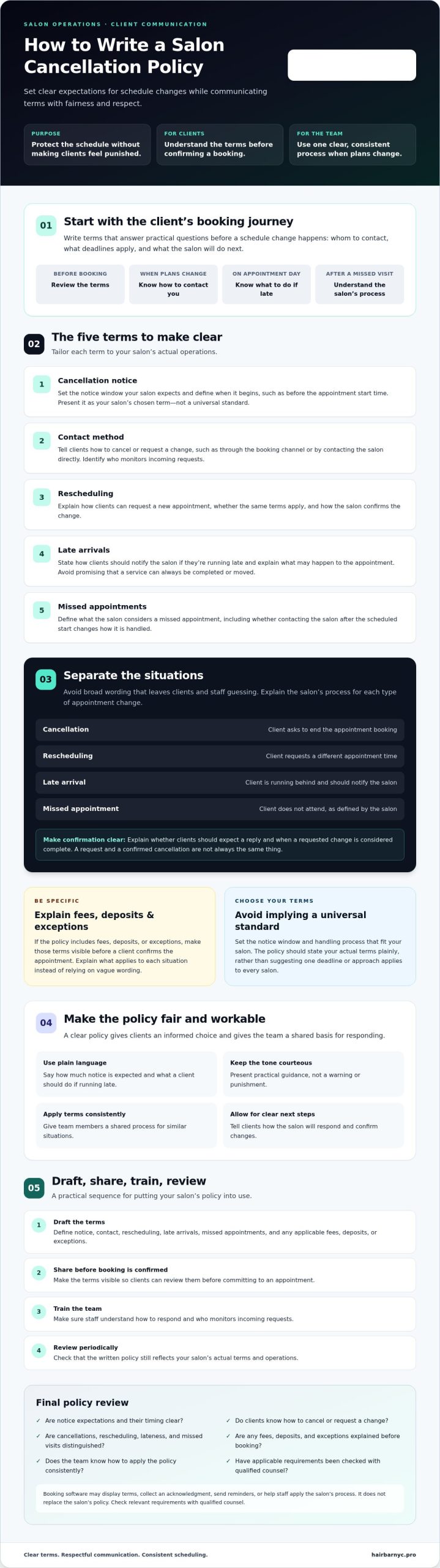
How to Write, Share, and Enforce Your Salon Cancellation Policy
A well-drafted policy works only if clients can find it and the team knows how to apply it. Build it into the salon’s booking and communication process, then check that the wording clients see matches the guidance staff follow. Software may help display terms, send reminders, or record an acknowledgment, but it can’t clarify vague language or decide what your policy should say.
Use this workflow to put the policy into practice:
- 1. Draft the terms. Define the appointment changes covered and write the salon’s chosen process in plain language. Check any fee or deposit wording with qualified counsel where appropriate.
- 2. Review the client experience. Read the policy from a client’s perspective. Can they tell what to do, by when, and what response to expect?
- 3. Place it before booking. Make the full terms readable near the online booking or appointment confirmation step. For phone or in-person bookings, explain how the client can review them before confirming.
- 4. Record acknowledgment. Use the salon’s existing booking process to note that the policy was presented and acknowledged, if that process supports it. Keep the record relevant and consistent.
- 5. Train the team. Review definitions, response steps, and the escalation route together. Staff should know where to find the full policy and how to answer common questions without improvising new terms.
- 6. Review and refine. Periodically check whether the policy is still practical. Use recurring client questions or staff uncertainties to identify wording that needs clarification.
Where should clients see the cancellation terms?
Place the full policy where clients make or confirm an appointment, not only on a front-desk sign. Repeat the most relevant details in confirmations and reminders, such as the deadline for requesting a change and the contact channel to use. Keep those messages concise and direct clients to the complete terms. Make sure every team member can explain where clients can review the policy.
How can a salon apply the policy consistently?
Use one shared version of the policy and one recordkeeping method for schedule changes and client notifications. If staff are unsure how a situation fits the terms, give them a clear escalation route rather than leaving each person to decide independently. Periodically review questions and exceptions as a team. Patterns may reveal that a definition, instruction, or confirmation message needs clearer wording.
Clear communication is part of a polished salon experience. Hair Bar NYC Professional offers professional hair-care products and online education for salon owners and beauty professionals. Explore Hair Bar NYC Professional.
Salon Cancellation Policy Example and Final Review Checklist
A template can help organize your terms, but it should reflect your salon’s actual booking process and choices about schedule changes. Use the sample below as a starting point, not as legal advice or a universal policy. Fill in each placeholder, remove anything that doesn’t apply, and publish only terms your team can explain and apply consistently.
What sample wording can a salon adapt?
Appointments and schedule changes: “Please cancel or request a change at least [salon’s notice window] before your appointment by contacting us through [accepted contact method]. We’ll confirm your request through [confirmation method]. Requests received after this deadline will be handled as follows: [salon’s chosen process].”
Rescheduling: “To reschedule, contact us through [accepted contact method]. [Explain how the salon handles a new appointment and any applicable deposit or fee under the stated terms.] Your new appointment is confirmed when [confirmation step].”
Late arrivals: “If you’re running late, please contact us through [contact method]. If you arrive after [salon’s chosen threshold], [explain how the salon will determine whether the appointment can proceed, be adjusted, or needs to be rescheduled].”
Missed appointments: “If you don’t attend your appointment and haven’t contacted us, we’ll handle the missed appointment as follows: [salon’s process, including any clearly disclosed applicable terms].”
Keep the wording direct and courteous. Don’t add a fee, exception, deadline, or consequence unless it matches the salon’s chosen terms and staff can follow through reliably.
What should owners review before publishing?
Review the policy as both a client and a team member before making it public. Confirm that each instruction matches how appointments are actually booked, changed, and confirmed. If the salon’s process doesn’t support a promise in the wording, revise the promise or the workflow first.
- Readable: Can clients quickly understand what to do, when to do it, and what happens next?
- Visible: Can clients find the full policy before confirming an appointment?
- Consistent: Can every team member explain the terms and follow the same steps?
- Reviewed: Have qualified counsel review legal questions and any fee or deposit language for applicable requirements?
Clear terms contribute to a more polished booking experience. Hair Bar NYC Professional provides salon-grade hair-care products and online education for salon owners and beauty professionals.
Put Clear, Consistent Terms Into Practice
A strong salon cancellation policy is a client agreement, not a threat. Clear terms help clients understand how to cancel or reschedule, while a shared staff process supports consistent decisions when plans change. Make the policy easy to find before booking, and revisit it when client questions or workflow changes reveal room for clarity.
Knowing how to write a salon cancellation policy means balancing practical boundaries with respectful communication. Define the salon’s chosen terms, explain them plainly, and make sure your team can apply them as written. If you include fees or deposits, have the wording reviewed for applicable requirements before publishing.
With thoughtful wording and a reliable process, you can set expectations while keeping the client experience welcoming. Explore professional hair-care products and online education for your salon from Hair Bar NYC Professional.
Frequently Asked Questions
What should a salon cancellation policy include?
A salon cancellation policy should explain how clients can cancel or reschedule, the salon’s notice window, how to report a late arrival, and what happens after a missed appointment. If deposits, fees, or exceptions apply, describe them plainly before booking. To make the policy easy to follow, specify how the salon confirms schedule changes and who clients should contact.
How much notice should a salon require for cancellations?
Choose a notice period that fits your salon’s services and scheduling needs, then state it clearly. There isn’t one period that every salon must use. Explain when the deadline applies, such as how far ahead of the appointment a client needs to contact you, and clarify which contact methods count. Make the chosen terms visible before booking and have staff communicate them consistently.
Can a salon charge a cancellation fee or require a deposit?
A salon may choose to use fees or deposits, but the terms should be clearly explained before the client books. State the amount or calculation, what situation triggers the charge, and how rescheduling affects it. Don’t rely on a notice posted only at checkout. Requirements can vary by location and circumstance, so ask qualified counsel to review the wording before putting fee or deposit terms into effect.
Is a salon cancellation policy legally enforceable?
Enforceability can depend on applicable law, the policy’s wording, how it was presented, and whether the client agreed to it before booking. A posted policy that clients never saw during booking may create disputes. Make the terms accessible, keep a record of how they were presented, and avoid assuming a particular clause is valid everywhere. Consult qualified counsel about requirements that apply to your salon.
How should a salon handle a client who repeatedly cancels?
Follow a consistent process based on the policy the client reviewed before booking. Keep brief, relevant records of appointment changes and communications, then have the designated staff member discuss the pattern with the client calmly. If your salon uses different booking terms for future appointments, explain them before accepting a new booking and apply the approach consistently. Avoid making exceptions or threats the team can’t reliably honor.
Can a salon refuse service after a no-show?
A salon may decide how it handles future booking requests after a missed appointment, but it shouldn’t assume that every refusal or added condition is appropriate in every situation. Check applicable requirements with qualified counsel, then document a consistent internal process. If you’ll require different booking terms before accepting another appointment, communicate them clearly before the client confirms. Keep the conversation professional and focused on scheduling expectations.
Where should a salon post its cancellation policy?
Make the full policy easy to find before clients confirm an appointment, especially near online booking steps. For appointments made by phone or in person, explain how clients can review the terms before confirming. Repeat key instructions in appointment confirmations and relevant reminders, such as how to request a change. Train staff to direct clients to the full policy and answer questions using the same wording and process.