Optimal Flat Iron Temperature for Silk Touch Keratin: The Professional Guide
The difference between a mediocre blowout and a breathtaking, high-shine finish isn’t just the product; it’s the precise calibration of your tools. Achieving the optimal flat iron temperature for silk touch keratin is the secret to locking in that coveted glass-hair aesthetic while preserving the structural integrity of every strand. We know the anxiety that comes with high heat, especially when you’re balancing the desire for a frizz-free transformation against the very real fear of thermal damage.
You’ve likely felt the frustration of inconsistent results or the confusion of trying to replicate a professional seal at home. This guide removes the guesswork, providing you with the exact thermal benchmarks required to activate your Silk Touch Keratin treatment safely. You will learn how to adjust your Professional Flat Iron settings based on your unique hair density, from fine, color-treated tresses at 374°F to coarse, resistant textures that require up to 446°F. By mastering the art of the precision pass, you’ll secure the longevity of your treatment and step out with the confidence of an industry insider.
Key Takeaways
- Understand the science of thermal activation and how heat bonds vegan proteins to the hair cuticle for a humidity-resistant barrier.
- Identify the optimal flat iron temperature for silk touch keratin tailored to your specific hair texture to achieve a glass-hair finish safely.
- Master the professional “Bone Dry” protocol to prevent internal steam damage and ensure even heat distribution during the sealing process.
- Learn how to adjust your heat settings between the initial salon application and home maintenance to maximize the longevity of your treatment.
- Discover why professional-grade plate technology is essential for maintaining consistent results and a high-end salon shine.
The Science of Sealing: Why Heat is Essential for Silk Touch Keratin
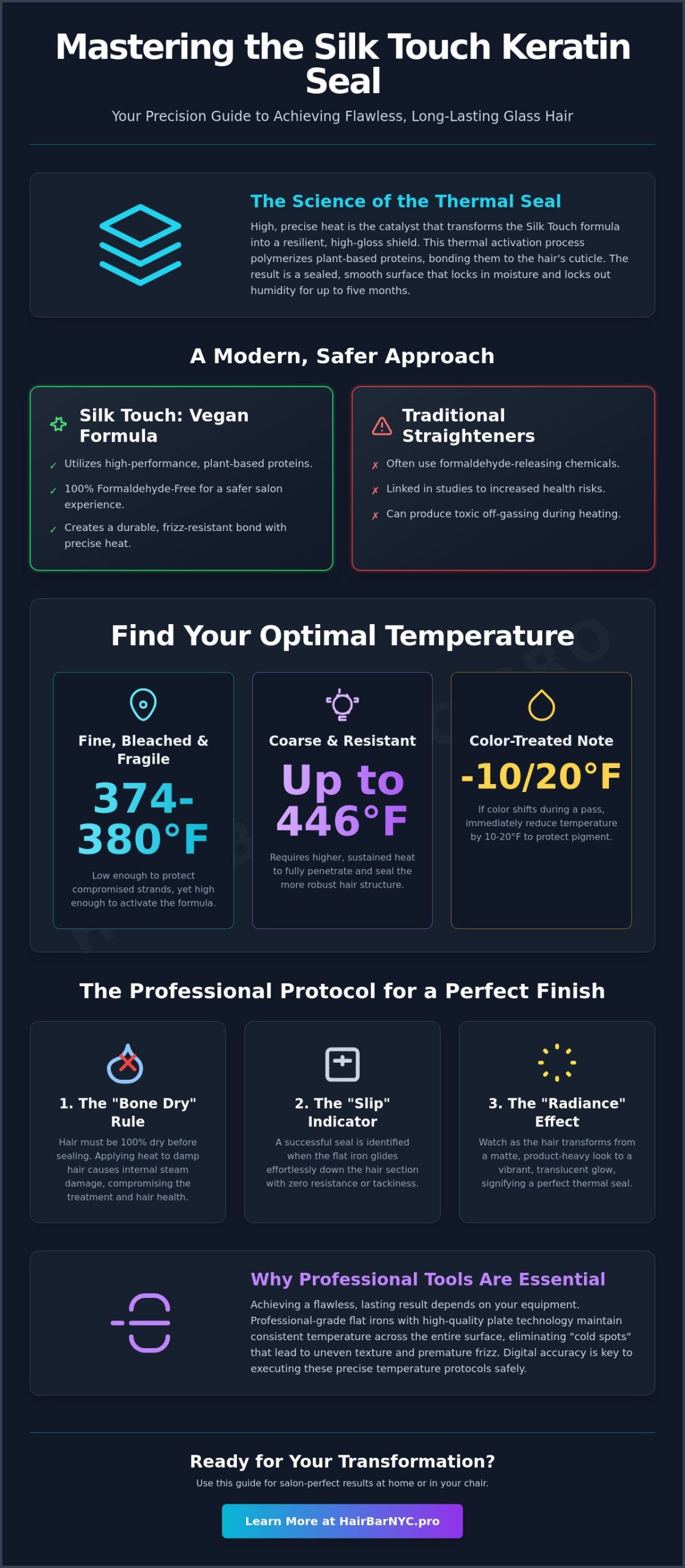
Heat serves as the essential catalyst in the Silk Touch system. It transforms a liquid application into a resilient, high-gloss shield. Unlike daily styling, which temporarily reshapes hydrogen bonds, sealing a professional treatment is a curing process. You aren’t just smoothing the hair; you’re fundamentally altering its surface architecture. Finding the optimal flat iron temperature for silk touch keratin is the only way to ensure the formula polymerizes correctly without compromising the hair’s structural health. Without this thermal activation, the treatment remains a superficial coating that will wash away within days.
The distinction between styling and curing is critical for results that last up to five months. Styling focuses on the aesthetic of the moment, while curing involves a chemical bond. To achieve that signature glass-hair finish, the heat must be consistent enough to fuse the formula to the hair’s internal structure. This requires a professional tool capable of maintaining a steady temperature across the entire plate surface, preventing “cold spots” that lead to inconsistent texture and premature frizz.
Vegan Formula vs. Traditional Keratin
Silk Touch represents a sophisticated shift toward safety in an industry under heavy regulatory scrutiny. With a 2022 NIH study linking traditional chemical straighteners to an increased risk of uterine cancer, and a 2023 Boston University study showing a 50% risk increase for postmenopausal women who frequently use relaxers, the demand for formaldehyde-free solutions has never been higher. Silk Touch utilizes plant-based proteins and glyoxylic acid to mimic the hair’s natural keratin structure without the toxic off-gassing associated with older keratin treatments.
Don’t mistake this “clean” profile for a lack of power. These vegan ingredients are engineered for high performance, but they require precise thermal activation to create a durable bond. There is a common myth that botanical or formaldehyde-free treatments require less heat. In reality, the optimal flat iron temperature for silk touch keratin must be high enough to reorganize the protein chains. If the temperature is too low, the vegan proteins won’t fuse to the hair shaft, leaving the treatment ineffective.
The Cuticle Sealing Process
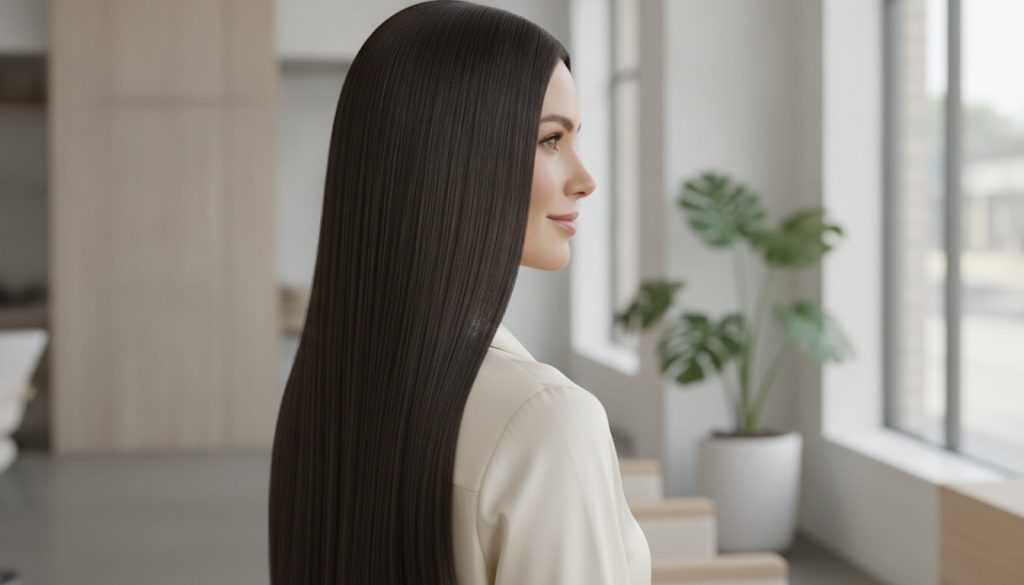
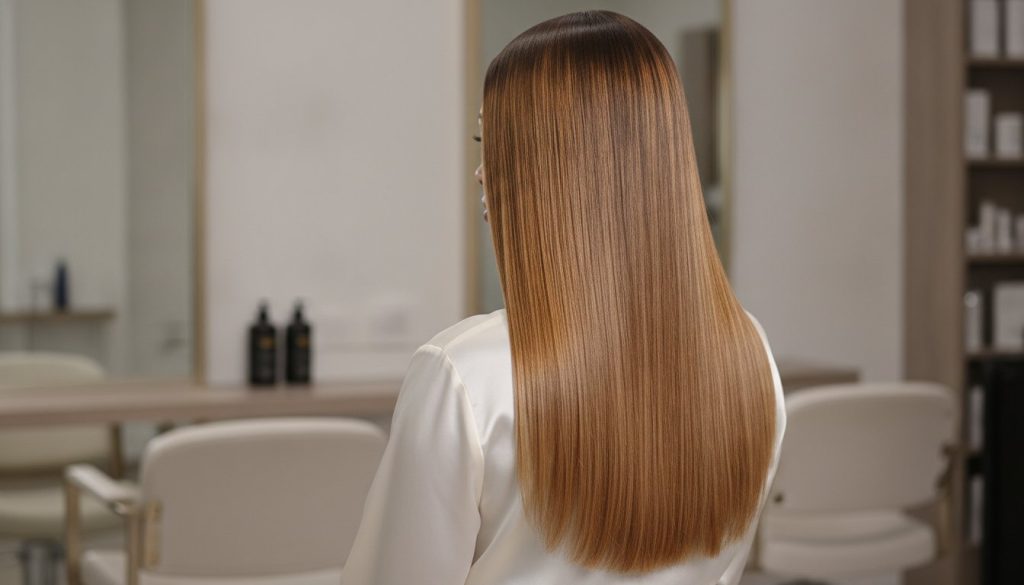
Thermal sealing is the process of using heat to polymerize keratin proteins onto the hair shaft. This action flattens the hair’s overlapping cuticle scales, effectively trapping moisture and nutrients inside while locking humidity out. When the flat iron reaches the correct temperature, it creates a smooth, reflective surface that gives the hair its elite, metropolitan shine. You can identify a successful thermal seal by two key sensory indicators:
- The Slip: The iron should glide effortlessly down the hair section without any resistance or “tackiness.”
- The Radiance: The hair transitions from a matte, product-heavy appearance to a vibrant, translucent glow.
By mastering this scientific approach to heat, you move beyond simple hair care into the world of professional hair transformation, ensuring every strand is protected, polished, and perfectly sealed.
Defining the Range: Optimal Temperatures for Every Hair Texture
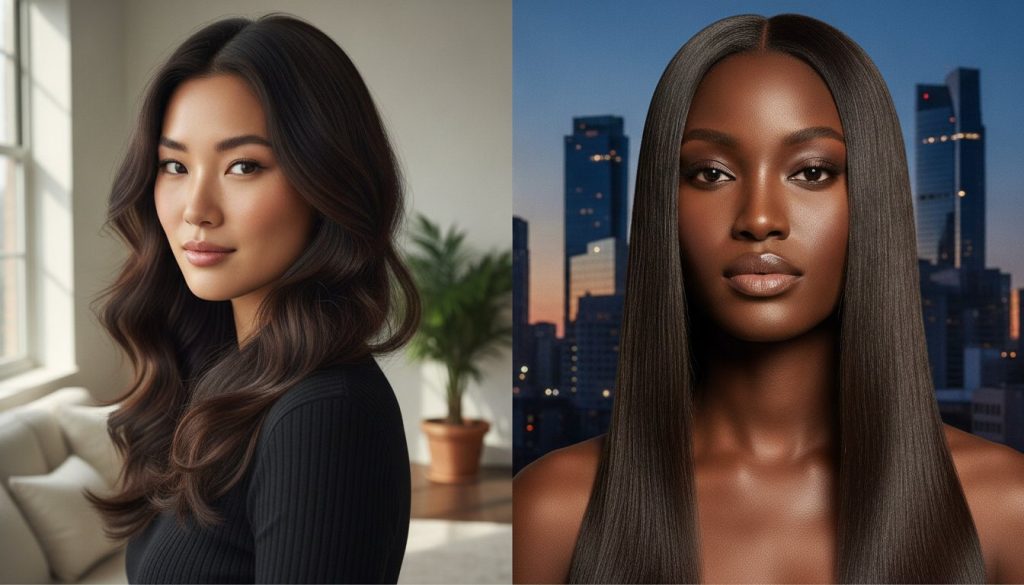
Precision is the hallmark of a master stylist. Setting the optimal flat iron temperature for silk touch keratin isn’t a matter of guesswork; it’s a calculated decision based on hair diameter, porosity, and chemical history. While generic styling tools often offer a single high-heat setting, professional results demand a nuanced approach. You must calibrate your equipment to the specific needs of the strand to ensure the vegan formula bonds correctly without causing thermal fatigue.
Fine, bleached, or fragile hair requires the most conservative touch. For these delicate textures, professional guidelines for Silk Touch recommend a range between 374°F and 380°F. This is high enough to trigger polymerization but low enough to protect compromised protein chains. If you’re working with color-treated hair, monitor the pigment closely. If the shade shifts by more than one level during a pass, immediately drop the temperature by 10 to 20 degrees to stabilize the tone. Using a Professional Flat Iron with digital accuracy is the only way to maintain this level of control.
Medium and normal textures find their efficiency “sweet spot” between 392°F and 419°F. This range provides the thermal energy necessary to fuse the Silk Touch proteins into a seamless, frizz-resistant shield. For those with coarse, thick, or highly resistant hair, you may need to approach the 428°F to 446°F threshold. These higher temperatures are often required to penetrate a denser cuticle layer, but they should be used with steady, rhythmic movements to prevent localized overheating.
The Texture Cheat Sheet
Identifying your hair’s specific heat tolerance is the first step toward a successful seal. Diameter matters more than curl pattern. A fine-haired client with tight curls will still require lower heat than a client with thick, straight hair. The “one-pass” philosophy is vital here. It’s far better to use an effective, stable temperature for a clean pass than to repeatedly iron the same section at an ineffective heat. Avoiding Heat Damage is fundamentally about efficiency; you want to achieve the seal in the fewest movements possible. While the Silk Touch protocol typically requires 8 to 12 passes to fully cure the formula, each pass must be executed with the precision of a single, fluid motion.
The Danger Zone: Why 450°F is Rarely the Answer
Many retail irons max out at 450°F, leading users to believe this is the standard for keratin treatments. In reality, this temperature is the danger zone. Scientific data indicates that hair begins to lose its structural integrity and approach its melting point near 428°F (220°C). Exceeding this limit doesn’t improve the “Silk Touch” effect. Instead, it can “cook” the keratin proteins, leading to a brittle, straw-like texture rather than a soft, glass-hair finish. True professional results come from finding the lowest effective temperature, not the highest the iron can reach.
Salon Precision vs. Home Styling: Adjusting Your Heat for Longevity
Mastering the optimal flat iron temperature for silk touch keratin requires understanding that heat serves two distinct purposes: sealing and styling. During your initial salon service, your stylist uses a high-performance thermal range to catalyze the vegan formula and fuse it to the hair shaft. This is a one-time intensive “cure” that sets the foundation for your results. Once you leave the professional environment, your approach must shift from activation to preservation. Using professional-level heat for daily touch-ups is the fastest way to strip the keratin layer and leave your hair vulnerable to frizz.
Think of your treatment as a protective glass shield. In the salon, we use intense heat to forge that shield. At home, you only need enough warmth to maintain the shape. Repeatedly applying 400°F or higher to hair that has already been treated will eventually cause the keratin proteins to degrade, shortening the lifespan of your smooth finish. To keep your hair in elite condition, you must rely on high-quality maintenance products that reinforce the thermal barrier rather than relying solely on the iron.
The First 72 Hours and Beyond
The first three days after your Silk Touch treatment are the critical “setting” period. During this window, the formula is still finalizing its bond. If you notice a stray kink or sleep-induced wave, a very light touch-up is permissible, but you must be conservative. Use a professional-grade iron with an adjustable dial and keep it at the lowest possible setting. Once you begin your washing routine, always use a sulfate-free system. Sulfates are aggressive detergents that not only strip color but also increase the hair’s sensitivity to heat, making your flat iron more damaging than it needs to be.
Preserving the Glass Hair Finish
For daily styling, lower temperatures in the 300°F to 320°F range are usually sufficient to refresh your look. Home maintenance heat should always be 50 degrees lower than the initial salon sealing temperature. This reduction ensures you achieve the desired “slip” and shine without eroding the Silk Touch proteins. Preparation is equally vital for longevity. Always prep your hair with Silk Touch Shampoo to gently cleanse without disrupting the cuticle. Follow this with Silk Touch Conditioner, which is specifically formulated to replenish the treatment’s protective layer. This duo creates a resilient foundation, allowing you to style with less heat while maintaining that uncompromising metropolitan shine.
The Professional Protocol: Avoiding Heat Damage and Preserving the Silk Finish
Execution is where professional results are won or lost. Even if you have dialed in the optimal flat iron temperature for silk touch keratin, your technique determines whether you seal the cuticle or scorch it. The most critical, non-negotiable rule in the elite salon environment is the “Bone Dry” standard. Hair must be 100% dry before the iron touches a single strand. If even a microscopic amount of moisture remains, the high heat causes that water to boil instantly. This creates internal steam that ruptures the hair cortex, a phenomenon often called “bubble hair” that leads to permanent structural failure.
Listen for the sizzle. If you hear a hiss or see a plume of steam, stop immediately. This is a warning that your hair isn’t dry enough or that you’re using a product that isn’t compatible with high-heat sealing. To ensure an even, metropolitan finish, work in thin, transparent sections no wider than an eighth of an inch. This level of precision allows the heat to penetrate every fiber simultaneously. It prevents the need for excessive, damaging passes on the outer layers while the inner core remains unsealed. For the most consistent thermal distribution, always use a Professional Flat Iron designed with advanced sensor technology.
Five Steps to a Professional Flat Iron Pass
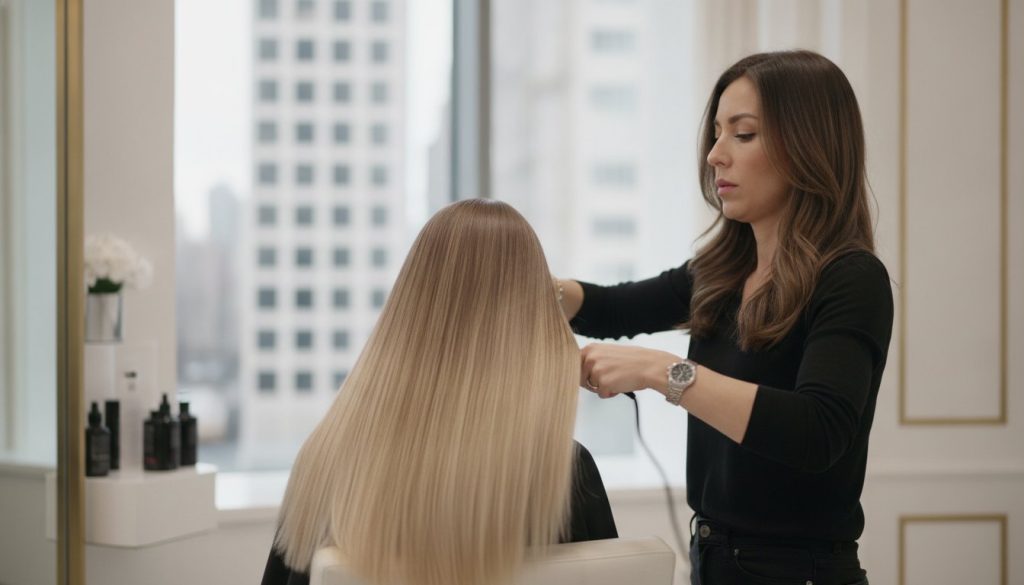
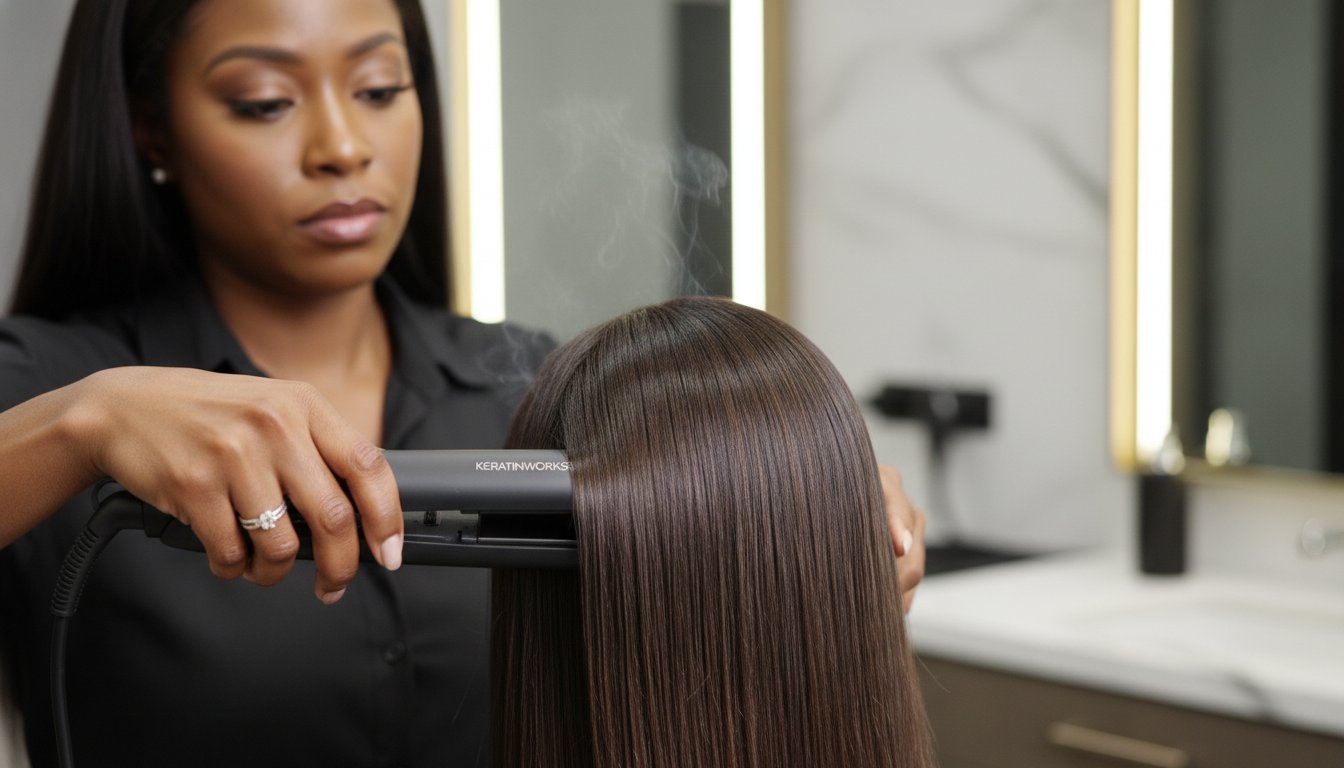
Achieving a flawless seal requires a rhythmic, intentional movement. Use the comb-chase method by placing a fine-tooth comb directly in front of your iron. This aligns the hair fibers so the plates hit every strand at the same angle. Maintain steady tension and move at a slow, fluid pace. Speed is your friend, but pausing is your enemy. Never stop the iron on any part of the hair, especially the ends. Since the last two inches of the hair are the oldest and most porous, reduce your passes in this area to prevent over-processing while still maintaining that sleek “silk” aesthetic.
Identifying and Reversing Heat Stress
Vigilance is key to maintaining hair health. If you notice a burnt sugar smell, visible smoke, or a sudden loss of elasticity where the hair feels “mushy” when wet, your iron is too hot. These are signs of thermal fatigue. To rescue over-styled or compromised strands, integrate the Keratin Intensive Treatment into your weekly routine. This professional-grade formula works to replenish the lost protein matrix and restore the hair’s natural bounce. Remember that even the best treatments can’t fix split ends; regular professional trims remain essential to remove heat-worn tips and keep your glass-hair finish looking sharp and sophisticated.
Elevating Your Routine: Professional Tools for a Lasting Silk Touch
The most sophisticated formula in the world cannot perform without the right hardware. While we’ve established the specific thermal ranges for different hair textures, achieving the optimal flat iron temperature for silk touch keratin is only possible with a tool engineered for consistency. Many consumer-grade irons suffer from significant heat fluctuation, dropping up to 50 degrees the moment they touch the hair. This instability forces you to make multiple, redundant passes, which increases the risk of thermal fatigue and uneven results. A Professional Flat Iron is designed with rapid heat recovery, ensuring that the first inch of the hair receives the exact same thermal energy as the last.
Choosing between titanium and ceramic plate technology is a decision that directly impacts the longevity of your Silk Touch results. Ceramic plates are excellent for gentle, everyday styling because they provide soft, infrared heat. However, for the initial sealing of a keratin treatment, titanium is often the preferred choice for the Expert Professional. Titanium plates possess superior heat conductivity and a higher ionic output, which helps to neutralize static and compress the hair cuticle more effectively. This creates the dense, high-gloss finish that defines the glass-hair aesthetic. By using a tool that distributes heat with absolute uniformity, you ensure that the vegan proteins are cured evenly across the entire hair shaft.
The Anatomy of a Professional Iron
Precision is not a luxury; it’s a requirement for elite hair care. Digital temperature controls allow you to lock in the optimal flat iron temperature for silk touch keratin with single-degree accuracy, a feat impossible with vague analog dials. Modern professional tools also feature floating plates. These plates adjust their angle based on your grip, ensuring even pressure without snagging or pulling the hair. When combined with built-in ionic technology, these features do more than just straighten. They actively polish the hair surface, enhancing the natural glow of the keratin and sealing in moisture for a frizz-free, metropolitan look that lasts through the most humid conditions.
Building Your Professional Home Kit
An investment-grade hair care routine extends far beyond the iron itself. To maintain the structural integrity of your treatment, you must integrate a 360-degree care system. This starts with using the Silk Touch Shampoo and Conditioner, which are chemically calibrated to support the keratin bond. These products provide the necessary slip and thermal protection to make your styling sessions faster and safer. Transitioning from standard retail items to a professional-tier kit is the only way to bridge the gap between the salon environment and your daily mirror. Shop the full Silk Touch Keratin Maintenance line for salon-quality results at home.
Secure Your Glass-Hair Standard
Mastering the optimal flat iron temperature for silk touch keratin is the final step in transitioning from a standard beauty routine to an elite care standard. You now understand that heat isn’t a threat but a precision activator. By aligning your thermal settings with your specific hair texture and utilizing the “Bone Dry” protocol, you ensure a flawless, long-lasting bond. These professional-grade formulas, trusted in elite NYC salons, are specifically vegan and formaldehyde-free to prioritize your health without compromising on performance.
Achieving a mirror-like shine requires more than just knowledge; it demands tools and formulas engineered for “one-pass” efficiency. Our collection is designed to bridge the gap between the salon chair and your home vanity, providing the structural support your hair needs to remain resilient and radiant. Discover the Silk Touch Keratin Collection for Professional Results and elevate your daily aesthetic. You have the expertise and the protocol; now, embrace the confidence of hair that is perfectly sealed and undeniably sophisticated.
Professional Insights: Silk Touch Keratin FAQ
Can I use a flat iron on my hair immediately after a Silk Touch Keratin treatment?
Yes, you can use a flat iron for minor touch-ups during the critical 72-hour setting window if you notice any sleep-induced kinks. However, you must use the lowest possible heat setting. The primary sealing is already completed in the salon, so at home, you only need a light, gentle pass to keep the hair aligned before your first sulfate-free wash.
What happens if I set my flat iron temperature too low during a keratin seal?
If the heat is insufficient, the Silk Touch formula will fail to polymerize and bond to the hair cuticle. This results in a treatment that lacks durability and may wash out after only a few shampoos. Achieving the optimal flat iron temperature for silk touch keratin is essential to activate the plant-based proteins and create the resilient, frizz-resistant barrier that defines the glass-hair aesthetic.
Is 450 degrees too hot for a keratin treatment at home?
Yes, 450 degrees is almost always too aggressive for home maintenance and can cause irreversible thermal damage. Most hair types begin to lose structural integrity near 428°F. For daily styling at home, you should keep your iron between 300°F and 320°F to refresh your look without eroding the protective keratin layer you’ve invested in.
How do I know if my flat iron is damaging my keratin treatment?
Watch for red flags such as a burnt sugar smell, visible smoke, or hair that feels “mushy” and lacks elasticity when wet. If your hair develops a dull, straw-like texture despite the treatment, your iron is likely too hot. These signs indicate you’ve exceeded the optimal flat iron temperature for silk touch keratin and are degrading the formula’s smooth, reflective finish.
Do I need a special flat iron for the Silk Touch Keratin system?
You need a professional-grade iron equipped with digital temperature accuracy and rapid heat recovery. Standard retail irons often have significant heat drops during a pass, which leads to inconsistent sealing. A high-performance tool ensures the plates maintain a steady temperature from roots to ends, which is the secret to achieving a uniform, high-shine result every time.
Can I use steam irons with the Silk Touch Keratin treatment?
No, you should avoid steam irons when working with keratin-treated hair. The “Bone Dry” protocol is a non-negotiable salon standard because moisture during ironing causes water to boil inside the hair shaft. This creates internal steam that ruptures the cortex. Stick to dry, consistent heat from professional plates to safely cure the formula and lock in the shine.
Should I use a heat protectant even if I have a keratin treatment?
Yes, applying a compatible heat protectant or serum provides an essential secondary shield against thermal fatigue. While the keratin treatment itself acts as a barrier, a professional protectant ensures the iron glides effortlessly and prevents the keratin layer from wearing down prematurely. It’s a simple step that reinforces the longevity of your treatment and enhances that signature metropolitan glow.
How often can I flat iron my hair after a Silk Touch treatment?
You should limit flat ironing to occasional touch-ups rather than a full daily routine. The Silk Touch system is engineered to reduce your dependence on high-heat tools by providing a naturally sleek foundation. Frequent ironing, even at lower maintenance temperatures, will eventually strip the keratin bond, so use your iron sparingly to preserve the treatment’s five-month lifespan.